Unisciti a noi in un viaggio nel mondo dei libri!
Aggiungi questo libro allo scaffale
Grey
Scrivi un nuovo commento Default profile 50px
Grey
Iscriviti per leggere l'intero libro o leggi le prime pagine gratuitamente!
All characters reduced
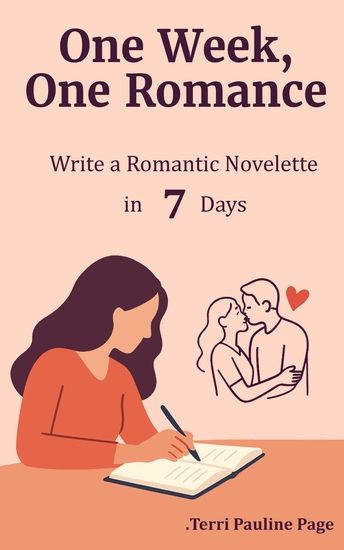
One Week One Romance - Write a Complete Romantic Novelette in 7 Days - cover

One Week One Romance - Write a Complete Romantic Novelette in 7 Days

Terri Pauline Page

Casa editrice: TPP Publishing

  • 0
  • 0
  • 0

Sinossi

Ready to write your first romance story but unsure how to start or how to finish?This 7-day challenge-style guide provides the structure, support, and inspiration you need to write a complete romantic novelette from beginning to end. Inside, you’ll find an easy-to-follow beat sheet, writing prompts, character tips, emotional tension tools, and a clear day-by-day writing plan. Whether you're a beginner or want a short project, this book helps you accomplish your goal with heart.
 
It’s perfect for indie authors, romance lovers, and writers seeking a quick win.
 
Inside you’ll get:
 
A beat sheet for short-form fiction romancePractical exercises to develop compelling characters and authentic dialogueTips and tricks to spark chemistry10+ popular romance tropes to inspire your plotA simple 7-day writing schedule to take you from idea to “The End”Motivation to stay kind to yourself—and keep writing, even when it’s tough.
Disponibile da: 11/07/2025.
Lunghezza di stampa: 32 pagine.

Altri libri che potrebbero interessarti

  • Setting Sights: Histories and Reflections on Community Armed Self-Defense - cover

    Setting Sights: Histories and...

    scott crow

    • 0
    • 0
    • 0
    Decades ago, Malcolm X eloquently stated that communities have the legitimate right to defend themselves “by any means necessary” with any tool or tactic, including guns. This wide-ranging anthology uncovers the hidden histories and ideas of community armed self-defense, exploring how it has been used by marginalized and oppressed communities as well as anarchists and radicals within significant social movements of the twentieth and twenty-first centuries. 
    Far from a call to arms, or a “how-to” manual for warfare, this volume offers histories, reflections, and questions about the role of firearms in small collective defense efforts and its place in larger efforts toward the creation of autonomy and liberation. 
    Featuring diverse perspectives from movements across the globe, Setting Sights includes vivid histories and personal reflections from both researchers and those who participated in community armed self-defense. Contributors include Dennis Banks, Kathleen Cleaver, Mable Williams, Subcomandante Marcos, Kristian Williams, George Ciccariello-Maher, Ashanti Alston, and many more.
    Mostra libro
  • Starry Field - A Memoir of Lost History - cover

    Starry Field - A Memoir of Lost...

    Margaret Juhae Lee

    • 0
    • 0
    • 0
    As a young girl growing up in Houston, Margaret Juhae Lee never heard about her grandfather, Lee Chul Ha. His history was lost in early twentieth-century Korea, and guarded by Margaret's grandmother, who Chul Ha left widowed in 1936 with two young sons. To his surviving family, Lee Chul Ha was a criminal, and his granddaughter was determined to figure out why. 


    Starry Field chronicles Chul Ha's untold story. Combining investigative journalism, oral history, and archival research, Margaret reveals the truth about the grandfather she never knew. What she found is that Lee Chul Ha was not a source of shame; he was a student revolutionary imprisoned in 1929 for protesting the Japanese government's colonization of Korea. He was a hero—and eventually honored as a Patriot of South Korea almost 60 years after his death. It is through the series of three interviews with her grandmother that Margaret finally finds a sense of recognition she's been missing. A story of healing old wounds and the reputation of an extraordinary young man, Starry Field bridges the tales of two women. 


    Starry Field weaves together the stories of Margaret's family against the backdrop of Korea's tumultuous modern history, with a powerful question at its heart. Can we ever separate ourselves from our family's past—and if the answer is yes, should we?
    Mostra libro
  • Noble Savage Deadbeat Dad - How Rousseau Invented Modern Society While Failing at Basic Human Decency - cover

    Noble Savage Deadbeat Dad - How...

    Sophia Blackwell

    • 0
    • 0
    • 0
    In this mercilessly funny takedown, Jean-Jacques Rousseau—history's most insufferable philosopher—gets the roasting he so richly deserves. "Noble Savage, Deadbeat Dad" exposes the spectacular hypocrisy of a man who abandoned five children at orphanages while writing the definitive guide to education, preached natural virtue while exposing himself to strangers, and railed against wealth while living off rich patrons. 
    Laugh out loud as we dissect Rousseau's greatest contradictions: his fetishization of indigenous cultures (without meeting any actual indigenous people), his belief that society corrupts natural goodness (while engaging in deeply unnatural bedroom activities), and his conviction that he alone understood true freedom (while being pathologically dependent on others for basic survival). 
    This savagely irreverent guide reveals how a paranoid, chronically constipated Swiss misanthrope somehow managed to inspire both democracy AND totalitarianism between bouts of accusing everyone he met of conspiring against him. With brutal honesty and razor-sharp wit, we explore how Rousseau's complete disaster of a personal life somehow produced philosophical insights that still haunt us today—especially when we complain about technology ruining society while scrolling through social media. 
    Perfect for philosophy students in desperate need of comic relief, or anyone who enjoys watching narcissistic geniuses get thoroughly eviscerated. Warning: Reading this book in public may cause uncontrollable laughter and concerned looks from serious academics.
    Mostra libro
  • Passive Aggression - Indirectly Expressing Hostility or Resistance - cover

    Passive Aggression - Indirectly...

    Cito Harder

    • 0
    • 0
    • 0
    Passive aggression is a form of indirect expression of hostility, where individuals communicate negative feelings, frustration, or anger without openly addressing them. Rather than confronting an issue head-on, the person engages in behaviors that subtly undermine or resist others, often making it difficult to pinpoint the exact cause of tension. These actions are often seen as passive because the aggressor avoids direct confrontation, preferring instead to express their displeasure in subtle, often disguised ways. While passive aggression can sometimes seem harmless or even humorous, it can cause significant distress and damage to relationships over time. 
    Understanding passive aggression requires an exploration of the psychological mechanisms behind it. People who exhibit passive aggressive behavior often struggle with direct confrontation. This may stem from fear of rejection, a lack of assertiveness, or an inability to express anger healthily. In many cases, these individuals are unable or unwilling to articulate their true emotions and instead choose passive-aggressive tactics to deal with frustration. This behavior can manifest in a range of actions, including procrastination, forgetfulness, silent treatment, sarcasm, and even sabotage. 
    One of the challenges of dealing with passive aggression is that it is often hidden beneath seemingly innocuous actions or words. For example, someone might agree to help with a task but intentionally delay or perform it poorly, thus conveying their resistance without direct confrontation. Similarly, someone might offer backhanded compliments or use sarcasm to indirectly express contempt while maintaining a facade of politeness. These subtle acts of hostility can leave the recipient confused, frustrated, and unsure of how to respond, as the negative feelings are often not openly acknowledged.
    Mostra libro
  • How America Worksand Why It Doesn't - A Brief Guide to the US Political System - cover

    How America Worksand Why It...

    William Cooper

    • 0
    • 0
    • 0
    Twenty-first-century America isn’t working the way it’s supposed to. 
    This book explains why. 
    Americans in the twenty-first century are becoming increasingly untethered from both reality and the essential principles and traditions that have shaped the nation’s historic success. A big part of why America isn’t working is because far too many Americans neither know nor care how it’s supposed to work. 
    “William Cooper presents an insightful, sensitive, and accessible account of the trials that face American democracy in the twenty-first century. This fair- and broad-minded volume makes compelling reading for those who are looking to build a better democracy.” Alexander Yen, Department of Politics and International Relations, University of Oxford 
    “Partisanship fuels personal convictions more than ever in our society, and convictions fuel mysided thinking and other cognitive biases. At no time have we needed this discussion of bias and partisan thinking more than now.” Keith E. Stanovich, author of The Bias That Divides Us 
    “William Cooper logically and authoritatively takes you step by step through all the reasons a President Trump couldn’t imprison his enemies, pardon his friends, overrule judges, weaponize the Department of Justice, prosecute Joe Biden, or order the military to enforce his unconstitutional actions” Cleveland Plain Dealer 
    “William Cooper is an insightful and thought-provoking writer about US politics. He deserves to be widely read.” Thomas Plate, former Editorial Page Editor, Los Angeles Times 
    "In How America Works . . . and Why It Doesn’t, William Cooper gives a thoughtful, readable guide to what ails American democracy. Required reading for any student of political science.” Uri Kaufman, author of Eighteen Days in October 
    "A must-read. His well-written and brief book covers a lot of important ground in a learned but accessible manner. Probably most noteworthy, though, is his astute and fair judgment―the book is not a polemic for the left or the right, but rather a fair appraisal of the strengths and weaknesses of both. I highly recommend reading it―it is an enjoyable tour of key aspects of history (as well as current events), ethics, political philosophy, constitutional law, environmental science, and cognitive psychology―all told in a lucid, efficient way." William O'Donohue, PhD, Professor, University of Nevada, Reno
    Mostra libro

  • Histories of Racial Capitalism - cover

    Histories of Racial Capitalism

    Justin Leroy, Destin Jenkins

    • 0
    • 0
    • 0
    The relationship between race and capitalism is one of the most enduring and controversial historical debates. The concept of racial capitalism offers a way out of this impasse. Racial capitalism is not simply a permutation, phase, or stage in the larger history of capitalism—since the beginning of the Atlantic slave trade and the colonization of the Americas, capitalism, in both material and ideological senses, has been racial, deriving social and economic value from racial classification and stratification. Although Cedric J. Robinson popularized the term, racial capitalism has remained undertheorized for nearly four decades. 


    Histories of Racial Capitalism brings together for the first time distinguished and rising scholars to consider the utility of the concept across historical settings. These scholars offer dynamic accounts of the relationship between social relations of exploitation and the racial terms through which they were organized, justified, and contested. Throughout, the contributors consider and challenge how some claims about the history and nature of capitalism are universalized while others remain marginalized. By theorizing and testing the concept of racial capitalism in different historical circumstances, this book shows its analytical and political power for today's scholars and activists.
    Mostra libro