Unisciti a noi in un viaggio nel mondo dei libri!
Aggiungi questo libro allo scaffale
Grey
Scrivi un nuovo commento Default profile 50px
Grey
Iscriviti per leggere l'intero libro o leggi le prime pagine gratuitamente!
All characters reduced
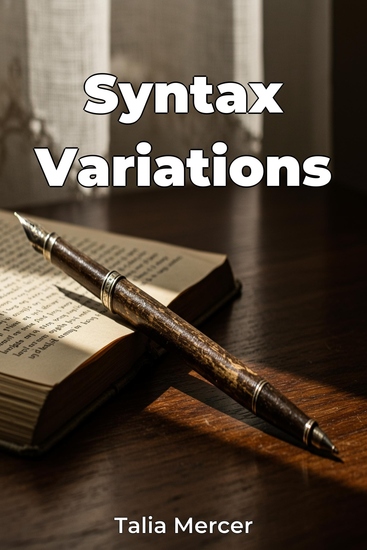
Syntax Variations - cover

Syntax Variations

Talia Mercer

Traduttore A Ai

Casa editrice: Publifye

  • 0
  • 0
  • 0

Sinossi

Syntax Variations delves into the crucial role of syntax in poetry, exploring how poets manipulate sentence structure to shape meaning and rhythm. It highlights how syntactic inversion, or altering word order, can emphasize specific elements. The book also examines rhythmic manipulation, where variations in sentence length impact a poem's emotional resonance. These techniques demonstrate that syntactic choices are fundamental tools, not mere stylistic flourishes. The book progresses systematically, starting with core syntactic concepts before delving into specific techniques such as anaphora and enjambment. By analyzing diverse poems, the book demonstrates how syntax variations influence interpretation. It connects linguistics, music theory, and rhetoric to enrich its analysis, offering a unique perspective by focusing on syntax as a primary driver of meaning and rhythm, rather than thematic or biographical elements. This detailed approach provides a nuanced understanding of poetic craft, valuable for students and enthusiasts alike. It offers practical tools for both analyzing and creating poetry, enhancing the reader's ability to appreciate the artistry behind poetic composition.
Disponibile da: 06/05/2025.
Lunghezza di stampa: 84 pagine.

Altri libri che potrebbero interessarti

  • Greatest Generals of the Roman Republic The: The History of the Military Leaders Who Led the Rise of Rome - cover

    Greatest Generals of the Roman...

    Charles River Editors

    • 0
    • 0
    • 0
    The Roman army is one of the most famous fighting forces in history. Through its power and prowess, a once obscure Italian city forged an empire that encircled the Mediterranean and covered half of Europe. The physical remains of its presence can be traced from the mountainous borders of Scotland to the arid deserts of Egypt, but its legacy is far greater and more enduring, as Rome's influence continues to shape the political, legal, and cultural landscape of Europe to this very day. 
    While the Roman army is rightly famed as an institution, the image of the individual legionary is also an iconic one. The uniformed, disciplined soldier of the late Republic and early Empire is one of the first things many people imagine when they think of Rome. They are the ultimate image of the ancient soldier, their arms and armor instantly recognizable. Their abilities, not only as warriors but also as engineers and administrators, have made them role models for other soldiers through the centuries. In the same vein, their commanders are still celebrated and studied, and generals the world over have tried to emulate the likes of Julius Caesar. 
    While he remains far less known than his rival Hannibal, Publius Cornelius Scipio, the man who has become known to history as Scipio Africanus, is widely regarded as one of the greatest military leaders of all time. In the space of less than 10 years, the genius of Scipio took Rome from being on the brink of utter destruction to becoming the dominant power in the Mediterranean.  
    Ironically, Gaius Marius’s reforms had made the legions fiercely loyal to their individual generals rather than the state, which allowed his eventual rival Sulla to march his army against Rome and force Marius into exile. With that, Rome’s first civil war was officially underway, but Sulla’s triumph proved short-lived.
    Mostra libro
  • The Art of Rome - Masterpieces of the Ancient Empire - cover

    The Art of Rome - Masterpieces...

    Rogan Fish

    • 0
    • 0
    • 0
    The art of ancient Rome was shaped by a blend of cultural influences, evolving through a combination of native traditions and foreign influences, most notably from the Etruscans and Greeks. Early Roman art was heavily influenced by the Etruscans, who occupied central Italy before the rise of Rome. Etruscan art was characterized by its religious themes, vibrant frescoes, and elaborate tomb paintings, which had a significant impact on the early Roman artistic style. These early Roman artists often adopted Etruscan methods but began incorporating their own innovations, creating a distinctive blend of the two cultures. 
    Greek art also played a crucial role in the development of Roman art. As Rome expanded and conquered Greece, it absorbed many aspects of Greek culture, including their artistic styles. Greek sculptural ideals of beauty, proportion, and harmony were emulated by Roman artists. However, while Greek art favored idealized forms and perfection, Roman art took a more realistic approach, focusing on depicting individuals as they truly appeared. Roman portraiture, for example, was known for its attention to detail, capturing the wrinkles, facial expressions, and other characteristics that defined a person’s likeness. This move toward realism was a major shift from the idealized forms of Greek art, and it became a hallmark of Roman artistry. 
    In the early stages of Roman art, the primary medium was sculpture, often used to commemorate important figures or events. The Romans developed a talent for creating lifelike statues and busts, which were displayed in homes and public spaces to honor ancestors and gods. These sculptures, often made from marble or bronze, served as a means of preserving the memory of individuals or celebrating military victories.
    Mostra libro
  • Dead Wake: Book Summary & Analysis - cover

    Dead Wake: Book Summary & Analysis

    Briefly Summaries

    • 0
    • 0
    • 0
    This is a concise summary and analysis of Dead Wake, by Erik Larson. It is not the original book and is not affiliated with or endorsed by Erik Larson. Ideal for those seeking a quick and insightful overview.
     
    In this gripping historical narrative, the tragic sinking of the Lusitania comes to life with vivid detail and meticulous research. As World War I rages, the luxury ocean liner embarks on its fateful journey across the Atlantic, unaware of the deadly threat lurking beneath the waves. Through the perspectives of passengers, crew members, and military strategists on both sides of the conflict, this compelling account reveals the political tensions, human stories, and crucial missteps that led to one of the most infamous maritime disasters in history. A masterful blend of suspense and historical insight, this book captures the dramatic final voyage of the Lusitania and its lasting impact on global events.
    Mostra libro
  • The Problem of China - cover

    The Problem of China

    Bertrand Russell

    • 0
    • 0
    • 0
    "The Problem of China" by Bertrand Russell is a thought-provoking and insightful exploration of the social, political, and cultural challenges facing China during the early 20th century. Russell delves into the complexities of Chinese society, examining its historical context and the impact of Western influences on its development. In this book, Russell examines China's struggle to reconcile its rich cultural heritage with the pressures of modernization and foreign intervention. He delves into various topics, including the conflict between traditional values and the need for progress, the role of education in shaping Chinese society, and the impact of imperialism on China's political and economic landscape. Read in English, unabridged.
    Mostra libro
  • Celtic Gods and Goddesses - Exploring the Divine in Ancient Celtic Lore - cover

    Celtic Gods and Goddesses -...

    Odessa Nightshade

    • 0
    • 0
    • 0
    The mythology of the Celts is a vast and complex tapestry woven with gods, goddesses, spirits, and mystical forces that shaped their understanding of the universe. Unlike the structured pantheons of Greek or Roman mythology, Celtic deities were deeply intertwined with nature, the cycles of life, and the mysterious Otherworld. Their gods and goddesses were not merely distant figures residing in the heavens but active participants in the world of mortals, influencing the landscape, the seasons, and even the fate of individuals.  
      
    At the heart of Celtic belief was an intimate connection with the land. The Celts saw sacredness in rivers, mountains, forests, and the sky, often linking divine beings to specific places. Many gods and goddesses had direct associations with natural elements—Brigid with sacred wells and fire, Manannán mac Lir with the sea, and Cernunnos with the wild and untamed forests. This reverence for nature shaped their spiritual practices, with offerings made at holy sites and rituals performed to honor the divine forces that governed their world.  
      
    Another key aspect of Celtic spirituality was the concept of the Otherworld. This was not a place of punishment or reward but a mystical realm existing parallel to the human world. It was the dwelling place of powerful deities, spirits, and the souls of the departed. The Otherworld was often accessible through sacred sites, burial mounds, or moments of deep ritual significance. Many myths tell of heroes or mortals who ventured into this hidden realm, encountering gods, gaining wisdom, or even securing supernatural gifts. 
    Mostra libro
  • What's Your Enneatype? An Essential Guide to the Enneagram - Understanding the Nine Personality Types for Personal Growth and Strengthened Relationships - cover

    What's Your Enneatype? An...

    Liz Carver, Josh Green

    • 0
    • 0
    • 0
    Harness the power of the Enneagram to learn about yourself, maximize your strengths, and improve your relationships. Pronounced ENN-EE-UH-GRAM, stemming from the Greek words ennea (nine) and grammos (a written symbol), the Enneagram is a centuries-old categorization tool that classifies human personalities into nine interconnected personality types.  Through in-depth descriptions and discussion, learn how to assess how you think, feel, and experience life, so that you can correctly identify which of the nine types you are.  Type 1: The Improver/Reformer/Perfectionist (Life Strategy: “I must be perfect and do what is right.”)  Type 2: The Helper/Giver/Befriender (Life Strategy: “I must be helping, caring, and needed.”)  Type 3: The Achiever/Performer/Motivator (Life Strategy: “I must be impressive and look accomplished and successful.”)  Type 4: The Individualist/Romantic/Artist (Life Strategy: “I must be understood uniquely as I am.”)  Type 5: The Investigator/Observer/Theorist (Life Strategy: “I must be knowledgeable and equipped.”)  Type 6: The Loyalist/Skeptic/Guardian (Life Strategy: “I must be secure and safe.”)  Type 7: The Enthusiast/Optimist/Epicurean (Life Strategy: “I must be enjoying myself and avoiding pain.”)  Type 8: The Challenger/Protector/Advocate (Life Strategy: “I must be strong and outside the control of others.”)  Type 9: The Peacemaker/Mediator/Reconciler (Life Strategy: “I must maintain peace and calm.”)  Authors Liz Carver and Josh Green, creators of the hugely popular Instagram account @justmyenneatype, help you discover how knowing your type—and the types of those around you—can affect your daily life, your decisions, and your relationships with others, and how to use this wisdom to live life with more clarity, peace, and insight than you ever thought possible.  So what’s your enneatype? Find out today and get started on the journey to better understand your world, yourself, and your place within it.
    Mostra libro