Join us on a literary world trip!
Add this book to bookshelf
Grey
Write a new comment Default profile 50px
Grey
Subscribe to read the full book or read the first pages for free!
All characters reduced
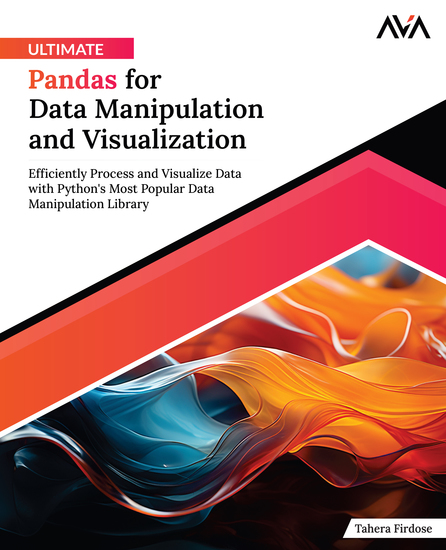
Ultimate Pandas for Data Manipulation and Visualization - Efficiently Process and Visualize Data with Python's Most Popular Data Manipulation Library - cover

Ultimate Pandas for Data Manipulation and Visualization - Efficiently Process and Visualize Data with Python's Most Popular Data Manipulation Library

Tahera Firdose

Publisher: Orange Education Pvt. Ltd

  • 0
  • 0
  • 0

Summary

Unlock the power of Data Manipulation with Pandas.
Book Description
Unlock the power of Pandas, the essential Python library for data analysis and manipulation. This comprehensive guide takes you from the basics to advanced techniques, ensuring you master every aspect of pandas. You'll start with an introduction to pandas and data analysis, followed by in-depth explorations of pandas Series and DataFrame, the core data structures.
Learn essential skills for data cleaning and filtering, and master grouping and aggregation techniques to summarize and analyze your data sets effectively. Discover how to reshape and pivot data, join and merge multiple datasets, and handle time series analysis.
Enhance your data analysis with compelling visualizations using Matplotlib, and apply your knowledge in a real-world scenario by analyzing bank customer churn. Through hands-on examples and practical use cases, this book equips you with the tools to clean, filter, aggregate, reshape, merge, and visualize data effectively, transforming it into actionable insights.
Table of Contents
1. Introduction to Pandas and Data Analysis
2. Pandas Series
3. Pandas DataFrame
4. Data Cleaning with Pandas
5. Data Filtering with Pandas
6. Grouping and Aggregating Data
7. Reshaping and Pivoting in Pandas
8. Joining and Merging Data in Pandas
9. Introduction to Time Series Analysis in Pandas
10. Visualization Using Matplotlib
11. Analyzing Bank Customer Churn Using Pandas    
Index
Available since: 10/06/2024.

Other books that might interest you

  • Living the Technology Revolution - How life has changed since I was a kid - cover

    Living the Technology Revolution...

    Martin K. Ettington

    • 0
    • 0
    • 0
    This isn't a book filled with dry timelines or technical blueprints of the digital revolution. Instead, it's a firsthand journey—my journey—through one of the most astonishing transformations in human history: the rise of personal computing and the dawn of the digital age. 
    I was born in November 1955, at a time when the word “computer” was barely whispered outside of military labs and universities. My earliest memories include a bulky black-and-white television with rabbit-ear antennas, broadcasting a single channel. That flickering screen was my first encounter with electronic media—a far cry from the high-definition, touch-responsive world we live in now. 
    Over the decades, my path as an engineer and software developer placed me squarely in the midst of this technological upheaval. I didn’t just watch the future arrive—I helped build it, one line of code and one innovation at a time. 
    This book is a personal time capsule—a chronicle of what it was really like to live through the shift from analog to digital, from typewriters to tablets, from rotary phones to the infinite power in our pockets today. If you're a younger reader curious about how we got here, or someone who remembers the glow of vacuum tubes and the clack of punch cards, I invite you to walk with me through the decades. 
    You may be surprised by how far we’ve come—and how much we’ve forgotten along the way. 
    Many of the chapters are identified with the years or periods of time where these changes occurred.
    Show book
  • Meditation for Anxiety and Stress - cover

    Meditation for Anxiety and Stress

    Ruminarration

    • 0
    • 0
    • 0
    Feeling overwhelmed by anxiety and stress? Looking for a way to find calm amidst the chaos? Discover the power of meditation with our audio program designed specifically for you. Imagine starting each day with a clear mind and a peaceful heart, ready to face any challenge. This program offers guided meditations that are easy to follow, helping you to relax and let go of tension. Whether you’re new to meditation or have some experience, these sessions are crafted to fit seamlessly into your daily routine. Picture yourself unwinding after a long day, feeling the stress melt away as you listen. With regular practice, you’ll notice a profound change in your ability to handle stress and anxiety. Let our soothing guidance lead you to a place of tranquility and balance. Take the first step towards a more peaceful life. Start your journey to relaxation and well-being today.
    Show book
  • In the Shadows of the Stars - Dark Space and the Fate of the Universe - cover

    In the Shadows of the Stars -...

    Dirk Fallon

    • 0
    • 0
    • 0
    The concept of the universe has captivated human curiosity for centuries, but what lies at its edge? The truth is that the edge of the universe is not defined by a physical boundary but by the limits of what we can observe and understand. Space stretches endlessly in every direction, but as we look farther and farther, the light from distant objects becomes increasingly redshifted, eventually disappearing beyond our ability to detect it. This phenomenon marks the boundary of the observable universe, a region from which light has had enough time to reach us since the beginning of the universe, around 13.8 billion years ago. 
    At the edge of the observable universe, we find a vast expanse of empty space, known as the "cosmic void." These regions contain few galaxies, stars, or other celestial objects, and their emptiness gives them an eerie and mysterious quality. The voids between galaxies are immense, sometimes stretching hundreds of millions of light-years across, and they represent one of the most puzzling aspects of cosmology. Why are these vast expanses of nothingness so prevalent? And what does it mean for the structure of the universe? 
    As we peer deeper into space, we encounter objects that have been traveling towards us for billions of years, their light providing a glimpse into the past. The most distant galaxies, discovered using advanced telescopes, show us the early universe as it was just a few hundred million years after the Big Bang. These galaxies offer valuable clues about the formation of stars, galaxies, and larger cosmic structures. However, the farther we look, the more difficult it becomes to see clearly. The expansion of the universe means that galaxies are moving away from us at an accelerating rate, causing their light to become increasingly stretched out, or redshifted. This makes them harder to detect and study, and the universe seems to grow darker the farther we look.
    Show book
  • ChatGPT For Hire - It Never Sleeps and Never Makes Excuses! - cover

    ChatGPT For Hire - It Never...

    Omar Johnson

    • 0
    • 0
    • 0
    Outsourcing and entrusting your tasks or projects to freelancers, employees or consultants is risky because they are not always reliable. They are prone to missing deadlines, making excuses or handing in subpar work. 
    Such scenarios aren't just frustrating; they’re expensive, stressful, and can damage your business's reputation. Every delayed project is a missed opportunity, and every substandard delivery erodes your credibility with your customers or clients. More than that, these issues are a direct assault on your financial bottom line with funds spent on underperforming staff, lost customers, and the often-hidden costs of finding and training replacements. 
    In this unforgiving environment, traditional hiring models often seem more like a gamble than a strategy. But there has to be a solution, right? Meet ChatGPT, a solution that brings the promise of stability and reliability to this chaotic landscape. 
    Imagine a world where your 'employee' is available around the clock, needs no breaks or vacations, and is impervious to the personal issues that routinely derail human workers. This employee writes flawlessly, researches tirelessly, handles customer inquiries with tact and precision and doesn’t miss deadlines. 
    In his book entitled ChatGPT For Hire: It Never Sleeps and Never Makes Excuses author Omar Johnson shows you how to make the paradigm shift from hiring unreliable freelancers, employees, and consultants to empowering yourself with AI. This book is an invitation for you to explore a new paradigm, one where AI—specifically ChatGPT—becomes your go-to solution for a wide array of tasks that, until now, you depended on a human workforce to perform. 
    Includes 150+ Bonus Prompts Inside
    Show book
  • Göbekli Tepe - The World's First Megaliths - cover

    Göbekli Tepe - The World's First...

    Hugh Newman

    • 0
    • 0
    • 0
    What is the earliest temple complex on Earth? Who built it? Is it really 7000 years older than Stonehenge and the Pyramids How did such a sophisticated civilisation evade detection for so long? In this groundbreaking little book, packed with original reseach and illustrations, megalithomaniac Hugh Newman tells the story of Göbekli Tepe, Karahan Tepe, Nevali Çori and other temples in Turkey, which are so old that their very existence challenges history as we know it.
    Show book
  • The AI Dilemma - 7 Principles for Responsible Technology - cover

    The AI Dilemma - 7 Principles...

    Art Kleiner, Juliette Powell,...

    • 0
    • 0
    • 0
    The misuse of AI has led to wrongful arrests, denial of medical care, even genocide-this book offers 7 powerful principles that business can use now to end the harm. 
     
    AI holds incredible promise to improve virtually every aspect of our lives, but we can't ignore its risks, mishaps and misuses. Juliette Powell and Art Kleiner offer seven principles for ensuring that machine learning supports human flourishing. They draw on Powell's research at Columbia University and use a wealth of real-world examples. 
      
    Four principles relate to AI systems themselves. Human risk must be rigorously determined and consciously included in any design process. AI systems must be understandable and transparent to any observer, not just the engineers working on them. People must be allowed to protect and manage their personal data. The biases embedded in AI must be confronted and reduced. 
      
    The final three principles pertain to the organizations that create AI systems. There must be procedures in place to hold them accountable for negative consequences. Organizations need to be loosely structured so that problems in one area can be isolated and resolved before they spread and sabotage the whole system. Finally, there must be psychological safety and creative friction, so that anyone involved in software development can bring problems to light without fear of reprisal. 
      
    Powell and Kleiner explore how to implement each principle, citing current best practices, promising new developments, and sobering cautionary tales. Incorporating the perspectives of engineers, businesspeople, government officials, and social activists, this book will help us realize the unprecedented benefits and opportunities AI systems can provide.
    Show book