Junte-se a nós em uma viagem ao mundo dos livros!
Adicionar este livro à prateleira
Grey
Deixe um novo comentário Default profile 50px
Grey
Assine para ler o livro completo ou leia as primeiras páginas de graça!
All characters reduced
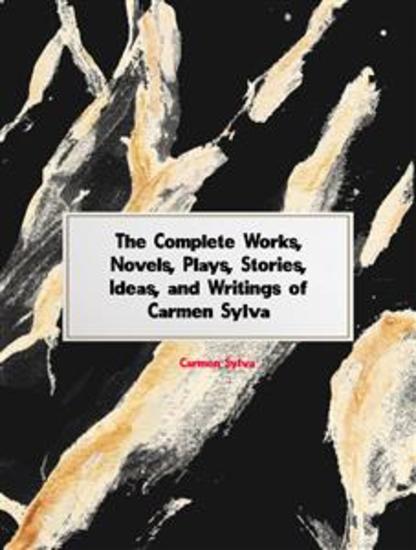
The Complete Works Novels Plays Stories Ideas and Writings of Carmen Sylva - cover
LER

The Complete Works Novels Plays Stories Ideas and Writings of Carmen Sylva

Sylva Carmen

Editora: ICTS

  • 0
  • 0
  • 0

Sinopse

The Complete Works, Novels, Plays, Stories, Ideas, and Writings of Carmen Sylva

This Complete Collection includes the following titles:
--------
1 - Aus meinem Königreich: Tales from the Carpathian Mountains
2 - Pilgrim Sorrow
3 - Sweet Hours
4 - From memory's shrine
5 - Legends from River & Mountain
 
Disponível desde: 28/12/2023.

Outros livros que poderiam interessá-lo

  • New Welsh Review 135 (summer 2024) - Threshold - cover

    New Welsh Review 135 (summer...

    Philippa Holloway, Satterday...

    • 0
    • 2
    • 0
    Bringing together the best of Wales' review-essays, including a comparison of new editions of nature classics, 'Back to the Land' by Pippa Marland. The books under review, Thomas Firbank's I Bought a Mountain and Margiad Evans' Autobiography take contrasting blustering and humble approaches to stepping over the sub/urban doorstep into nature. A showcase of new nonfiction, previewing forthcoming titles from some of Wales' key English-language publishers, exploring books on anti-Welsh media vitriol covering the early Manic Street Preachers, and historical flooding and the riches of an Eton-owned Benedictine fishery on the Gwent Levels. In original fiction: a wonderful story about a teenage boy on the cusp of bodily and emotional change, 'Trout', by Satterday Shaw, and a second, finely crafted story about the effect of geographical dislocation on teenage identity emergence, 'Another Place' by Philippa Holloway, set on Crosby beach. Plus Editorial by Gwen Davies and a new opinion feature, Last Page, by Richard Lewis Davies, in which the writers note that magazines in Wales are undergoing a transition, during which readers and subscribers will need to step up to the plate if a commitment to expressing – without interference - our particular place and time, is to be maintained.
    EDITORIAL
    Half-in, half-out Gwen Davies
    NONFICTION
    Bears at the Fridge: From Goldcliff to Whitson Preview extract from This Stolen Land by Marsha O'Mahony
    The Kinnock Factor: The Manics and Anti-Welshness Edited abridged preview from International Velvet by Neil Collins
    FICTION
    Another Place Story by Philippa Holloway
    Trout Story by Satterday Shaw
    ESSAYS
    Dark Formula Timothy Laurence Marsh on why reckless travel writing matters
    Books for Alien Girls JL George's personal and practical reflections on the role neurodivergence can and should play when writing fiction
    REVIEW-ESSAYS
    Back to the Land Pippa Marland on two nature memoir classics, one of hubristic bluster, the other humbly receptive
    'Queer Old Codgers' Claire Pickard on the portrayal of highly nuanced gay identities and history in recent nonfiction titles and a major short story anthology
    THE LAST PAGE
    Back to the Future Richard Lewis Davies on how a culture with ambition needs critics and readers
    Ver livro
  • Learning to Think - A Memoir of Faith Superstition and the Courage to Ask Questions - cover

    Learning to Think - A Memoir of...

    Tracy King

    • 0
    • 0
    • 0
    Tracy King was raised in a house of contradictions—her family was happy and creative, yet shadowed by debt, phobias, her father's alcoholism, and the illusory promises of a born-again Christian church. The uneasy balance of the King household was irrevocably upended on a rainy spring night in 1988, when her father was killed by teenagers just blocks from their public housing estate. 


    The account of her father's death remained hazy, made worse by the fact that four of the accused teenagers—neighborhood boys she could not avoid—were never charged. What could have triggered such an act of aggression? 


    Over the years, in a bid to balm her grief and gaps in formal education, King journeyed through multiple belief systems: she distanced herself from fundamentalism, searching for clarity instead in the occult, paranormal beliefs, and conspiracy theories. Amid the chaos of her coming of age, she stumbled upon a copy of Carl Sagan's The Demon-Haunted World on the shelves of a Birmingham bookshop—a discovery that proved transformative. 


    Learning to Think is a resounding battle cry for the value of education and the freedom to think critically, imaginatively, and for oneself.
    Ver livro
  • SpaceX - Elon Musk and the Final Frontier - cover

    SpaceX - Elon Musk and the Final...

    Brad Bergan

    • 0
    • 0
    • 0
    Explore the fascinating past, present, and possible future of Elon Musk’s SpaceX in this comprehensive history of the company.The private space industry’s consensus leader, SpaceX, headed by controversial billionaire Elon Musk, was worth an estimated $187 billion in 2023 while taking on more roles—flying cargo, supplies, and astronauts to outer space, and even playing a central role as rocket supplier to NASA’s Artemis moon mission. In SpaceX: Elon Musk and the Final Frontier, science journalist and editor Brad Bergan tells the story of SpaceX.Bergan examines every detail surrounding SpaceX’s efforts to accelerate humankind’s exploration and understanding of outer space, including:The personal and private forces that led Musk to form the company The business of private space exploration, including contracts with other private firms and NASA Chief rivals, including Blue Origin, founded by Amazon’s Jeff BezosSpaceX roles in missions to the Moon, Mars, and beyond Bergan also covers some of SpaceX's controversial headlines, from space junk to failed test launches and the Starlink satellite constellation. While examining the business, the missions, and the hardware, Bergan looks at the importance of design-forward equipment and, finally, the endgame: what ultimately is “in it” for SpaceX?SpaceX: Elon Musk and the Final Frontier is the ultimate look at a groundbreaking company, with an eye toward its relatively short past—and a critical eye toward its possible dominion in deep space.
    Ver livro
  • Applications of Impossible Things - A Near Death Experience in Iraq - cover

    Applications of Impossible...

    Natalie Sudman

    • 0
    • 0
    • 0
    This is an amazing true story of a female civilian employee of the Army Corps of Engineers in Basrah and Nasiriyah, Iraq. She was riding in a truck with other men when a roadside bomb destroyed the vehicle. Her body was so severely damaged that there was no possible way she could live. She vividly recounts her Near Death Experience when she went out of the body to the spirit world. There it was decided that her work on Earth was not done and with the help of spirit guides, they repaired the body so she could reenter it. She retained the conscious memory of what happened and during the time in the hospital, more details returned. This is the amazing story of a survival in wartime conditions. This has happened to many others in Iraq, but how many remember the spirit side of the experience? 
    Before this experience, Sudman was dubious about anything that smacked of the paranormal. This experience made her a believer. She shares her story here for the first time to demonstrate that the paranormal is normal and to assist others who have had similar experiences. 
    This is a book for anyone interested in near death experiences and out of body experiences. It is one of the first such book to come out of the Iraq conflict
    Ver livro
  • Fastovski's Tales of Hampstead - and significant reminiscences of misspent youth - cover

    Fastovski's Tales of Hampstead -...

    Wallace Fields

    • 0
    • 0
    • 0
    Imagine that Isaac Babel’s Cossacks wassail together with Runyonesque Liverpool Jews outside the plate-glass window of a Hampstead café where a Klezmer band is playing to a packed and tea-drinking congregation of jazzmen, Hasidic scholars, surrealists, old soldiers, and retired 
    strippers; and you have the tone and temperature of this unique and unclassifiable memoir – no, not memoir, more a stream-of-consciousness novella – no, not a novella but a piece of autobiographical fiction – no, not autobiography but a picaresque drama conquered from the 
    unreliable and fertile brain of the eponymous Fastovski.And who is Fastovski? Is he real or invented? Is he perhaps the alter-ego of real-life jazz pianist, Klezmer swinger, big band leader and flaneur, Wallace Fields, who stares at us from the book’s frontispiece in shades, Diaghilev coat and moustache, over a cup of strong black coffee? 
    Fastovski’s not telling and anyway, who cares.This is a book to be devoured, disseminated, denounced, and delighted in. It belongs to all who think art and life are one and that the Arch-Savant of Canterbury, Issy Bonn, Rashid the Manic Berber Chef of NW3, and Mrs Karl Popper, have an equal claim on history. I haven’t had such a good time since I shared Sir Ralph Richardson’s motorbike with a parrot and a striking grandmother clock.Piers PlowrightAugust 2008
    Ver livro
  • At Christmas Time - From their pens to your ears genius in every story - cover

    At Christmas Time - From their...

    Anton Chekhov

    • 0
    • 0
    • 0
    Anton Pavlovich Chekhov was born on 29th January 1860 in Taganrog, on the south coast of Russia.  
    His family life was difficult; his father was strict and over-bearing but his mother was a passionate story-teller, a subject Chekhov warmed to. As he later said; ‘our talents we got from our father, but our soul from our mother’.  
    At school Chekhov was distinctly average. At 16 his father mis-managed his finances and was declared bankrupt. His family fled to Moscow. Chekhov remained and eked out a living by various means, including writing and selling short sketches to newspapers, to finish his schooling. That completed and with a scholarship to Moscow University obtained he rejoined his family. 
    He was able to help support them by selling satirical sketches and vignettes of Russian lifestyles and gradually obtained further commissions. In 1884, he qualified as a physician and, although it earned him little, he often treated the poor for free, he was fond of saying ‘Medicine is my lawful wife, and literature is my mistress.’ 
    His own health was now an issue as he began to cough up blood, a symptom of tuberculosis.  Despite this his writing success enabled him to move the family into more comfortable accommodation.  
    Chekhov wrote over 500 short stories which included many, many classics including ‘The Kiss’ and ‘The Lady with a Dog’.  His collection ‘At Dusk’ won him the coveted Pushkin Prize when was only 26.  
    He was also a major playwright beginning with the huge success of ‘Ivanov’ in 1887.   
    In 1892 Chekhov bought a country estate north of Moscow. Here his medical skills and money helped the peasants tackle outbreaks of cholera and bouts of famine. He also built three schools, a fire station and a clinic.  It left him with less time for writing but the interactions with real people gained him detailed knowledge about the peasantry and their living conditions for his stories.  
    His most famous work, ‘The Seagull’ was received disastrously at its premiere in St Petersburg. It was later restaged in Moscow to highlight its psychological aspects and was a huge success. It led to ‘Uncle Vanya’, ‘The Three Sisters’ and ‘The Cherry Orchard’.  
    Chekhov suffered a major lung hemorrhage in 1897 while visiting Moscow. A formal diagnosis confirmed tuberculosis and the doctors ordered changes to his lifestyle.  
    Despite a dread of weddings the elusive literary bachelor quietly married the actress Olga Knipper, whom he had met at rehearsals for ‘The Seagull’, on 25th May 1901. 
    By May 1904 with his tuberculosis worsening and death imminent he set off for the German town of Badenweiler writing cheerful, witty letters to his family and assuring them his health was improving.  
    On 15th July 1904 Anton Chekhov died at Badenweiler.  He was 44.
    Ver livro