¡Acompáñanos a viajar por el mundo de los libros!
Añadir este libro a la estantería
Grey
Escribe un nuevo comentario Default profile 50px
Grey
Suscríbete para leer el libro completo o lee las primeras páginas gratis.
All characters reduced
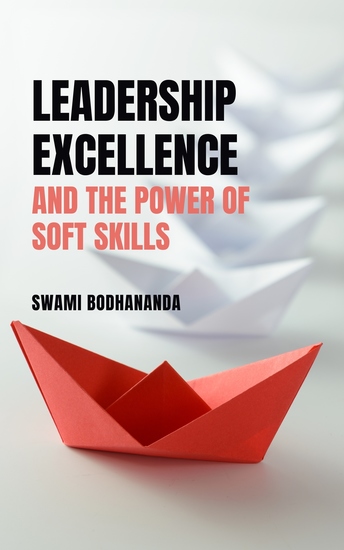
Leadership Excellence - And the Power of Soft Skills - cover

Leadership Excellence - And the Power of Soft Skills

Swami Bodhananda

Editorial: Publishdrive

  • 0
  • 0
  • 0

Sinopsis

Swami Bodhananda connects leadership excellence in an intricate yet simple manner to the life and soft skills needed.  Through Five Themes: Relationships, Happiness, Joy of Doing, Nurturing Values, and Caring and Sharing, he elaborates in a practical manner how excellence in leadership can be achieved, as well as the critical and reflective thinking needed to be in touch with the environment and people from a practical perspective.
Disponible desde: 10/05/2024.
Longitud de impresión: 105 páginas.

Otros libros que te pueden interesar

  • The Coach’s Toolkit - cover

    The Coach’s Toolkit

    Santiago Machain

    • 0
    • 0
    • 0
    The Coach's Toolkit is the second book in the transformational The Coaching Evolution Series. Designed for aspiring and practicing coaches, this guide bridges the gap between foundational knowledge and powerful application. Within its pages, readers will discover essential coaching frameworks like GROW, SMART goals, and SWOT analysis, and learn how to use them with integrity and flexibility. 
    The book dives deep into career mapping, entrepreneurial planning, personal branding, and financial mindset coaching. It equips readers to work with both job seekers and business clients—guiding them through career transitions, startup scaling, market discovery, networking, and beyond.  
    Whether you're a new coach seeking structure or an experienced coach refining your craft, this book offers actionable insights, rich context, and practical wisdom to elevate your practice and your clients' outcomes.
    Ver libro
  • Bait and Switch - Offering Something Desirable to Lure Someone into a Different Situation - cover

    Bait and Switch - Offering...

    Cito Harder

    • 0
    • 0
    • 0
    Deception is an inherent part of human interaction, deeply rooted in psychology and social dynamics. The bait-and-switch technique exploits fundamental cognitive biases, taking advantage of people’s expectations, desires, and trust. Understanding why people fall for deception provides insight into how bait-and-switch schemes function and why they can be so effective. 
    At the core of deception is the brain’s tendency to seek patterns and predict outcomes. When an individual is presented with an offer, their mind begins forming expectations based on past experiences and perceived credibility. If the offer aligns with their desires, they become emotionally invested before verifying all the details. This investment creates cognitive bias, making it harder for them to walk away when the offer changes. The stronger the initial attraction, the more difficult it becomes to reject the switch. 
    Another psychological factor that plays a significant role in deception is the principle of commitment and consistency. Once people commit to an idea, product, or opportunity, they feel an internal pressure to stay consistent with that commitment, even when circumstances change. This effect is particularly strong when the initial bait requires some effort on the part of the target—whether it's filling out forms, spending time researching, or even just mentally envisioning the benefits of the offer. By the time the switch occurs, many individuals feel compelled to follow through rather than admit they were deceived.
    Ver libro
  • The Invention of the Restaurant - Paris and Modern Gastronomic Culture 2nd edition - cover

    The Invention of the Restaurant...

    Rebecca L. Spang, Adam Gopnik

    • 0
    • 0
    • 0
    Why are there restaurants? Why would anybody consider eating alongside perfect strangers in a loud and crowded room to be an enjoyable pastime? To find the answer, Rebecca Spang takes us back to France in the eighteenth century, when a restaurant was not a place to eat but a quasi-medicinal bouillon not unlike the bone broths of today. 


    This is a book about the French revolution in taste—about how Parisians invented the modern culture of food, changing the social life of the world in the process. We see how over the course of the Revolution, restaurants that had begun as purveyors of health food became symbols of aristocratic greed. In the early nineteenth century, the new genre of gastronomic literature worked within the strictures of the Napoleonic state to transform restaurants yet again, this time conferring star status upon oysters and champagne.
    Ver libro
  • Pablo Picasso: A short biography - 5 Minutes: Short on time - long on info! - cover

    Pablo Picasso: A short biography...

    5 Minutes, 5 Minute Biographies,...

    • 0
    • 0
    • 0
    Pablo Picasso, Spanish painter and universal genius: Life and work in a short biography! Everything you need to know, brief and concise. Infotainment, education and entertainment at its best!
    Ver libro
  • On Benefits - cover

    On Benefits

    Lucius Annaeus Seneca

    • 0
    • 0
    • 0
    The original Latin name of this important essay by Seneca, written around 60 CE, was De Beneficiis, which is why it is generally translated as ‘On Benefits’. However, it is more usefully titled ‘On Favours’, because this is what it is essentially about: the giving and receiving of favours, with all the implications of such transactions. Seneca is concerned with demonstrating that while such exchanges can be straightforward and beneficial to both parties, often there are pitfalls and hidden complications that, sooner or later, result in problems. Though some centuries later Shakespeare summed it up concisely with Polonius’s warning: ‘Neither a borrower nor a lender be,’ Seneca is well aware that in all levels and activities of society, benefits or favours play an undoubtedly crucial role. This was certainly true of Roman society, but little has changed since. Seneca deals with the subject in detail, considering the purposes of role of the giver, of which ‘kindness’, he says, is an important aspect – but not the only one by any means. Similarly, the role and attitude of the receiver, plays its part – and ‘gratitude’ is again only one response. Seneca’s background as a Stoic underpins his approach, so he warns against the inappropriate giving and receiving of benefits, which extend far beyond just material goods: it includes influence, wives, patronage and all manner of vice and immorality. In short, Seneca points out that the giving and receiving of favours can be, and often is a pernicious and dangerous affair, resulting in later disaster. Something to be exercised with caution.
    Ver libro
  • Alien Conspiracy - cover

    Alien Conspiracy

    Raphael Terra

    • 0
    • 0
    • 0
    The aliens came a long time ago. They genetically engineered humanity and now they are controlling us. 
     
    Prepare to understand that everything you think and do is in fact controlled and manipulated for a massive agenda. A secret so great and so powerful that it staggers belief.
    Ver libro