Join us on a literary world trip!
Add this book to bookshelf
Grey
Write a new comment Default profile 50px
Grey
Subscribe to read the full book or read the first pages for free!
All characters reduced
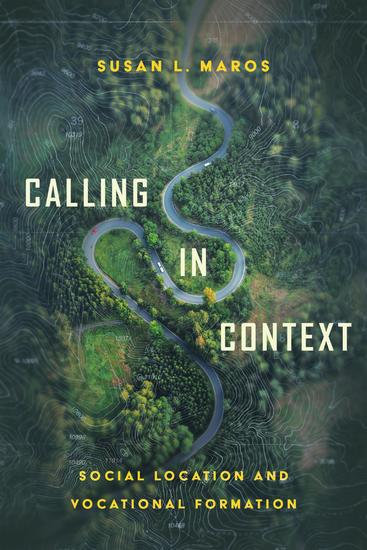
Calling in Context - Social Location and Vocational Formation - cover

Calling in Context - Social Location and Vocational Formation

Susan L. Maros

Publisher: IVP Academic

  • 0
  • 0
  • 0

Summary

"I don't care for vocational books written in the United States; they're too American." When Susan Maros heard this comment from a Malaysian colleague, she was initially taken aback. Isn't the concept of calling universal? Why wouldn't resources with a biblical perspective on vocation apply to everyone?The reality is that each of us encounters our questions of calling from within a particular context. In this paradigm-shifting book, Maros explores how various dimensions of social location—including race, ethnicity, culture, socioeconomic status, and gender—shape our assumptions and experiences with vocation. Maros helps Christians in the United States in particular see how ideas about calling that emphasize certainty, career paths, and personal achievement arise from cultural priorities that shouldn't go unexamined, such as individualism, productivity, and meritocracy. She explains how unexamined "mental maps" can distort our perspective and refocuses our attention on biblical insights about calling as a lifelong journey. In the process, she helps us find both clarity and encouragement to explore the paths before us.God calls all people, yes—but calling is not a monolithic concept. Filled with numerous stories from Christians in diverse communities, Calling in Context invites anyone exploring questions of calling to find fresh possibilities in their own identity and engagement with God's mission. Reflection questions and Bible study prompts are included throughout.
Available since: 04/19/2022.
Print length: 240 pages.

Other books that might interest you

  • The Swift Conquest - Unraveling Hitler's Rapid Domination of Europe - cover

    The Swift Conquest - Unraveling...

    John Harpoon

    • 0
    • 0
    • 0
    The rise of Adolf Hitler and the Nazi Party did not occur in isolation but was the culmination of a confluence of societal, economic, and political factors. Post-World War I Germany was a nation in turmoil, grappling with humiliation, economic devastation, and political instability. The Treaty of Versailles, signed in 1919, placed the blame for the war squarely on Germany's shoulders, imposing severe reparations that crippled its economy. The German people, burdened by hyperinflation, unemployment, and poverty, became disillusioned with the democratic Weimar Republic, which they perceived as weak and ineffectual. 
    Amid this chaos, Hitler emerged as a figure of radical change. A decorated veteran of the First World War, Hitler initially joined the German Workers’ Party, a small and obscure nationalist group. With his fiery oratory skills and an unrelenting focus on propaganda, he quickly rose to prominence, transforming the group into the National Socialist German Workers' Party (NSDAP), or the Nazi Party. Hitler’s message was simple yet potent: he promised to restore Germany to greatness, overturn the Treaty of Versailles, and provide a scapegoat for the nation’s suffering—the Jewish people and other minorities. 
    By the early 1920s, Hitler had crafted a political doctrine that combined virulent nationalism, anti-Semitism, and a disdain for democracy. He also sought to exploit the populace’s fears of communism, which was gaining traction in Europe following the Bolshevik Revolution in Russia. The failed Beer Hall Putsch in 1923, an attempted coup in Munich, briefly landed Hitler in prison. However, this setback proved instrumental to his ideological development, as he used the time to dictate Mein Kampf, a manifesto outlining his vision for Germany’s future and the expansion of Lebensraum, or "living space," for the German people.
    Show book
  • The Philosophers and the Mere - A Modern Myth Without a Tower - cover

    The Philosophers and the Mere -...

    Brian Capleton

    • 0
    • 0
    • 0
    The inner circle of the philosophers of Pavi Bujdam are a close group of friends who include a renowned artist, a mathematician, musicians, dancers, theologians and an astrologer, who all live with the great philosophical question of what lies beyond the mere surrounding their almost trouble-free land. In their meetings together they are always exploring their philosophies, an exploration in which the reader is invited to share in the form of the entertainment of the story. 
    In a setting of symbolism and literary device, through the storytelling in The Philosophers and the Mere we tacitly meet Buddhism, ancient Greek philosophy, the Hindu Puranas, Renaissance Neoplatonism, Christianity, the subject matter of great paintings by Poussin and Botticelli, and even the deep philosophical questions of modern physics, all in an original, progressively poetical setting. 
    The tenor of The Philosophers and the Mere is outside the mould of ordinary stories of troubles and strife in personal affairs of human love and relationships. In The Philosophers and the Mere such trouble regularly appears only in the annual masquerade which takes place at the Mereage, the most beautiful part of Pavi Bujdam in which all the friends live. 
    As the story progresses, the philosophy of the friends begins to come to life. In the language of Mythic Symbolism the very landscape of the tale itself undergoes its own metamorphosis. Its final unfolding reveals a post-contemporary myth within whose fabric is woven a message about love and human existence.
    Show book
  • Subversive - Christ Culture and the Shocking Dorothy L Sayers - cover

    Subversive - Christ Culture and...

    Crystal Downing

    • 0
    • 0
    • 0
    Known for her bestselling detective novels, Dorothy L. Sayers lived a fascinating, groundbreaking life as a novelist, feminist, Oxford scholar, and important influence on the spiritual life of C. S. Lewis. This pioneering woman not only forged a literary career for herself but also spoke about faith and culture in revolutionary ways as she addressed the evergreen question of to what extent faith should hold on to tradition and to what extent it should evolve with a changing culture. Thanks to her unmatched wisdom, prophetic tone, and insistent strength, Dorothy Sayers is a voice that we cannot afford to ignore. 


    Providing a blueprint for bridge-building in contemporary, polarizing contexts, Subversive shows how Sayers used edgy, often hilarious metaphors to ignite new ways to think about Christianity, shocking people into seeing the truth of ancient doctrine in a new light. Urging readers to reassess interpretations of the Bible that impede the cause of Christ, Sayers helps twenty-first-century Christians navigate a society increasingly suspicious of evangelical vocabularies and find new ways to talk and think about faith and culture. Ultimately, she will inspire believers, on both the right and the left, to evaluate how and why their language perpetuates divisive certitude rather than the hopeful humility of faith, and will show us all a better way forward.
    Show book
  • True Magic - cover

    True Magic

    Raphael Terra

    • 0
    • 0
    • 0
    This audiobook has been recorded using Text to speech (TTS). 
     
    From the very beginning, mankind has been fascinated with the world of the occult – the unseen. From the first cave paintings to the Bible, magic can be found everywhere. From secret societies to Victorian occult spiritualists, from influential masters of the black arts to Disney films, Magic holds a spell over us. 
     
    But what is magic? 
     
    Magic is not the trickery of a conjurer. True magic is much more. True magic is the focus on the mystical world, the non-material world, the strange and wonderful. True magic explains the inexplicable. It is revelation beyond science and logic. True magic will make you question reality itself. In fact it will show you reality and help you understand that you have been living in a false world all along. 
     
    If you seek answers to the big questions of conscious existence then you need to enter the realm of real magic. If you wish to understand the mysteries of the universe, then you need magic.
    Show book
  • Ninjas of Ancient Japan - Japanese History about the Ninjas in the Shadows - cover

    Ninjas of Ancient Japan -...

    Kelly Mass

    • 0
    • 0
    • 0
    The ancient Ninjas in Japan have fueled stories, movies, books and other media to go on and on about the sneaky assassins that terrorized their country. Today, you and I will go in-depth into this topic and find out more about the truth. 
    Some of the stories sound accurate, others have more to it, or are completely false. In a nutshell, this brief book will cover the following topics and more: 
    The most important facts about the Japanese ninjas. 
    Shaolin monks and Japanese pirates. 
    Feudalism compared with European knights. 
    The 7 most famous ninjas. 
    The biggest ninja fight ever in history that took place in 1581. 
    False concepts about ninjas. 
    Daimyo lords in Japan. 
    Ninja training, schools, weapons, and disguises. 
    Educate yourself and figure out where the stories came from, and then connect the dots. This guide will help you along the way.
    Show book
  • Atomic Days - The Untold Story of the Most Toxic Place in America - cover

    Atomic Days - The Untold Story...

    Joshua Frank

    • 0
    • 0
    • 0
    Once home to the United States's largest plutonium production site, the Hanford Nuclear Reservation in Washington State is laced with 56 million gallons of radioactive waste. The threat of an explosive accident at Hanford is all too real—an event that could be more catastrophic than Chernobyl. 


    The EPA designated Hanford the most toxic place in America; it is also the most expensive environmental clean-up job the world has ever seen, with a $677 billion price tag that keeps growing. Huge underground tanks, well past their life expectancy and full of boiling radioactive gunk, are leaking, infecting groundwater supplies and threatening the Columbia River. 


    Whistleblowers are now speaking out, hoping their pleas can help bring attention to the dire situation at Hanford. Aside from a few feisty community groups and handful of Indigenous activists, there is very little public scrutiny of the clean-up process, which is managed by the Department of Energy and carried out by contractors with shoddy track records, like Bechtel. In the context of renewed support for atomic power as a means of combating climate change, Atomic Days provides a much-needed refutation of the myths of nuclear technology—from weapons to electricity—and shines a spotlight on the ravages of Hanford and its threat to communities, workers, and the global environment.
    Show book