

Join us on a literary world trip!
Add this book to bookshelf
Grey
Write a new comment Default profile 50px
Grey
Subscribe to read the full book or read the first pages for free!
All characters reduced
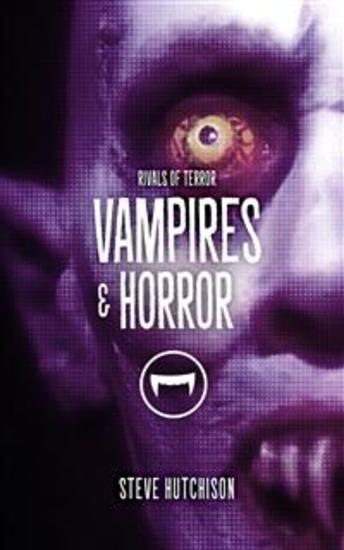
Vampires & Horror (2019) - cover

Vampires & Horror (2019)

Steve Hutchison

Publisher: Tales of Terror

  • 0
  • 0
  • 0

Summary

Vampires are undead beings that subsist by feeding on blood or vital force. They are a major archetype of horror movies. In this book, film critic Steve Hutchison reviews and ranks 50 of the best horror movies featuring vampires ever released. How many have you seen?
Available since: 04/19/2023.

Other books that might interest you

  • Emotional Design - Why We Love (or Hate) Everyday Things - cover

    Emotional Design - Why We Love...

    Don Norman

    • 0
    • 0
    • 0
    Why attractive things work better and other crucial insights into human-centered design 


    Emotions are inseparable from how we humans think, choose, and act. In Emotional Design, cognitive scientist Don Norman shows how the principles of human psychology apply to the invention and design of new technologies and products. In The Design of Everyday Things, Norman made the definitive case for human-centered design, showing that good design demanded that the user's must take precedence over a designer's aesthetic if anything, from light switches to airplanes, was going to work as the user needed. In this book, he takes his thinking several steps farther, showing that successful design must incorporate not just what users need, but must address our minds by attending to our visceral reactions, to our behavioral choices, and to the stories we want the things in our lives to tell others about ourselves. Good human-centered design isn't just about making effective tools that are straightforward to use; it's about making affective tools that mesh well with our emotions and help us express our identities and support our social lives. From roller coasters to robots, sports cars to smart phones, attractive things work better. Whether designer or consumer, user or inventor, this book is the definitive guide to making Norman's insights work for you.
    Show book
  • Empire of Ife - The Cradle of Yoruba Culture and the Kingdom of Sculptors - cover

    Empire of Ife - The Cradle of...

    Rolf Hedger

    • 0
    • 0
    • 0
    The origins of Ife are deeply rooted in mythology, oral traditions, and historical accounts, making it one of the most revered ancient cities in West Africa. Ife is often referred to as the cradle of the Yoruba civilization, a place where culture, religion, and governance took form. The story of its beginning is intertwined with Yoruba cosmology, particularly the legend of Oduduwa, who is considered the progenitor of the Yoruba people. 
    According to Yoruba mythology, Olodumare, the Supreme Being, entrusted Oduduwa with the sacred task of creating the earth. He descended from the heavens with a chain, a handful of earth, and a rooster. Upon reaching the watery expanse that covered the world, he spread the earth on the surface, and the rooster scattered it, forming the first landmass. This sacred land became known as Ile-Ife, meaning “The Land of Expansion.” Over time, Oduduwa and his followers established a kingdom that became the center of Yoruba civilization, laying the foundation for its political, spiritual, and artistic traditions. 
    Beyond mythology, historical and archaeological evidence suggests that Ife was already a flourishing city-state by the 9th century, possibly earlier. It grew as a hub of trade, attracting merchants and artisans from different parts of West Africa. Its strategic location allowed for the exchange of goods, ideas, and cultural practices, contributing to the city’s rapid development. The city’s early rulers, often referred to as the Oonis, played a crucial role in consolidating power and maintaining the harmony between religious and political institutions. The Ooni of Ife, regarded as both a king and a divine figure, acted as the intermediary between the people and the gods, reinforcing Ife’s status as a sacred city.
    Show book
  • Drawn Testimony - My Four Decades as a Courtroom Sketch Artist - cover

    Drawn Testimony - My Four...

    Jane Rosenberg

    • 0
    • 0
    • 0
    From America’s top courtroom sketch artist, a penetrating, compulsively readable memoir about her dramatic four-decade career“A mesmerizing look at this rarest of professions…”–Bookpage STARRED review"Readers will be hard-pressed to put this down.”—Publishers Weekly STARRED review"Rosenberg’s fascinating debut offers a front row seat to some of the most high-profile criminal cases of the last four decades."—Library Journal STARRED review"Perceptive, compassionate, and endlessly fascinated by how the human condition is revealed in the courtroom, Rosenberg tells riveting and resonant tales in image and word."—Booklist STARRED reviewFor over forty years, Jane Rosenberg has been at the heart of the news cycle, covering almost every major trial that has passed through the New York justice system as a courtroom sketch artist, including the most recent Donald Trump hush money trial.In Drawn Testimony, Rosenberg brings us into the dramatic high-stakes world of her craft, where art, psychology and courtroom drama collide. Over the course of her legendary career, Jane has had a front-row seat to some of the most iconic and notorious moments in our nation’s recent history, including cases pertaining to:• Mick Jagger• Martha Stewart• Tom Brady's "Deflategate" scandal• John Lennon’s murder trial • Ghislaine Maxwell• John Gotti• Harvey Weinstein• The Boston Marathon bomber• Donald TrumpReaders will learn how she has honed her unique powers of perception and also what her portraits reveal, not only about her subjects, but about the human condition in general.Fearless, fascinating and gorgeously written, Drawn Testimony captures the unique career of an artist whose body of work depicts history as it’s happening.
    Show book
  • Why Lhasa de Sela Matters - cover

    Why Lhasa de Sela Matters

    Fred Goodman

    • 0
    • 0
    • 0
    An artist in every sense of the word, Lhasa de Sela wowed audiences around the globe with her multilingual songs and spellbinding performances, mixing together everything from Gypsy music to Mexican rancheras, Americana and jazz, chanson française, and South American folk melodies. In Canada, her album La Llorona won the Juno Award and went gold, and its follow-up, The Living Road, won a BBC World Music Award. Tragically, de Sela succumbed to breast cancer in 2010 at the age of thirty-seven after recording her final album, Lhasa. 
     
    Tracing de Sela’s unconventional life and introducing her to a new generation, Why Lhasa de Sela Matters is the first biography of this sophisticated creative icon. Raised in a hippie family traveling between the United States and Mexico in a converted school bus, de Sela developed an unquenchable curiosity, with equal affinities for the romantic, mystic, and cerebral. Becoming a sensation in Montreal and Europe, the trilingual singer rejected a conventional path to fame, joining her sisters’ circus troupe in France. Revealing the details of these and other experiences that inspired de Sela to write such vibrant, otherworldly music, Why Lhasa de Sela Matters sings with the spirit of this gifted firebrand.
    Show book
  • Civil Rights and Equal Protection Cases 1856-1948 - cover

    Civil Rights and Equal...

    United States Supreme Court

    • 0
    • 0
    • 0
    "Civil Rights and Equal Protection Cases 1856-1948 is a collection of landmark decisions by the United States Supreme Court that focus on civil rights and equal protection. These cases span the period from 1856 to 1948 and address crucial legal and social issues related to equality, justice, and individual rights.    Here are some notable cases included in this collection:    Dred Scott v. Sandford (1856): A pivotal case involving the rights of enslaved individuals and their status as property or citizens 1.  Strauder v. West Virginia (1879): A case challenging racial discrimination in jury selection 1.  Yick Wo v. Hopkins (1886): A landmark decision addressing discriminatory treatment of Chinese immigrants .  Plessy v. Ferguson (1896): The infamous "separate but equal" ruling that upheld racial segregation .  Missouri ex rel. Gaines v. Canada (1938): A case concerning access to higher education for African American students .  Shelley v. Kraemer (1948): A significant decision regarding racially restrictive housing covenants .  These cases shaped the legal landscape and had a profound impact on civil rights in the United States. They continue to resonate as essential milestones in the ongoing struggle for equality and justice."
    Show book
  • Cliché-Verre - Miniatures on Glass - cover

    Cliché-Verre - Miniatures on Glass

    Brian Allan Skinner

    • 0
    • 0
    • 0
    Cliché-verre is a technique of etching and painting directly on photographic negatives. The term means “glass negative” in French and is as old as photography itself, dating to the 1840s and earlier. The first successful photographic process involved coating glass plates with light-sensitive chemicals from which reversed (positive) prints could be made. Artists experimented with drawing, etching, and combining images directly on the glass, resulting in fanciful black-and-white prints. But few artists were inspired to develop the idea further until the advent of color photography in the early 20th Century. 
    The Magic Lantern, long predating photography, was invented by Christiaan Huygens, a Dutch astronomer and physicist, in the 1600s. It is a simple device for projecting images, based upon the centuries-old principles of the “camera obscura” or “darkened room.” When the photographic process evolved to film rather than glass plates, the technology spread. Color film arrived in the 1930s. There were now both film negatives and positives (slides). 
    Brian Allan Skinner is the author of six volumes of illustrated fiction. His experiments with cliché-verre began in the 1960s. Here are 50 examples of his work from the past half-century, in brilliant color. In the epilogue, he explains his process in detail.
    Show book
