Unisciti a noi in un viaggio nel mondo dei libri!
Aggiungi questo libro allo scaffale
Grey
Scrivi un nuovo commento Default profile 50px
Grey
Iscriviti per leggere l'intero libro o leggi le prime pagine gratuitamente!
All characters reduced
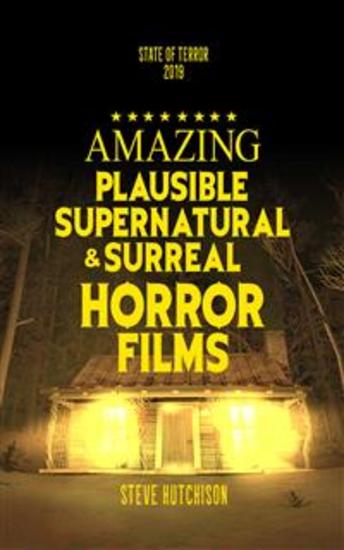
Amazing Plausible Supernatural and Surreal Horror Films (2019) - cover

Amazing Plausible Supernatural and Surreal Horror Films (2019)

Steve Hutchison

Casa editrice: Tales of Terror

  • 0
  • 0
  • 0

Sinossi

This book contains 66 reviews of plausible horror films, 66 reviews of supernatural horror films, and 66 reviews of surreal horror films written and ranked by critic and blogger Steve Hutchison. Each description includes five ratings (stars, story, creativity, acting, quality), a synopsis, and a review. How many have you seen?
Disponibile da: 22/04/2023.
Altri libri che potrebbero interessarti

  • Yannis Pappas: Andrew Schulz Presents - Yannis Pappas: Blowing the Light - cover

    Yannis Pappas: Andrew Schulz...

    Yannis Pappas

    • 0
    • 0
    • 0
    It’s a good time, difficult time, narcissistic time. The Newly married Yannis Pappas explores the political division in America, online culture, how the amenities of modernity have saved and ruined us all and finally his controversial idea to bring everyone in the world together in his first hour stand-up comedy special shot at NY Comedy Club in NYC, produced by Andrew Schulz.
    Mostra libro
  • Classic Movie Radio Commercials - Volume 2 - cover

    Classic Movie Radio Commercials...

    Various Various

    • 0
    • 0
    • 0
    This fascinating audio program includes actual radio commercials from the 1960s and 1970s for the following classic movies: Barbarella (1968), directed by Roger Vadim, featuring Jane Fonda, John Phillip Law, Anita Pallenberg; Bunny Lake Is Missing (1965), directed by Otto Preminger, featuring Laurence Olivier, Carol Lynley, Keir Dullea; Chappaqua (1966), directed by Conrad Rooks, featuring Conrad Rooks, William S. Burroughs, Jean-Louis Barrault; Endless Summer (1965), directed by Bruce Brown, featuring Robert August, Michael Hynson, Lord James Blears; Seaside Swingers(1964), directed by James Hill, featuring John Leyton, Michael Sarne, Peter Birrell; The Green Slime (1968), directed by Finji Fukasaku, featuring Robert Horton, Luciana Paluzzi; Hells Angels On Wheels (1967), directed by Richard Rush, featuring Adam Roarke, Jack Nicholson; Help!(1965), directed by Richard Lester, featuring The Beatles; How I Won The War (1967), directed by Richard Lester, featuring Michael Crawford, John Lennon; I Am A Groupie (1970), directed by Derek Ford, featuring Esme Johns, Billy Boyle; Luv (1967), directed by Clive Donner, featuring Jack Lemmon, Peter Falk; Monterey Pop (1968), directed by D.A. Pennebaker, featuring Jimi Hendrix, The Mamas and the Papas; The Pied Piper (1972), directed by Jacques Demy, featuring Donovan, Donald Pleasence; Don't Make Waves (1967), directed by Alexander Mackendrick, featuring Sharon Tate, Claudia Cardinale; The Good, The Bad And The Ugly (1966), directed by Sergio Leone, featuring Clint Eastwood, Eli Wallach, Lee Van Cleef; The Producers (1967), directed by Mel Brooks, featuring Zero Mostel, Gene Wilder; Thunderball (1965), directed by Terence Young, featuring Sean Connery, Claudine Auger; Wild In The Streets (1968), directed by Barry Shear, featuring Christopher Jones, Shelley Winters; Yellow Submarine (1968), directed by George Dunning, featuring The Beatles.
    Mostra libro
  • Bruce Nauman - cover

    Bruce Nauman

    Robert Storr

    • 0
    • 1
    • 0
    How can we interpret the work of contemporary artists? Focal Points is a new book series of essays, articles and reviews by acclaimed curator and critic Robert Storr. Expertly edited by art historian and curator Francesca Pietropaolo, and richly illustrated, it lends Storr’s illuminating insights into an artist’s practice and way of thinking across recent decades. Brilliantly scholarly, accessible and engaging, Focal Points offers fresh interpretations of the varied territory of modern and contemporary art.????Through a selection of texts spanning from 1986 to 2016, volume one brings together thirty years of Storr’s writings on American artist Bruce Nauman (b.1941) whose practice encompasses sculpture, photography, neon, drawing, printmaking and performance. Much of Nauman’s work makes use of language games and visual puns, influenced by the linguistic theories of twentieth-century thinker Ludwig Wittgenstein and by the work of writer, poet and playwright Samuel Beckett. Describing his work in 1970, Nauman said: ‘Sometimes the activity involves making something, and sometimes the activity is the piece.’
    Mostra libro
  • Your Thought - cover

    Your Thought

    Mitansh

    • 0
    • 0
    • 0
    “Believe you can and you're halfway there. No one can make you feel inferior without your consent.” “Success is not how high you have climbed, but how you make a positive difference to the world.” “Opportunities don't happen
    Mostra libro
  • Drawing the Line - What to Do with the Work of Immoral Artists from Museums to the Movies - cover

    Drawing the Line - What to Do...

    Erich Hatala Matthes

    • 0
    • 0
    • 0
    Recent years have proven rife with revelations about the misdeeds, objectional views, and, in some instances, crimes of popular artists. Given more access than ever thanks to social media and the internet in general, the public has turned an alert and critical eye upon the once-hidden lives of previously cherished entertainers. But what should we members of the public do, think, and feel in response to these artists' actions or statements? It's a predicament that many of us face: whether it's possible to disentangle the deeply unsettled feelings we have toward an artist from how we respond to the art they produced. As consumers of art, and especially as fans, we have a host of tricky moral question to navigate: do the moral lives of artists affect the aesthetic quality of their work? Is it morally permissible for us to engage with or enjoy that work? Can we separate an artist from their art? 


    In Drawing the Line, Erich Hatala Matthes offers insight and clarity to the ethical questions that dog us. He argues that it doesn't matter whether we can separate the art from the artist, because we shouldn't. Matthes argues both that the lives of artists can play an important role in shaping our moral and aesthetic relationship to the artworks that we love and that these same artworks offer us powerful resources for grappling with the immorality of their creators.
    Mostra libro
  • Bohemians - A Very Short Introduction - cover

    Bohemians - A Very Short...

    David Weir

    • 0
    • 0
    • 0
    The Romantic myth of Bohemia originated in the early nineteenth century as a way of describing the new conditions faced by artists and writers when the previous system of aristocratic patronage collapsed in the wake of the Age of Revolution. Without the patron system, the artist was free to move around, to seek an audience wherever fortune beckoned. This marketing model likening the artist's vagabond career to the "gypsy" life helps to explain part of the bohemian myth, but not all of it. Most bohemians have scant interest in commercial gain and are not so itinerant after all, confining their movements to down-market urban neighborhoods where the rent is cheap and the morals are loose. 


    This Very Short Introduction traces the myth of Bohemia through its various fictional manifestations, from Henry Murger's novel Scenes of Bohemian Life and Giacomo Puccini's opera La Bohème to Aki Kaurismäki's film La vie de Bohème and Jonathan Larson's musical Rent. It goes on to examine the history of different bohemian communities, including those in the Latin Quarter of Paris and the Greenwich Village neighborhood of New York. David Weir also considers the politics of Bohemia and traces the careers of the artists Gustave Courbet and Pablo Picasso and the great chanteuses Yvette Guilbert, Fréhel, and Edith Piaf in the Montmartre neighborhood of Paris.
    Mostra libro