Join us on a literary world trip!
Add this book to bookshelf
Grey
Write a new comment Default profile 50px
Grey
Subscribe to read the full book or read the first pages for free!
All characters reduced
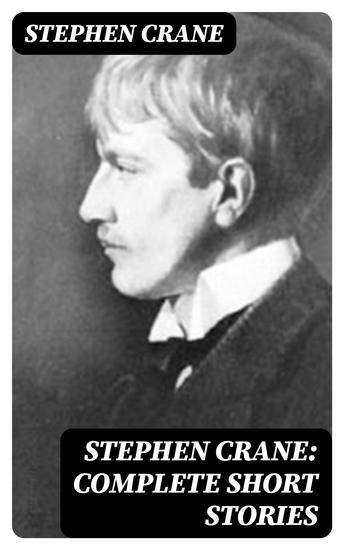
Stephen Crane: Complete Short Stories - Over 100 Stories & Novellas - cover

Stephen Crane: Complete Short Stories - Over 100 Stories & Novellas

Stephen Crane

Publisher: DigiCat

  • 0
  • 0
  • 0

Summary

Stephen Crane: Complete Short Stories showcases a remarkable body of work that captures the essence of human experience against the backdrop of the late 19th-century America. Renowned for its vivid imagery and pioneering use of naturalism and impressionism, this collection presents stories that delve into themes of war, survival, and the complexities of human emotion. Crane's masterful prose is marked by its brevity and poignant symbolism, reflecting the existential struggles faced by his characters. Through innovative narrative techniques, he paints a stark portrait of life that transcends time and resonates with readers today. Stephen Crane, an eminent figure in American literature, was profoundly influenced by his own experiences as a war correspondent and the tumult of the Civil War. Born in 1871, Crane's short, yet impactful career was characterized by a deep empathy for the human condition. His explorations of fate, desire, and the inner workings of the human psyche stem from a rich tapestry of historical and personal narratives, all of which are evident in this comprehensive collection of short stories. Crane's understanding of the gritty realities of life informs his poignant storytelling, making his work timeless. Given its rich thematic depth and stylistic innovation, Stephen Crane: Complete Short Stories is essential reading for anyone interested in American literature and the short story form. This collection not only showcases Crane's literary genius but also invites readers to engage with profound existential questions shaped by society's tumultuous landscape. It is a compelling journey into the heart of humanity that should not be missed.
Available since: 05/17/2022.
Print length: 930 pages.

Other books that might interest you

  • By Virtue Fall - cover

    By Virtue Fall

    Barbara Anne Machin

    • 0
    • 0
    • 0
    A trio of stories depicting true life struggles for people in all walks of life. How individuals can spoil what is good in life through the very stubbornness in their own nature. Jealously. Harsh words and anger. Misunderstanding that would be easier to face talk about instead of walking away. No problem is insurmountable if faced instead of ignored.
    Show book
  • The Price We Pay - cover

    The Price We Pay

    M.H. Lee

    • 0
    • 0
    • 0
    What If You Didn't Have To Struggle Anymore?Clark has spent every day of his life fighting to survive his terminal illness and provide for his family, but then all his wishes are unexpectedly answered and he's left asking the question, what now?
    Show book
  • Russian Short Story The - Volume 3 - Fyodor Dostoyevsky to Leo Tolstoy - cover

    Russian Short Story The - Volume...

    Fyodor Dostoyevsky, Nikolai...

    • 0
    • 0
    • 0
    The Russian novel has a reputation that is immense, both in narrative and in length.  Unquestionably though the ideas, themes and characters make many novels rightly revered as world class, as icons of literature. 
     
    Perhaps an easier way to enjoy a wider selection of the Russian heritage, with its varied and glorious literary talents, is with the short story.  These gems sparkle and beguile the mind with their characters and narrative, exploring facets of society and the human condition that more Western authors somehow find more difficult to navigate, or to explore, explain and relate to.   
     
    The Russian short story is, in many respects, in a genre of its own.  It is at its captivating best whether it’s an exploration of real-life experiences, through fantasy and fables and on to total absurdity. 
     
    In a land so vast it is unsurprising that it is a world almost unto itself. Cultures and landscapes of differing hues are packed together bound only by the wilful bonds and force of Empire. 
     
    The stories in this collection traverse the decades where one might be a serf under an absolute monarch, and the reality of that was pretty near to slavery, into an emancipation of sorts in the fields, or towns under the despotic will of landowners and the rich into the upheavals of Empire and then the overthrow of the ruling class and its replacement by the communists, who promised equality for all and delivered a society where the down-trodden remained the lowest yet vital cog of the state machine and its will.  
     
    Whilst Tolstoy, Gogol, Dostoevsky, Pushkin and Chekhov are a given in any Russian collection we also explore and include Andreyev, Korolenko, Turgenev, Blavatsky and many others to create a world rich and dense across a sprawling landscape of diverse people, riddled with the class and unfairness in perhaps some of the most turbulent times that Russia has ever experienced. 
     
    01 - The Russian Short Story - Volume 3 - An Introduction 
    02 - An Honest Thief by Fyodor Dostoyevsky 
    03 - The Crocodile. An Extraordinary Incident - Part 1 by Fyodor Dostoyevsky 
    04 - The Crocodile. An Extraordinary Incident - Part 2 by Fyodor Dostoyevsky 
    05 - Bobok by Fyodor Dostoyevsky 
    06 - How a Muzhik Fed Two Officials by Nikolai Schedrin 
    07 - Diary of a Lunatic by Leo Tolstoy 
    08 - Aloysha the Pot by Leo Tolstoy 
    09 - How Much Land Does A Man Need by Leo Tolstoy 
    10 - The Snowstorm - Part 1 by Leo Tolstoy 
    11 - The Snowstorm - Part 2 by Leo Tolstoy 
    12 - God Sees The Truth But Waits by Leo Tolstoy
    Show book
  • 3 Christmas Stories - Sad Russian - A trio of Xmas themed stories for the holiday season - cover

    3 Christmas Stories - Sad...

    Anton Chekhov, Fyodor Dostoyevsky

    • 0
    • 0
    • 0
    There is something about the number 3.    
     
    The Ancient Greeks believed 3 was the perfect number, and in China 3 has always been a lucky number, and they know a thing or two.   
     
    Most religions also have 3 this and 3 that and, of course, in these more modern times, three’s a crowd may be too many, except when it’s a ménage à trois.  It seems good things usually come in threes. 
     
    Whatever history and culture says WE think 3, a hat-trick of stories, is a great number to explore themes and literary avenues that classic authors were so adept at creating. 
     
    From their pens to your your ears.
    Show book
  • Vladimir Korolenko - A Short Story Collection - Ukranian born brilliant writer that was an outspoken critic of Tsarism and Communism - cover

    Vladimir Korolenko - A Short...

    Vladimir Korolenko

    • 0
    • 0
    • 0
    Vladimir Galaktionovich Korolenko was born in Zhytomyr, Ukraine, then part of the Russian Empire on 27th July 1853. 
     
    His father died when he was 13 and life was then often struck with bouts of poverty, which resulted in his education being somewhat erratic.   A spell in exile at 23 was followed by another as the politics of the times opposed his volatile but heart-felt passions. 
     
    Writing was also coming to the fore and in 1879 his debut short story telling of a young Narodnik searching for social and spiritual identity, was published. 
     
    In 1881, Korolenko refused to swear allegiance to the new Russian Tsar and was again exiled, this time much farther afield.  He spent the next three years doing manual work, but took time to study local customs and history.  These impressions in exile provided rich material for his writings. 
     
    In 1885 he was allowed to settle in Nizhny, where again he repeatedly questioned the authorities.  That same year ‘Makar's Dream’ established his literary reputation and was part of his first collection ‘Sketches and Stories’, the following year. 
     
    In the early 1890’s when famine struck Central Russia, he went to work on relief missions, collecting donations, supervising the delivery and distribution of food, opening 45 free canteens, all this while writing the graphic reports that would later be published as ‘In the Year of Famine’ in 1893. 
     
    By 1896 despite some psychological disorders, he was well regarded amongst Russian writers and was even a member of the Russian Academy of Sciences.  Throughout his writing career Korolenko was a staunch advocate of human rights, putting that sacred activity above what he called his 'part-time-writing'. 
     
    In the Revolutionary year of 1905, under his editorship, Russkoye Bogatstvo published the Manifest by the Petersburg Soviet of the Workers' deputies. Korolenko was now repeatedly harassed by the authorities, had his flat raided many times and materials confiscated. 
     
    As a lifetime opponent of Tsarism, he guardedly welcomed the Revolution of 1917.  Once the nature of Bolshevism was established, he soon started to criticize it. During the Russian Civil War that ensued, he condemned both the Red Terror and the White Terror.  
     
    Despite suffering from a progressive heart disorder, he collected food packages for children in famine-stricken Moscow and Petrograd as well as organised orphanages and shelters for the homeless.  
     
    Vladimir Korolenko died in Poltava, Ukraine, of the complications of pneumonia on 25th December 1921.  He was 68. 
     
    1 - Vladimir Korolenko - A Short Story Collection - An Introduction 
    2 - The Village of God by Vladimir Korolenko 
    3 - The Old Bell Ringer by Vladimir Korolenko 
    4 - Neccesity. An Eastern Tale by Vladimir Korolenko 
    5 - Lights by Vladimir Korolenko 
    6 - The Shades, a Phantasy by Vladimir Korolenko
    Show book
  • Seeking Arrangements - A Good Women Story - cover

    Seeking Arrangements - A Good...

    Halle Hill

    • 0
    • 0
    • 0
    A woman boards a Greyhound bus to Florida with her ailing sugar daddy on a long journey to meet his mother. In the middle of the night, in the middle of rural Georgia, another passenger disrupts her plan.Seeking Arrangements is a short story from Halle Hill’s Good Women, which delves into the lives of twelve Black women across the Appalachian South. Darkly funny and deeply human, Good Women observes how place, blood ties, generational trauma, obsession, and boundaries―or lack thereof―influence how we navigate our small worlds, and how those worlds so often collide in ways we don’t expect.
    Show book