Unisciti a noi in un viaggio nel mondo dei libri!
Aggiungi questo libro allo scaffale
Grey
Scrivi un nuovo commento Default profile 50px
Grey
Iscriviti per leggere l'intero libro o leggi le prime pagine gratuitamente!
All characters reduced
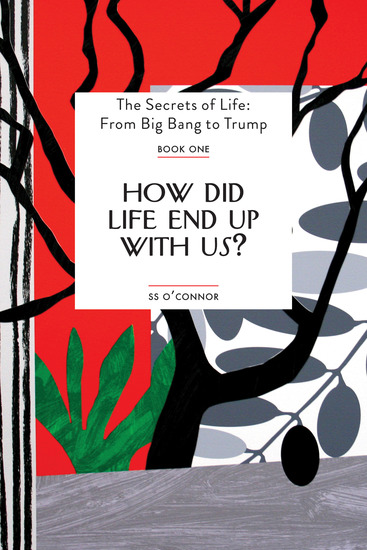
How Did Life End Up With Us? - The Secrets of Life: From Big Bang to Trump - cover

How Did Life End Up With Us? - The Secrets of Life: From Big Bang to Trump

Ss O'Connor

Casa editrice: Otium Press

  • 0
  • 0
  • 0

Sinossi

Why does the gene behave like a hedge fund manager? Why are mutations like a gambling scam? Why does nothing ever become top dog in life and win forever? Humans only arrived after 99.99% of the time there’s been life on earth. So what was here before us? And how did these species, and the evolutionary process that created them, end up with the unpromising creatures that were our ancestors?In this, the first book of The Secrets of Life quartet, SS O’Connor brings his outsider’s, questioning eye to reveal the great forces that lie behind life: from the laws that arose with Big Bang, through to the ‘decisions’ that organisms make to determine their chances.But how did everything come about? And what made some life forms succeed - while others would join the 99.9% of species that appeared, yet went on to become extinct? The story goes right back to our single-celled forebears - the only things that were on the planet for 80% of its existence, and then continues as it lays out the ways that successive transmissions built increasing complexity, and how the resulting species found their synergistic ways of coexisting.  In an easy-going, conversational style, O'Connor explains in lay-man's language how the gene is the great conductor of life’s orchestra, how it helped millions of life forms to refine themselves - yet why it also sees failure, death and extinctions as opportunities rather than disasters.  Last, the book tells the story of the men who unpicked the mysteries, what they meant by fitness and ‘the fittest’, but why they continued to be baffled by organisms that broke the rules by helping each other. Why would some even choose to be sterile when producing the next generation was the overriding compulsion in life? And why would the answer to this question explain why altruism is the proof for the ‘gene-based theory of evolution’ - and why cooperation was to become the strongest force in life?
Disponibile da: 31/03/2023.

Altri libri che potrebbero interessarti

  • Dissidently Speaking - Change the Words Change the War - cover

    Dissidently Speaking - Change...

    Brent Hamachek

    • 0
    • 0
    • 0
    Mostly Americans need to take a fresh look at ourselves. To do that we need to apply critical thinking, add some skepticism, and be willing to replace answers with questions. 
    Compiled from a decade of writings and contemplation, and further aided by a forty-year career in the world of business dealing with hundreds of companies, this book represents a synthesis between the theoretical and the empirical. Each chapter stands entirely on its own, but each stands stronger when joined with the others. The author’s goal is simply to have the reader challenge their preconceived notions. 
    This book is for you if you feel confident enough to challenge everything you might think about the American political dynamic, how honestly and effectively you communicate with others, and how you process what you find in the news or on social media. Do you have what it takes to become a political dissident? Find out. Finally, and most difficult of all, are you up to taking a look into the mirror and asking yourself: Am I ethical? 
    Get ready to have your toy box dumped all over the floor. Prepare to check all your premises. Be willing to think!
    Mostra libro
  • Folk Myths and Legends - Exploring the Realms of the Dead - cover

    Folk Myths and Legends -...

    Odessa Nightshade

    • 0
    • 0
    • 0
    Since the dawn of civilization, storytelling has been an essential part of human culture. Long before written language, myths and legends were passed down through generations, shaping societies, preserving history, and explaining the mysteries of the world. These tales, often woven with elements of the supernatural, serve not only as entertainment but also as a means of teaching values, reinforcing traditions, and connecting people to their heritage. Whether told around a fire, painted on cave walls, or transcribed into sacred texts, myths and legends offer profound insights into the beliefs and customs of different cultures.  
    One of the most remarkable aspects of folklore is its universality. While each culture has its own unique stories, striking similarities emerge when comparing myths from different parts of the world. Themes of creation, heroism, trickery, love, and the afterlife appear across civilizations, suggesting a shared human experience. The flood myth, for example, exists in various forms in Mesopotamian, biblical, Hindu, and Indigenous traditions, each with its own interpretation but conveying a common theme of destruction and renewal. These recurring motifs highlight how storytelling transcends time and geography, reinforcing the idea that despite cultural differences, people everywhere grapple with similar questions about existence, morality, and destiny.  
    Myths and legends also serve as powerful tools for shaping identity and societal values. Many of history’s greatest civilizations—Greek, Norse, Egyptian, and Chinese, among others—built their cultural foundations upon stories of gods, heroes, and mythical creatures. These tales not only provided explanations for natural phenomena but also established codes of behavior, demonstrating the rewards of courage, loyalty, and wisdom while warning against greed, deceit, and hubris.
    Mostra libro
  • Firing the Cloud - How Humanity Survived and Accelerated - cover

    Firing the Cloud - How Humanity...

    Ylia Callan

    • 0
    • 0
    • 0
    This audiobook is narrated by an AI Voice.   
    Firing the Cloud: How Humanity Survived and Accelerated is a sweeping, provocative journey through 15,000 years of human history tracing how we evolved from small, fire-lit bands of hunter-gatherers to a globally networked civilisation living inside a digital cloud. 
    The book explores the great transitions that shaped us: the Agricultural Revolution’s trade of autonomy for stability, the Industrial Age’s relentless acceleration and the Technological Era’s shift from reality to virtuality. Each chapter weaves anthropology, history, and systems thinking to reveal what we gained and what we lost at every turn. 
    Thoughtful, urgent and ultimately hopeful, this audiobook challenges listeners to become memory-keepers of the human story and to shape a future that is not only faster, but wiser.
    Mostra libro
  • A Rare Recording of John Wanamaker Telling a Leo Tolstoy Anecdote - cover

    A Rare Recording of John...

    John Wanamaker

    • 0
    • 0
    • 0
    Unable to make the 1908 Pennsylvania German Society's annual gathering due to illness, their president-- businessman, religious leader, and politician, John Wanamaker--sent in a message he recorded "through this wonderful invention of Mr. Edison on the Edison phonograph." This recording recalls an anecdote of Leo Tolstoy's, in which the Russian writer stopped at the roadside and asked a farmer who was ploughing, "Friend, what would you do today if you knew positively you would die tomorrow?" 
     
    John Wanamaker (July 11, 1838 - December 12, 1922), born in Philadelphia, was a religious, civic, and political figure, as well as, founder of one of the first American department stores. He was considered a proponent of advertising and a "pioneer in marketing." In addition, Wanamaker served as U.S. Postmaster General from 1889 to 1893 during the term of U.S. President Benjamin Harrison.
    Mostra libro
  • Mosquito Men - The Elite Pathfinders of 627 Squadron - cover

    Mosquito Men - The Elite...

    David Price

    • 0
    • 0
    • 0
    The story of one of the most remarkable – and feared – British aircraft of the Second World War: the de Havilland DH.98 Mosquito fighter-bomber. 
     
    Nicknamed the 'wooden wonder' for its balsawood frame, the two-man Mosquito excelled in several different roles, from reconnaissance to the bombing of sensitive priority targets. Following a Mosquito raid on the main Berlin broadcasting station on 30 January 1943, which succeeded in removing Hermann Goering from the airwaves, the Luftwaffe chief observed ruefully: 'It makes me furious when I see the Mosquito. I turn green and yellow with envy.' From the summer of that year, as RAF Bomber Command intensified its saturation-bombing campaign against German cities and industrial centres, Mosquitos were used by the RAF Pathfinder Force, which marked targets for night-time bombing, to potent and devastating effect. 
     
    David Price's involving and fast-paced narrative traces the contrasting wartime fortunes of a number of Mosquito crews, alongside which the development and operational history of the aeroplane (especially with the Pathfinder Force) forms a descant to the principal human narrative. Like the author's earlier book The Crew, Mosquito Men is rich in evocative and technically authoritative accounts of individual missions flown by an aircraft that ranks alongside the Spitfire, the Hurricane and the Avro Lancaster as one of the RAF's greatest ever.
    Mostra libro
  • Eco-Anxiety (and What to Do About It) - Practical Tips to Allay Your Fears and Live a More Environmentally Friendly Life - cover

    Eco-Anxiety (and What to Do...

    Harriet Dyer

    • 0
    • 0
    • 0
    Be kind to the planet, but most of all, be kind to yourself 


    When you feel the weight of the world on your shoulders, grab this book for a dose of calm and courage. Packed with reassuring tips and advice, from mindfulness exercises to practical steps you can take to make a difference, this guide will ease your eco-anxiety and help you to live a more environmentally friendly life.
    Mostra libro