Unisciti a noi in un viaggio nel mondo dei libri!
Aggiungi questo libro allo scaffale
Grey
Scrivi un nuovo commento Default profile 50px
Grey
Iscriviti per leggere l'intero libro o leggi le prime pagine gratuitamente!
All characters reduced
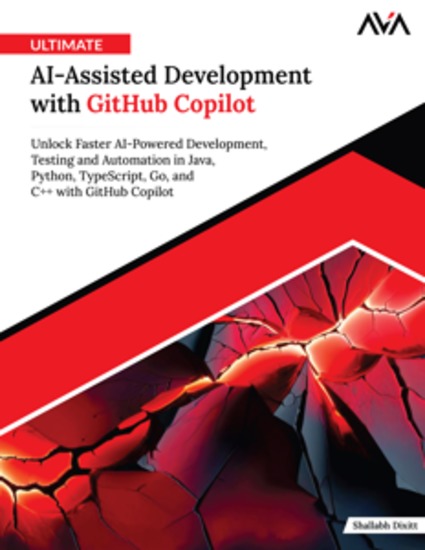
Ultimate AI-Assisted Development with GitHub Copilot - Unlock Faster AI-Powered Development Testing and Automation in Java Python TypeScript Go and C++ with GitHub Copilot - cover

Ultimate AI-Assisted Development with GitHub Copilot - Unlock Faster AI-Powered Development Testing and Automation in Java Python TypeScript Go and C++ with GitHub Copilot

Shallabh Dixitt

Casa editrice: Orange Education Pvt Ltd

  • 0
  • 0
  • 0

Sinossi

Code smarter, Test faster, and Build better with GitHub Copilot!Key Features● Master prompt engineering and multi-modal Copilot interactions.● Use GitHub Copilot for real coding, testing, and DevOps tasks.● Speed up development with AI-powered code and test generation.Book DescriptionAI-assisted coding is transforming how software is built—faster, smarter, and with fewer errors. GitHub Copilot leads this revolution by turning natural language into functional code, enabling developers to focus on solving problems rather than writing boilerplate.The Ultimate AI-Assisted Development with GitHub Copilot takes you step-by-step through mastering Copilot, starting with initial setup and basic use across multiple languages like Java, Python, TypeScript, Go, and C++. You’ll explore prompt engineering techniques to craft effective instructions, leverage multi-modal inputs to interact beyond text, and unlock advanced features like Vibe Coding and Agent Mode to create context-aware, intelligent workflows. The book also covers integrating Copilot into testing and debugging processes, automating repetitive tasks, and embedding AI-powered coding into CI/CD pipelines to streamline DevOps practices.Whether you're building APIs, automating tests, refactoring code, or optimizing release workflows, this book teaches you how to collaborate with AI—not just use it. Don't get left behind—unlock the full potential of GitHub Copilot and future-proof your skills today.What you will learn● Use GitHub Copilot effectively in Python, Java, Go, and C++.● Write smart prompts to guide Copilot across coding scenarios.● Build and debug applications using AI-generated code snippets.● Enhance test automation and integrate Copilot into CI/CD flows.● Leverage Agent Mode and Vibe Coding for intelligent automation.● Adapt Copilot for education, framework design, and DevOps tasks.Table of Contents1. The Rise of AI in Coding2. Getting Started with GitHub Copilot3. JavaScript/TypeScript with GitHub Copilot4. Python and AI-Assisted Coding5. Java with Copilot6. C/C++ with Copilot7. Go Programming with Copilot8. Pair Programming with Copilot9. Advanced Techniques with Copilot10. Testing and Debugging with Copilot11. Updating Workflows with GitHub Copilot12. Integrating Copilot with IDEs13. Best Practices and Limitations14. Copilot in Education15. Real-World Use Cases and Case Studies16. The Future of AI-Assisted Coding17. Recap of the Key Points       IndexAbout the AuthorsShallabh Dixitt is a passionate technology leader, AI testing strategist, and automation architect with over 17 years of experience at the intersection of quality engineering, intelligent automation, and next-gen AI-driven development. Known for blending deep technical expertise with pragmatic innovation, he has led transformative digital initiatives for Fortune 500 companies across finance, media, real estate, and enterprise technology.Shallabh began his career as a .NET developer in 2008, but his relentless curiosity for automation soon drew him into the world of testing and frameworks. From Selenium and Appium to designing modern, scalable solutions with Playwright, he has continually evolved with the industry. His hands-on mastery across Java, C#, TypeScript, Python, DevOps pipelines, and test orchestration has helped organizations deliver with greater speed, intelligence, and confidence.
Disponibile da: 11/08/2025.
Lunghezza di stampa: 590 pagine.

Altri libri che potrebbero interessarti

  • Slippery Beast - A True Crime Natural History with Eels - cover

    Slippery Beast - A True Crime...

    Ellen Ruppel Shell

    • 0
    • 0
    • 0
    What is it about eels? Depending on who you ask, they are a pest, a fascination, a threat, a pot of gold. Eels emerged some 200 million years ago, weathered mass extinctions and continental shifts, and were once among the world's most abundant freshwater fish. But since the 1970s, their numbers have plummeted. Because eels—as unagi—are another thing: delicious. 


    In Slippery Beast, journalist Ellen Ruppel Shell travels in the world of "eel people," pursuing a fascination with this mysterious creature. Despite centuries of study by thinkers from Aristotle to Leeuwenhoek to Sigmund Freud, much about eels remains unknown. Eels cannot be bred reliably in captivity and infant eels are unbelievably valuable. A pound of the tiny, translucent, bug-eyed "elvers" caught in the fresh waters of Maine can command $3,000 or more on the black market. Illegal trade in eels is an international scandal measured in billions of dollars every year. In Maine, federal investigators have risked their lives to bust poaching rings. 


    Ruppel Shell follows the elusive eel from Maine to the Sargasso Sea, stalking riversides, fishing holes, laboratories, restaurants, courtrooms, and America's first commercial eel "family farm." This is an enthralling, globe-spanning look at an animal that you may never come to love, but which will never fail to astonish you.
    Mostra libro
  • The Dark Energy Puzzle - Piecing Together the Forces of the Cosmos - cover

    The Dark Energy Puzzle - Piecing...

    Dirk Fallon

    • 0
    • 0
    • 0
    In the late 1990s, astronomers made a discovery that completely changed our understanding of the universe. While studying distant supernovae to measure how fast the universe was expanding, researchers expected to see signs that the expansion was slowing down due to gravity. Instead, they found the opposite—the expansion was speeding up. This unexpected observation pointed to something completely unknown, an unseen force that counteracts gravity and drives galaxies apart at an accelerating rate. That force was given the name "dark energy." 
    The term "dark" doesn't mean this energy is black or shadowy, but rather that it's unknown and mysterious. Scientists still don’t know what it really is, only that it seems to make up around 68 percent of the total energy in the universe. That’s a huge amount, especially considering that everything we can see—stars, planets, gas, dust—makes up less than 5 percent. The rest is made of dark matter, another unknown component, but dark energy is even more puzzling. It doesn’t clump like matter does, and it seems to be spread evenly through space. 
    Astronomers began piecing this together by observing Type Ia supernovae, which are exploding stars that always reach roughly the same brightness. Because of that consistency, they can be used like cosmic measuring sticks. When scientists looked at supernovae that were billions of light-years away, they saw that those objects were dimmer than expected. That meant they were farther away than predicted, and the only explanation was that the universe had expanded more than anyone thought. It wasn’t just expanding—it was accelerating.
    Mostra libro
  • Rare & Severe Infections - From the Uncommon to the Deadly (3 in 1) - cover

    Rare & Severe Infections - From...

    Lilly Richardsen

    • 0
    • 0
    • 0
    Uncommon infections represent the frontiers of medical challenge, where diagnostic complexity, rapid progression, and severe outcomes converge to create some of the most daunting scenarios in clinical medicine. This comprehensive exploration delves into three distinct yet equally consequential infections—Meningitis, Elephantiasis (Lymphatic Filariasis), and Legionella pneumophila infection—each exemplifying the remarkable diversity of microbial pathogenesis and the profound ways in which rare infections can transform human health and lives. 
    The narrative of rare and severe infections extends beyond their medical rarity; it encompasses the intricate biological mechanisms, unique transmission patterns, and complex clinical presentations that make these conditions simultaneously fascinating to researchers and devastating to patients. By examining the neurological inflammation of meningitis, the disfiguring lymphatic disruption of elephantiasis, and the respiratory assault of Legionella, this book illuminates how different pathogenic organisms exploit specific biological vulnerabilities to produce extraordinarily consequential diseases. Readers will journey through the epidemiological landscapes where these infections emerge—from the global burden of meningococcal disease to the tropical endemic regions of lymphatic filariasis and the modern built environments where Legionella thrives—while exploring the scientific advances in diagnosis, treatment, and prevention that offer hope against these formidable pathogens.
    Mostra libro
  • The Complete (Short) Guide to Absolutely Everything - Adventures in Math and Science - cover

    The Complete (Short) Guide to...

    Adam Rutherford, Hannah Fry

    • 0
    • 0
    • 0
    Despite our clever linguistic abilities, humans are spectacularly ill-equipped to comprehend what's happening in the universe. The Complete Guide to Absolutely Everything (Abridged) tells the story of how we came to suppress our monkey minds and perceive the true nature of reality. 


    Geneticist Adam Rutherford and mathematician Hannah Fry guide listeners through time and space, through our bodies and brains, showing how emotions shape our view of reality, how our minds tell us lies, and why a mostly bald and curious ape decided to begin poking at the fabric of the universe. 


    Rutherford and Fry shine as science sleuths, wrestling with some truly head-scratching questions: Where did time come from? Do we have free will? Does my dog love me? Hilarious sidebars present memorable scientific oddities: for example, hypnotized snails, human-sized ants, and the average time it takes most animals to evacuate their bladders. 


    Both rigorous and playful, The Complete Guide to Absolutely Everything (Abridged) is a celebration of the weirdness of the cosmos, the strangeness of humans, and the joys and follies of scientific discovery.
    Mostra libro
  • A Brief History of Timekeeping - The Science of Marking Time from Stonehenge to Atomic Clocks - cover

    A Brief History of Timekeeping -...

    Chad Orzel

    • 0
    • 0
    • 0
    Predating written language and marching on through human history, the desire for ever-better timekeeping has spurred technological innovation and sparked theories that radically reshaped our understanding of the universe and our place in it. 


    Chad Orzel, a physicist and bestselling author, continues his tradition of demystifying thorny scientific concepts by using the clocks and calendars central to our everyday activities as a jumping-off point to explore the science underlying the ways we keep track of our time. Ancient solstice markers depend on the basic astrophysics of our solar system; mechanical clocks owe their development to Newtonian physics; and the ultra-precise atomic timekeeping that enables GPS hinges on the predictable oddities of quantum mechanics. 


    Along the way, Orzel visits the delicate negotiations involved in Gregorian calendar reform, the intricate and entirely unique system employed by the Maya, and how the problem of synchronizing clocks at different locations ultimately required us to abandon the idea of time as an absolute and universal quantity. Sharp and engaging, A Brief History of Timekeeping is a story not just about the science of sundials, sandglasses, and mechanical clocks, but also the politics of calendars and time zones, the philosophy of measurement, and the nature of space and time itself.
    Mostra libro
  • The Human Gene Editing Debate - cover

    The Human Gene Editing Debate

    John H. Evans

    • 0
    • 0
    • 0
    In 2018 the first genetically modified babies were reportedly born in China, made possible by the invention of CRISPR technology in 2012. This controversial advancement overturned the pre-existing moral consensus, which had held for over fifty years before: while gene editing an adult person was morally acceptable, modifying babies, and thus subsequent generations, crossed a significant moral line. If this line is passed over, scientists will be left without an agreed-upon ethical limit. What do we do now? 


    John H. Evans here provides a meta-level guide to how these debates move forward and their significance to society. He explains how the bioethical debate has long been characterized as a slippery slope, with consensually ethical use at the top, nightmarish dystopia at the bottom, and specific agreed-upon limits in between, which draw the lines between the ethical and the unethical. Evans frames his analysis around these limits, or barriers. He examines the history of how barriers were placed, then fell, then replaced by new ones, and discusses how these insights inform where the debate may head. He evaluates other proposed barriers relevant to where we are now, projects that most of the barriers suggested by scientists and bioethicists will not hold, and cautiously identifies a few that could serve as the moral boundary for the next generation.
    Mostra libro