Join us on a literary world trip!
Add this book to bookshelf
Grey
Write a new comment Default profile 50px
Grey
Subscribe to read the full book or read the first pages for free!
All characters reduced
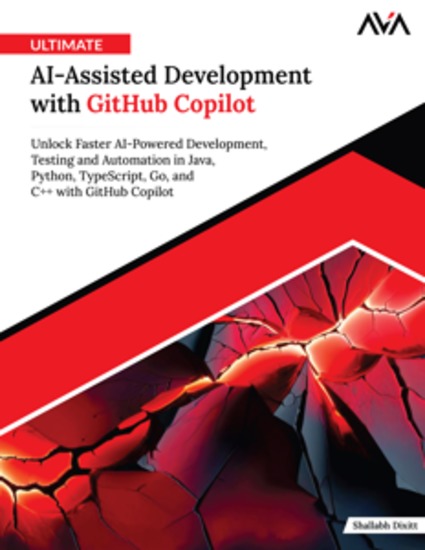
Ultimate AI-Assisted Development with GitHub Copilot - Unlock Faster AI-Powered Development Testing and Automation in Java Python TypeScript Go and C++ with GitHub Copilot - cover

Ultimate AI-Assisted Development with GitHub Copilot - Unlock Faster AI-Powered Development Testing and Automation in Java Python TypeScript Go and C++ with GitHub Copilot

Shallabh Dixitt

Publisher: Orange Education Pvt Ltd

  • 0
  • 0
  • 0

Summary

Code smarter, Test faster, and Build better with GitHub Copilot!Key Features● Master prompt engineering and multi-modal Copilot interactions.● Use GitHub Copilot for real coding, testing, and DevOps tasks.● Speed up development with AI-powered code and test generation.Book DescriptionAI-assisted coding is transforming how software is built—faster, smarter, and with fewer errors. GitHub Copilot leads this revolution by turning natural language into functional code, enabling developers to focus on solving problems rather than writing boilerplate.The Ultimate AI-Assisted Development with GitHub Copilot takes you step-by-step through mastering Copilot, starting with initial setup and basic use across multiple languages like Java, Python, TypeScript, Go, and C++. You’ll explore prompt engineering techniques to craft effective instructions, leverage multi-modal inputs to interact beyond text, and unlock advanced features like Vibe Coding and Agent Mode to create context-aware, intelligent workflows. The book also covers integrating Copilot into testing and debugging processes, automating repetitive tasks, and embedding AI-powered coding into CI/CD pipelines to streamline DevOps practices.Whether you're building APIs, automating tests, refactoring code, or optimizing release workflows, this book teaches you how to collaborate with AI—not just use it. Don't get left behind—unlock the full potential of GitHub Copilot and future-proof your skills today.What you will learn● Use GitHub Copilot effectively in Python, Java, Go, and C++.● Write smart prompts to guide Copilot across coding scenarios.● Build and debug applications using AI-generated code snippets.● Enhance test automation and integrate Copilot into CI/CD flows.● Leverage Agent Mode and Vibe Coding for intelligent automation.● Adapt Copilot for education, framework design, and DevOps tasks.Table of Contents1. The Rise of AI in Coding2. Getting Started with GitHub Copilot3. JavaScript/TypeScript with GitHub Copilot4. Python and AI-Assisted Coding5. Java with Copilot6. C/C++ with Copilot7. Go Programming with Copilot8. Pair Programming with Copilot9. Advanced Techniques with Copilot10. Testing and Debugging with Copilot11. Updating Workflows with GitHub Copilot12. Integrating Copilot with IDEs13. Best Practices and Limitations14. Copilot in Education15. Real-World Use Cases and Case Studies16. The Future of AI-Assisted Coding17. Recap of the Key Points       IndexAbout the AuthorsShallabh Dixitt is a passionate technology leader, AI testing strategist, and automation architect with over 17 years of experience at the intersection of quality engineering, intelligent automation, and next-gen AI-driven development. Known for blending deep technical expertise with pragmatic innovation, he has led transformative digital initiatives for Fortune 500 companies across finance, media, real estate, and enterprise technology.Shallabh began his career as a .NET developer in 2008, but his relentless curiosity for automation soon drew him into the world of testing and frameworks. From Selenium and Appium to designing modern, scalable solutions with Playwright, he has continually evolved with the industry. His hands-on mastery across Java, C#, TypeScript, Python, DevOps pipelines, and test orchestration has helped organizations deliver with greater speed, intelligence, and confidence.
Available since: 08/11/2025.
Print length: 590 pages.


Other books that might interest you

  • Ancient Lights - cover

    Ancient Lights

    Algernon Blackwood

    • 0
    • 0
    • 0
    "Ancient Lights," written by Algernon Blackwood in 1912 and published two years later, is the tale of a man hired to remove a standing grove of trees so the owner's house can maintain the direct light and view that it has enjoyed for a number of years.
    Show book
  • Mining - A Very Short Introduction - cover

    Mining - A Very Short Introduction

    Hannah S.R. Hughes, Karen A....

    • 0
    • 0
    • 0
    'If it can't be grown, it must be mined.' This fundamental truth underscores the global need for mining, and the reason why it has been carried out since prehistoric times. To supply the raw materials for buildings, industrial goods, vehicles, technology, and even art, minerals and rock must be removed from the Earth. 'Mining' describes this removal, but also covers the ore deposit exploration, developments of ore deposit models (geological, engineering and mineral economics-focused) and post-removal processing to extract the economically valuable materials, environmental protection, and social and corporate responsibility, in a construct known as the 'Mining Value Chain.' Mining continues to evolve due to the new emphasis on extracting a wider range of materials than ever before for green technologies, on using novel robotic and earth observation technology in exploration and mining, and on integrating environmental and social protection measures throughout the Mining Value Chain. Today's paradigms are 'sustainable' and 'responsible mining', mining that is profitable but protects the environment, human rights, and health. Mining: A Very Short Introduction covers this information and looks to the future to see where mining ideally will go.
    Show book
  • On the Origin of Species - cover

    On the Origin of Species

    Charles Darwin

    • 0
    • 0
    • 0
    Charles Darwin's seminal work published in 1859, presents the theory of evolution through natural selection. The book outlines how species change over time, with variations in physical and behavioral characteristics allowing organisms better suited to their environment to survive and reproduce, passing on favorable traits to future generations. Darwin cites evidence from his observations, experiments, and research, including on his voyage aboard the HMS Beagle, to argue that all life shares a common ancestor and that the diversity of species arises through this process of gradual evolution, rather than through special creation as widely believed at the time. The book challenged prevailing religious and scientific views, sparking intense debate, but Darwin's theory of natural selection has since become the foundation of modern evolutionary biology.
    Show book
  • Remote Work Revolution - Succeeding from Anywhere - cover

    Remote Work Revolution -...

    Anonymous

    • 0
    • 0
    • 0
    “I often talk about the importance of trust when it comes to work: the trust of your employees and building trust with your customers. This book provides a blueprint for how to build and maintain that trust and connection in a digital environment.” —Eric S. Yuan, founder and CEO of Zoom 
    A Harvard Business School professor and leading expert in virtual and global work provides remote workers and leaders with the best practices necessary to perform at the highest levels in their organizations.    
     
    The rapid and unprecedented changes brought on by Covid-19 have accelerated the transition to remote working, requiring the wholesale migration of nearly entire companies to virtual work in just weeks, leaving managers and employees scrambling to adjust. This massive transition has forced companies to rapidly advance their digital footprint, using cloud, storage, cybersecurity, and device tools to accommodate their new remote workforce. 
    Experiencing the benefits of remote working—including nonexistent commute times, lower operational costs, and a larger pool of global job applicants—many companies, including Twitter and Google, plan to permanently incorporate remote days or give employees the option to work from home full-time. But virtual work has it challenges. Employees feel lost, isolated, out of sync, and out of sight. They want to know how to build trust, maintain connections without in-person interactions, and a proper work/life balance. Managers want to know how to lead virtually, how to keep their teams motivated, what digital tools they’ll need, and how to keep employees productive. 
    Providing compelling, evidence-based answers to these and other pressing issues, Remote Work Revolution is essential for navigating the enduring challenges teams and managers face. Filled with specific actionable steps and interactive tools, this timely book will help team members deliver results previously out of reach. Following Neeley’s advice, employees will be able to break through routine norms to successfully use remote work to benefit themselves, their groups, and ultimately their organizations. 
    Supplemental enhancement PDF accompanies the audiobook.
    Show book
  • Embryology - From Conception to Birth The Science of Development - cover

    Embryology - From Conception to...

    Mike Crawford

    • 0
    • 0
    • 0
    The process of human conception is an extraordinary biological event that marks the beginning of life. It is a highly coordinated sequence of events that begins with the formation of gametes—sperm and egg—culminating in fertilization and the establishment of a genetically unique individual. This miraculous process is governed by intricate molecular mechanisms that ensure the successful transmission of genetic information from one generation to the next. 
    Gametogenesis, the formation of sperm and egg cells, is the first essential step in conception. In males, this process, known as spermatogenesis, occurs in the testes and results in the production of millions of motile sperm cells. In females, oogenesis takes place within the ovaries, producing a limited number of mature eggs, typically one per menstrual cycle. Unlike sperm, which are continuously produced throughout a man’s life, a female is born with all the eggs she will ever have, and they gradually diminish in number over time. These gametes contain half the genetic material necessary for human life, ensuring that when they unite, the resulting zygote inherits a complete set of chromosomes.
    Show book
  • The Indianapolis - The Worst Recorded Shark Attack Massacre in History - cover

    The Indianapolis - The Worst...

    Nova Ashford

    • 0
    • 0
    • 0
    The USS Indianapolis was a Portland-class heavy cruiser of the United States Navy, commissioned in 1932, and it played a vital role in the Pacific theater during World War II. Its most significant and tragic moment came in 1945, during its final mission. The ship was tasked with delivering critical components for the atomic bomb that would later be dropped on Hiroshima, Japan. This mission, which involved transporting the bomb's uranium core to the island of Tinian, was classified, and few knew about the importance of the cargo aboard the ship. 
    After successfully completing its mission and delivering the components to Tinian on July 26, 1945, the Indianapolis set sail for the Philippines, where it would rendezvous with other ships in the Pacific fleet. The ship’s captain, Charles B. McVay III, had orders to take the cruiser directly to its next destination, avoiding the traditional convoy routes to reduce the risk of submarine attack. With the war nearing its end and Japan’s defeat imminent, the ship's journey seemed routine, and there was little concern about the potential dangers ahead. The USS Indianapolis was an experienced and battle-tested ship, having served in key naval engagements throughout the war, including the Battle of Leyte Gulf and the Battle of the Philippine Sea. 
    However, the absence of a convoy left the Indianapolis vulnerable. On the night of July 29, 1945, while traveling through the Philippine Sea, the ship was struck by two torpedoes fired by the Japanese submarine I-58. The attack tore through the hull, causing devastating damage. Within minutes, the ship began to sink, and the crew was thrown into chaos. Many of the crew members perished instantly, while others scrambled into the water, trying to escape the fiery wreckage of the ship. The survivors faced an unimaginable nightmare as they found themselves stranded in the open ocean, with little hope of immediate rescue.
    Show book