Unisciti a noi in un viaggio nel mondo dei libri!
Aggiungi questo libro allo scaffale
Grey
Scrivi un nuovo commento Default profile 50px
Grey
Iscriviti per leggere l'intero libro o leggi le prime pagine gratuitamente!
All characters reduced
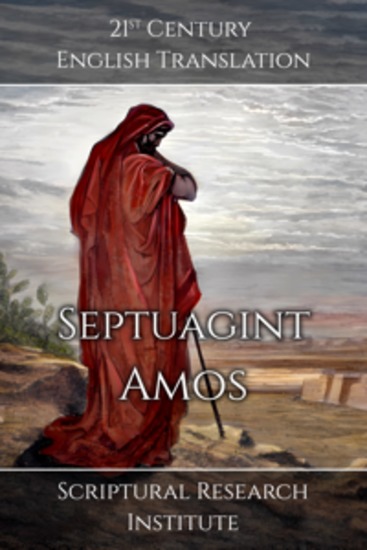
Septuagint - Amos - cover

Septuagint - Amos

Scriptural Research Institute

Casa editrice: Digital Ink Productions

  • 0
  • 0
  • 0

Sinossi

The Book of Amos is generally considered one of the older surviving books of the Israelite Scriptures, with most scholars dating it to before the Torah was compiled, or at least heavily redacted in the time of King Josiah. Most scholars accept that Amos was written by a prophet called Amos between 760 and 755 BC, who was most likely from the town of Tuqu, in the Kingdom of Judea, in the southern region of the modern Palestinian West Bank. His world was very different from the later Kingdom of Judea that emerged in the 2ⁿᵈ century BC, as the Israelites of his time were still polytheistic, worshiping the Canaanite gods, as well as statues of Yahweh, the God the Jews and Samaritans would later worship.While the Book of Amos  is accepted by many as dating to the 8ᵗʰ century BC, the oldest fragments of it to survive to the present are Hebrew fragments of the Sheneim Asar found among the Dead Sea Scrolls written in the Aramaic script, dating to the Hasmonean era, and fragments of the Dôdeka dating to the same era. The Dôdeka’s fragments are quite similar to the later copies of Amos in the Septuagint manuscripts, and the Hebrew fragments found within the Dead Sea Scrolls are generally the same as the Aleppo Codex’s Amos, which shows the surviving texts have been copied accurately since around 100 BC.In the Septuagint, Amos’ god was repeatedly called “God Omnipotent” in the Septuagint, which would have originally been “El Shaddai”. This god was one of the gods that the prophet Hosea, from the same era, was prophesying against. In addition to using the same term God Omnipotent, Hosea called El Shaddai, the Lord of Peor. Mount Peor was mentioned in the Torah’s Book of Numbers, as the home of a prophet called Balaam who was hired to curse the Israelites, but refused to, because his god refused to. It is a strange story, of a non-Israelite prophet, who was apparently a prophet of their God. This strange prophet is one of the few people in the Torah who has actually been proven to exist by archaeology.In 1967, an inscription now known as the Deir Alla Inscription (or KAI 312) was found during an excavation at Deir 'Alla, Jordan, which described Balaam as a prophet of the Elohim “Shaddayin,” accepted as the Moabite translation of “Shaddai.” The removal of the term “El Shaddai” makes sense in the late 2ⁿᵈ century BC, as it is stating that El Shaddai was not God, but one of the other gods that Hosea berated the Israelites for worshiping. As Hosea was prophesying in the name of El, meaning “god,” these two prophets appear to have been prophesying against each other’s gods, although Hosea’s main focus was Yhủh, the calf of Samaria, and only mentioned Lord El Shaddai in passing.The Book of Amos’ date of composition is one of the best documented of any ancient texts because he dated it himself to two years before “the earthquake.” The earthquake in question is known from the geological records as a major earthquake, believed to have been between 7.8 and 8.2 on the Richter scale, that struck Judea and Samaria during the lifetime of King Jeroboam II of Samaria. It is broadly dated to between 760 and 750 BC, and likely between 755 and 750 BC. The earthquake in question would have left major aftershock reoccurring for months, and is believed to have altered the landscape of the Dead Sea area.
Disponibile da: 11/04/2025.
Lunghezza di stampa: 71 pagine.

Altri libri che potrebbero interessarti

  • Lady Maybe - Revised 10th Anniversary Edition - cover

    Lady Maybe - Revised 10th...

    Julie Klassen

    • 1
    • 3
    • 0
    One final cry of terror, and suddenly her world shifted violently, until a blinding collision scattered her mind and shook her bones. Then, the pain. The freezing water. And as all sensation drifted away, a hand reached for hers before all faded into darkness. . . .  
     
    In the midst of a fierce storm, a carriage carrying Sir John Mayfield, Lady Marianna Mayfield, and her lady's companion careens off a narrow cliff road, changing their fates forever. When the wreckage is found, Sir John is gravely injured, and a woman is discovered unconscious wearing a valuable ring. As the woman regains consciousness in a strange house, she grapples with fragmented memories of the accident, unsettling dreams of a child in peril, and a deep mystery tied to the ring on her finger. Surrounded by unfamiliar faces and haunted by a sense of foreboding, the survivor realizes she cannot trust anyone and must uncover the truth of what happened that stormy night, even as danger mounts and enemies conspire against her.  
     
    In this revised and updated 10th anniversary edition of Julie Klassen's acclaimed novel, a woman's startling secrets lead her into unexpected danger and romance in Regency England. 
     
    Lady Maybe is a clean Regency romance full of mystery, adventure, and a search for identity. This novel will delight fans of the amnesia trope, Julia Quinn, Jane Austen, and Mimi Matthews.
    Mostra libro
  • Faithful Futures - Sacred Tools for Engaging Younger Generations - cover

    Faithful Futures - Sacred Tools...

    Josh Packard

    • 1
    • 1
    • 0
    Research-based strategies for Christian leaders to engage Gen Z and Gen Alpha 
     
    In a world where young people are increasingly disconnected from traditional religious institutions and influenced by social media, church leaders face an urgent challenge: how to authentically engage Gen Z and Gen Alpha in meaningful faith conversations. Faithful Futures offers a research-based lifeline with practical tools and strategies designed specifically for connecting with younger generations in today's rapidly changing cultural landscape. 
     
    This actionable resource provides church leaders with 
     
    ● research-based insights - fresh data on Gen Z and Gen Alpha faith patterns, digital behaviors, and cultural values; 
    ● practical ministry strategies - proven methods for building trust and fostering belonging; 
    ● digital-age tools - effective approaches for engaging youth who grew up online and think in micronarratives; 
    ● relationship-building frameworks - how to establish relational authority and create authentic connections with younger generations; and 
    ● ready-to-use resources - exercises, charts, tables, and discussion questions. 
     
    Traditional youth ministry approaches are often outdated and ineffective for digital natives who grew up online. Sociologist Josh Packard advocates a revolutionary approach that emphasizes relational authority, cultivates genuine belonging, and understands faith as an ongoing conversation rather than a one-time decision. 
     
    Drawing on fresh data, innovative practices, and more than twenty years of sociological experience, this comprehensive guide equips religious leaders to understand and engage younger generations authentically. It translates complex concepts into practical strategies, addressing the unique cultural and digital landscapes of today's youth and offering new ways to resonate with their realities. 
     
    Whether you're a senior pastor, youth minister, church staff member, or volunteer leader, this book provides the research-backed tools you need to build meaningful relationships with Gen Z and Gen Alpha.
    Mostra libro