Unisciti a noi in un viaggio nel mondo dei libri!
Aggiungi questo libro allo scaffale
Grey
Scrivi un nuovo commento Default profile 50px
Grey
Iscriviti per leggere l'intero libro o leggi le prime pagine gratuitamente!
All characters reduced
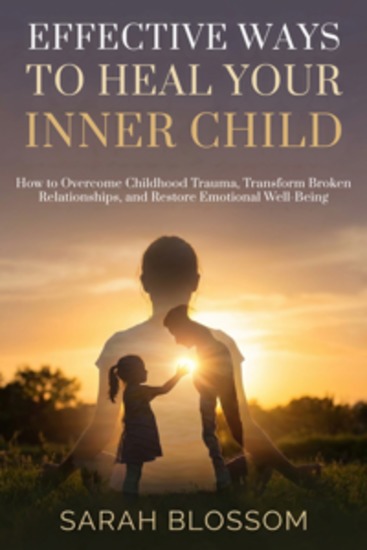
Effective Ways To Heal Your Inner Child - How to Overcome Childhood Trauma Transform Broken Relationships and Restore Emotional Well-Being - cover

Effective Ways To Heal Your Inner Child - How to Overcome Childhood Trauma Transform Broken Relationships and Restore Emotional Well-Being

Sarah Blossom

Casa editrice: BookRix

  • 0
  • 0
  • 0

Sinossi

Why do you keep choosing the wrong people? Why does success never feel like enough? Why can't you shake the anxiety, even when life is objectively good?The answer is simple, but painful: A wounded child is still running your adult life.You're 35 years old, sitting in a work meeting, but when your boss offers feedback, you're suddenly seven again—terrified, small, convinced you're about to lose everything. Your partner asks for space, and the panic that floods your body isn't about now—it's about the abandonment you felt at three years old when no one came when you cried.Your inner child never got what they needed. And they've been waiting ever since.The Trauma You Don't Call TraumaYou tell yourself, "I had a normal childhood." Nothing dramatic happened—no abuse, no addiction, no obvious neglect. But "normal" doesn't mean healthy. And the absence of overt trauma doesn't mean the absence of harm.This book is for you if:You struggle with relationships—choosing emotionally unavailable partners, people-pleasing until you're resentful, or sabotaging connection when it gets too closeYou're a perfectionist who can't tolerate mistakes, or you feel like an imposter no matter what you achieveYou experience anxiety, depression, or chronic physical tension that doctors can't fully explainYou don't trust yourself, don't know who you really are, or feel fundamentally "wrong" somehowYou've tried therapy, read the self-help books, practiced positive thinking—but lasting change remains elusiveThe problem isn't that you haven't tried hard enough. The problem is that no one taught you how to go back for the child you left behind.Inside, you'll discover:The 7 types of childhood emotional neglect that fly under the radar—and why "I had a good childhood" might be your first woundWhy you're attracted to people who hurt you—the neuroscience of trauma bonding and how to finally break the patternThe inner children living inside you at different developmental stages, each with specific needs you must meet to become wholeHow to release trauma stored in your body—breathwork, movement, and somatic techniques that talk therapy alone can't addressThe reparenting practices that give your inner child what they've been waiting for: safety, attunement, validation, and unconditional loveWhy forgiveness is optional—and how to heal completely whether you forgive your parents or notHow to build healthy relationships that don't repeat your past, even when your nervous system says healthy love feels "boring"The daily practices for reclaiming joy, play, and emotional freedom—because you didn't heal just to be "okay," you healed to be aliveWhat Makes This Book DifferentUnlike other inner child books that stay abstract and theoretical, Effective Ways To Heal Your Inner Child provides:Specific, actionable exercises you can do immediately—body scans, grounding techniques, reparenting dialogues, and grief ritualsReal-life examples showing exactly how childhood wounds show up in adult careers, friendships, parenting, and romantic relationshipsIntegration of multiple proven modalities—Internal Family Systems (IFS), Somatic Experiencing, polyvagal theory, and attachment scienceScripts and language for setting boundaries, communicating needs, and having difficult conversations with familyThe 4 pillars of effective reparenting that transform your relationship with yourself permanentlyGuidance on when to work with a professional versus when self-guided healing is appropriate—plus warning signs you're retraumatizing yourselfA complete three-phase framework: Awakening (understanding your wounds) → Deep Healing (grief, reparenting, somatic release) → Integration (living fully from your wholeness)Start your healing journey now.GRAB YOUR COPY of Effective Ways To Heal Your Inner Child and discover the step-by-step path to overcoming childhood trauma, transforming your relationships, and finally living with emotional freedom.
Disponibile da: 07/02/2026.
Lunghezza di stampa: 191 pagine.

Altri libri che potrebbero interessarti

  • Transcendentalism and the Cultivation of the Soul - cover

    Transcendentalism and the...

    Barry M. Andrews

    • 0
    • 0
    • 0
    A study of the spiritual practices developed by the nineteenth-century American Transcendentalist movement and a case for their necessity today. 


    "The stern old faiths have all pulverized," Ralph Waldo Emerson wrote in 1860. "'Tis a whole population of gentlemen and ladies out in search of religions." Often seen as a mainspring of the nineteenth-century literary tradition and the preserve of New England intellectuals in retreat from society, American Transcendentalism is more accurately described as a religious movement. In Transcendentalism and the Cultivation of the Soul, Barry M. Andrews shows how Transcendentalists developed rich spiritual practices, nurtured their souls, and discovered the divine. The practices they adopted are common and simple—among them, keeping journals, contemplation, walking, reading, simple living, and conversation. As Emerson, Thoreau, Fuller, and others pursued meaningful and rewarding spiritual lives, they were inspired to fight for abolition, women's rights, and education reform. In approachable and accessible prose, Andrews uncovers a wealth of spiritual practices that are of particular value for today's spiritual seekers and religious liberals.
    Mostra libro
  • Gladiators and Games - The Spectacles of Rome - cover

    Gladiators and Games - The...

    Rogan Fish

    • 0
    • 0
    • 0
    The origins of gladiatorial games can be traced back to the ancient Roman Republic, although their roots extend even further back into earlier civilizations. While the gladiatorial contests that are iconic today were popularized by the Romans, the initial concept of such games was deeply influenced by traditions and customs from earlier societies, especially the Etruscans. In fact, the Etruscans are often credited with introducing the practice of gladiatorial combat to the Roman world. 
    The earliest gladiatorial contests were likely held as part of funeral rites. Roman aristocrats and leaders believed that these violent spectacles would honor the deceased and ensure their passage into the afterlife. These games, known as munera, were originally private events, organized by wealthy individuals to display their power and wealth, while offering a form of public entertainment. The idea was that the bloodshed and valor shown by the fighters would symbolize a tribute to the dead and possibly even appease the spirits of the departed. The number of gladiators involved in these early contests was small, and the fights were often staged in temporary arenas. 
    The practice gradually evolved from being a private funeral tradition into a state-sponsored spectacle, especially during the 3rd century BCE, as the Republic expanded and began to look for ways to solidify its control over its vast territories. The games became a tool of political propaganda, used by ambitious politicians and generals to gain favor with the masses. By the time of the Roman Empire, these gladiatorial contests had grown to monumental proportions, with arenas like the Colosseum hosting thousands of spectators.
    Mostra libro
  • Refreshed - Devotions For Your Time Away - cover

    Refreshed - Devotions For Your...

    John Hindley

    • 0
    • 0
    • 0
    Devotions for a vacation that’s refreshing in every way.Vacations often give us an opportunity to rest and reflect. However, when our normal routines and habits are suspended, it can be hard to spend time with God.These 30 devotions have been specifically designed to help you to rest in the Lord’s goodness and glory during your time away so that you can return home feeling refreshed spiritually as well as physically.Author John Hindley, who also wrote Serving without Sinking, says this:“I want to help you find rest, peace, joy, hope, and renewed zeal. We go away to be refreshed. Christ is the one who sets his Spirit in our hearts to cause streams of living water to well up within us and flow from us. Sometimes we rest away from Jesus, but how much better to rest with and in him? He is where our true refreshment is found.”You can pick and choose which devotions to read depending on the type of vacation you are on (for example, city break or beach) and there are optional family activities and questions linked to each devotion giving other family members an opportunity to reflect alongside you.
    Mostra libro
  • Learn Hungarian While Sleeping - Learn While Sleeping - cover

    Learn Hungarian While Sleeping -...

    Innovative Language Learning, ...

    • 0
    • 0
    • 0
    Can you learn while sleeping? Studies* say that… yes you can.


    Listening to a language while asleep can help supercharge your vocabulary.


    Learn Easily with the Power of Pleasant Repetition


    With the Learn Hungarian While Sleeping Audiobook, you’ll absorb over 430 Hungarian words and phrases effortlessly.


    You can use this Beginner-Level Audiobook to
     
    • Relax while listening to Hungarian phrases and translations
     
    • Relieve stress. Just listen in — No confusing grammar rules
     
    • Wind down before bed to help you fall asleep
     
    • And of course — learn words passively — in your sleep.


    How does it work? Just press play... and listen to the gentle voice of a native teacher.


    Our teacher repeats each word and phrase multiple times... so you’ll retain them better… whether you’re awake or in bed. For best results, listen while awake first. Then, listen while falling asleep.


    What Will You Learn? You’ll Master 430+ Beginner Words & Phrases Including
     
    • Basic Greetings
     
    • Numbers in Hungarian
     
    • Common Questions and Answers
     
    • Words for Introducing Yourself
     
    • Basic Verbs & Adjectives
     
    • And much more


    The Learn Hungarian While Sleeping Audiobook includes
     
    • 13 Beginner-Level Audio Lessons
     
    • 6+ Hours of Lessons in Total
     
    • Accompanying PDF eBook with all of the words, phrases and translations


    * Züst, Mark Alain et al. “Implicit Vocabulary Learning during Sleep is Bound to Slow-Wave Peaks.” Current Biology. October 21, 2019.


    Download the PDF and read along
    Mostra libro
  • Fighter Group - The 352nd "Blue-Nosed Bastards" in World War II - cover

    Fighter Group - The 352nd...

    Jay A Stout

    • 0
    • 0
    • 0
    From a historian, retired fighter pilot, and combat aviation specialist, “the finest book yet written about the air war over Europe during World War II.” (Air & Space, Smithsonian magazine ) As described by award-winning author Jay A. Stout, the 352nd Fighter Group was one of the Eighth Air Force's most successful fighter units and counted history's two top-scoring P-51 aces among its ranks.  This book—the most comprehensive work ever to cover the actions of a single USAAF fighter unit—details the air actions of not only the group's notable aces, but also the rank-and-file fliers who carried the bulk of the load.  It describes the 352nd’s activities from its formation at the close of 1942, its movement to England and its combat operations flying P-47s and P-51s against the Third Reich. Although the book covers the units actions as a whole, it also follows several pilots in detail.  Rich descriptions of tactics and equipment, personal reflections, letters home, amusing anecdotes and, of course, detailed descriptions of air combat.  Not simply an award-winning historian, Stout draws from his own combat experience as a fighter pilot to make these discussions credible, interesting and real.  Winner of the San Diego Book Award for History. “Stout’s crisp, concise writing powers a narrative that highlights a collection of aviators who destroyed more than 700 German aircraft. The book is certain to take its place with other memorable accounts of European combat.” —John F. Wukovits, author of Black Sheep
    Mostra libro
  • Chasing Bandits in the Badlands - cover

    Chasing Bandits in the Badlands

    Bob Breen

    • 0
    • 0
    • 0
    In January 1993, the Australian government sent just under one thousand young men and women to serve under American command in a violent, impoverished, starving society. Most males over the age of twelve either carried or had access to a gun, and most Somali men had been fighting a vicious civil war for years. 
    Australian soldiers and their teams had to gain control of the streets of Baidoa and surrounding towns. This contest was not ‘find, fight and kill’ warfare. There was no decisive victory or defeat. The aim was to detect ‘the bad boys’ and deter and de-escalate their violence rather than escalate hostilities to success through ‘body count’. This mode of operation was not community policing by soldiers either. It involved adjusting attitudes forcefully and assuring uncomfortable consequences for bad behaviour and ultimately lethal responses to armed challenges. 
     
    The world looked over their shoulders. Corporals and diggers had to make split-second decisions to open or hold fire. Holding fire when provoked by punks constituted disciplined professional performance. Opening fire before understanding the situation, especially against unarmed provocateurs, constituted unprofessional conduct and possible condemnation, even criminal charges. These young Australians carried the international reputation of Australia and its army on their shoulders. Their actions would either enhance that reputation or create controversy, negative publicity and, potentially, international embarrassment and condemnation. 
     
    After adjusting their own attitudes to balance aggression and compassion, fight leaders and their diggers forcefully adjusted Somali attitudes, secured a stalemate, and then took control for the time they were in Somalia Australian soldiers individually and collectively helped a traumatised society needing a ‘fair go’ and gave ordinary Somali men, women and children trying to survive a little bit of hope.
    Mostra libro