Unisciti a noi in un viaggio nel mondo dei libri!
Aggiungi questo libro allo scaffale
Grey
Scrivi un nuovo commento Default profile 50px
Grey
Iscriviti per leggere l'intero libro o leggi le prime pagine gratuitamente!
All characters reduced
The battle of the Swash and the capture of Canada - cover

The battle of the Swash and the capture of Canada

Samuel Barton

Casa editrice: Good Press

  • 0
  • 0
  • 0

Sinossi

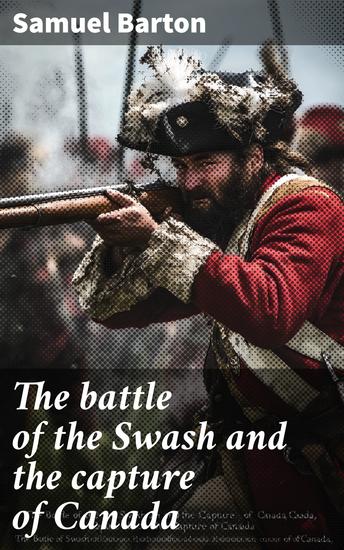
In "The Battle of the Swash and the Capture of Canada," Samuel Barton takes readers on a vivid journey through a tumultuous period in North American history. This historical novel interweaves rich narratives of bravery and conflict with a nuanced understanding of the political landscape of the time. Barton's striking blend of descriptive prose and dialogue evokes the harsh realities and camaraderie found among soldiers during the battle, while also exploring broader themes of loyalty and ambition within the colonial context. The deft use of vivid imagery and pacing captures the urgency and complexities of war, setting a compelling backdrop for the unfolding drama. Samuel Barton, a historian turned novelist, draws upon his extensive research and personal experiences in Canada to breathe life into this narrative. Having grown up surrounded by tales of early colonial struggles and the indomitable spirit of its people, Barton channels his passion for history into this work. His academic background informs his storytelling, allowing for an authentic representation of the era, crafted with both respect for historical accuracy and a flair for engaging fiction. For readers interested in historical fiction that resonates with themes of conflict and camaraderie, "The Battle of the Swash and the Capture of Canada" is a must-read. Barton's ability to intertwine fact with dramatic storytelling provides not just entertainment but also a deeper understanding of the sacrifices made during this pivotal moment in history. Immerse yourself in this gripping tale, and discover the enduring legacy of courage amidst chaos.
Disponibile da: 02/03/2025.
Lunghezza di stampa: 160 pagine.

Altri libri che potrebbero interessarti

  • Agents of Influence - Britain's Secret Intelligence War Against the IRA - cover

    Agents of Influence - Britain's...

    Aaron Edwards

    • 0
    • 0
    • 0
    Recruited by British Intelligence to infiltrate the IRA and Sinn Féin during the height of the Northern Ireland Troubles, they were ‘agents of influence’. With codenames like INFLICTION, STAKEKNIFE, 3007 and CAROL, these spies played a pivotal role in the fight against Irish republicanism. Now, for the first time, some of these agents have emerged from the shadows to tell their compelling stories. Agents of Influence takes you behind the scenes of the secret intelligence war which helped bring the IRA’s armed struggle to an end. 
     
    Historian Aaron Edwards, the critically acclaimed author of UVF: Behind the Mask, explains how the IRA was penetrated by British agents, with explosive new revelations about the hidden agendas of prominent republicans like Martin McGuinness and Freddie Scappaticci and lesser-known ones like Joe Haughey and John Joe Magee. Bringing to light recently declassified TOP SECRET documents and the firsthand testimonies of agents and their handlers, Edwards reveals how British Intelligence gained extraordinary access to the IRA’s inner circle and manipulated them into engaging with the peace process. 
     
    With new insights into the spy masters behind the scenes, their strategies and tactics, and Britain’s international intelligence network in Northern Ireland, Europe, and beyond, Agents of Influence offers a rare and shocking glimpse into the clandestine world of secret agents, British intelligence strategy and the betrayal at the heart of militant Irish republicanism during the vicious decades of the Troubles.
    Mostra libro
  • Yours Truly - An Obituary Writer's Guide to Telling Your Story - cover

    Yours Truly - An Obituary...

    James R. Hagerty

    • 0
    • 0
    • 0
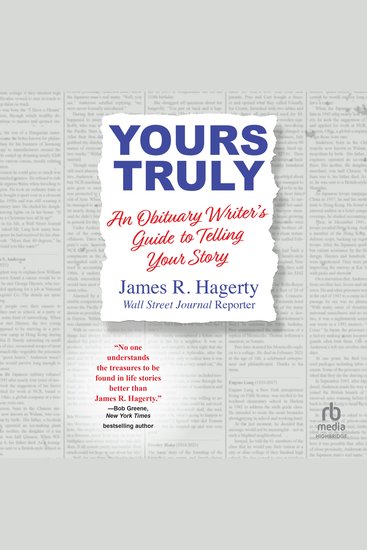
    Someday, your life story is likely to be boiled down to a few lines. If you leave things to chance, your obituary is almost sure to be solemn, formulaic, and full of errors—an obligatory final chapter written in haste by others. James R. Hagerty, longtime obit writer for The Wall Street Journal, knows how to get the job done right: Do it yourself, starting now, while you still can. 


    In this heartfelt and reassuring guide, Hagerty explains how to preserve your personal history—from crafting a brief obituary for newspapers and websites, to a more thoughtful and detailed mini-memoir for those close to you. Through his personal stories, on-the-job anecdotes, and insights, you will learn what to include, what to leave out, and how to provide historical context, record oral histories, and make the most of details, all with candor and wit. Best of all, you'll find that reviewing your life story helps you think about what you're doing with your time on Earth and whether you're on the right path. It isn't too late to improve the narrative with a stronger ending. 


    Telling your story your way can be the best gift you ever give to friends and loved ones—and yourself.
    Mostra libro
  • Captive Gods - Religion and the Rise of Social Science - cover

    Captive Gods - Religion and the...

    Kwame Anthony Appiah

    • 0
    • 0
    • 0
    Philosopher Kwame Anthony Appiah explores how early social scientists developed our modern understandings of society through their theories of religion The foundations of modern social science were built on the study of religion, the acclaimed thinker Kwame Anthony Appiah argues. Delving into the intellectual currents of the nineteenth and early twentieth centuries, he investigates how formative thinkers—notably Edward Burnett Tylor, Émile Durkheim, Georg Simmel, and Max Weber—grappled with the concepts of society and religion as interdependent categories. Appiah shows how their efforts to define religion, or evade the task, mark the power and limitations of social thought in ways that persist among theorists today. Religion was not an object of study but a framework through which early social scientists established sociology as a discipline. Appiah also examines recent work in both interpretive sociology and evolutionary and cognitive psychology about the mechanisms through which communities form beliefs and values—while underscoring the enduring significance of these earlier debates for contemporary social thought. Throughout, he intertwines storytelling, historical analysis, and philosophical reflection to show how our ideas about society and culture have been, and continue to be, forged in dialogue with religious questions.
    Mostra libro
  • Beyond Quantity - Research with Subsymbolic AI - cover

    Beyond Quantity - Research with...

    Jens Schröter, Andreas Sudmann,...

    • 0
    • 0
    • 0
    How do artificial neural networks and other forms of artificial intelligence interfere with methods and practices in the sciences? Which interdisciplinary epistemological challenges arise when we think about the use of AI beyond its dependency on big data? Not only the natural sciences, but also the social sciences and the humanities seem to be increasingly affected by current approaches of subsymbolic AI, which master problems of quality (fuzziness, uncertainty) in a hitherto unknown way. But what are the conditions, implications, and effects of these (potential) epistemic transformations and how must research on AI be configured to address them adequately?
    Mostra libro
  • Determinism - Fate Coincidence and the Question of Free Will - cover

    Determinism - Fate Coincidence...

    Hector Davidson

    • 0
    • 0
    • 0
    The question of whether humans possess free will has intrigued philosophers, scientists, and thinkers for centuries. At the heart of this debate lies the concept of determinism—the idea that every event or action is the result of preceding causes, governed by laws of nature and logic. If everything that happens is the result of a cause, can we truly say we have control over our decisions? Is free will simply an illusion? These questions challenge our sense of autonomy and personal responsibility, and they invite us to explore the complex relationship between fate, coincidence, and choice. 
    Determinism suggests that all events, including human actions, are preordained by prior causes. From a deterministic standpoint, the universe is a vast, interconnected web of cause and effect, where each moment flows seamlessly from the one before it. This view raises profound questions about the nature of human agency. If every decision we make, every thought we have, and every action we take is determined by a series of preceding events—genetic, environmental, and even cosmic—where does the space for free will lie? Are we merely puppets of fate, our strings pulled by forces beyond our control? 
    However, this deterministic view is not universally accepted. Many philosophers argue that humans can exercise free will—that we have the capacity to make choices independent of the deterministic forces at play. This belief in free will asserts that while factors such as genetics, upbringing, and circumstances may influence our decisions, we retain the ability to act in ways that transcend these influences. The challenge, then, is reconciling the possibility of free will with the idea that many of our actions may be shaped or even constrained by forces outside our conscious control.
    Mostra libro
  • Technological & Social Shifts - How Innovation and Culture Are Transforming Society (3 in 1) - cover

    Technological & Social Shifts -...

    Fredrich Hazelton

    • 0
    • 0
    • 0
    This book contains these titles: 
    - The Rise of Social Media: The rise of social media has reshaped the way people connect, communicate, and consume information. Over the past two decades, digital platforms have evolved from niche online communities to global networks that influence nearly every aspect of modern life. Social media is no longer just a tool for staying in touch with friends and family—it has become a powerful force in politics, business, entertainment, and culture. As the world becomes increasingly interconnected, understanding the impact of these platforms is essential.  
    - The Rise of Remote Work: The COVID-19 pandemic marked a turning point in how the world approaches work. Overnight, offices across the globe emptied as organizations scrambled to adapt to a new reality: remote work. What began as an emergency measure to ensure continuity during a global crisis evolved into a massive experiment that reshaped traditional workplace norms. For many, the home became an office, kitchen tables transformed into desks, and digital platforms like Zoom and Microsoft Teams replaced conference rooms.  
    - The Fall of the Berlin Wall: The Berlin Wall stands as one of the most defining symbols of the Cold War, a stark reminder of the ideological divide that shaped global politics in the second half of the 20th century. For nearly three decades, it separated families, friends, and a nation, embodying the tension between the communist East and the capitalist West. Its fall on November 9, 1989, marked the beginning of the end of the Cold War and set the stage for German reunification, forever altering the political landscape of Europe and the world. 
    Mostra libro