Begleiten Sie uns auf eine literarische Weltreise!
Buch zum Bücherregal hinzufügen
Grey
Einen neuen Kommentar schreiben Default profile 50px
Grey
Jetzt das ganze Buch im Abo oder die ersten Seiten gratis lesen!
All characters reduced
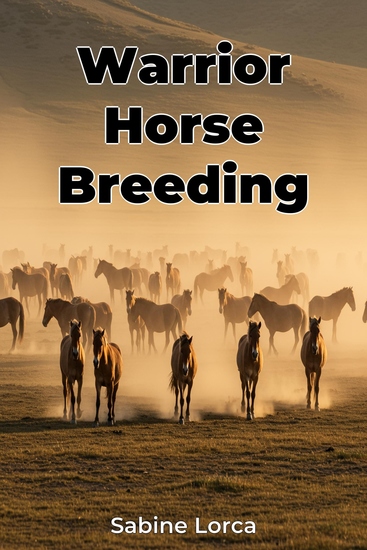
Warrior Horse Breeding - cover

Warrior Horse Breeding

Sabine Lorca

Übersetzer A AI

Verlag: Publifye

  • 0
  • 0
  • 0

Beschreibung

Warrior Horse Breeding explores the overlooked role of indigenous cultures in strategically breeding horses for military and logistical advantages. Challenging conventional narratives, the book argues that groups like the Comanches, Bedouin, and Mongols actively shaped equine genetics to enhance traits like speed and endurance, thereby impacting their political and economic power. For instance, selective breeding allowed some cultures to develop horses uniquely suited for warfare and long-distance travel, transforming their capabilities. 

 
The book systematically examines equine genetics, the historical impact of selective breeding on warfare and transportation, and specific methodologies employed by indigenous cultures. By analyzing archaeological findings, historical accounts, and genetic studies, the author demonstrates how specific traits were enhanced through selective breeding. 

 
Ultimately, Warrior Horse Breeding highlights the agency and ingenuity of indigenous peoples in shaping the animals that played a crucial role in their success, filling a gap in existing literature by placing indigenous knowledge at the center of the narrative. The book progresses by first introducing equine genetics, then moves to specific case studies of indigenous cultures and their breeding practices. It then explores the military advantages these horses conferred and concludes with the lasting implications on modern horse breeds and animal science. This approach allows for a comprehensive understanding of how indigenous knowledge shaped the evolution of horse breeds and influenced warfare and transportation throughout history.
Verfügbar seit: 29.03.2025.
Drucklänge: 60 Seiten.

Weitere Bücher, die Sie mögen werden

  • America’s Greatest Engineering Projects: The Construction History of the Transcontinental Railroad the Panama Canal and the Hoover Dam - cover

    America’s Greatest Engineering...

    Editors Charles River

    • 0
    • 0
    • 0
    The Transcontinental Railroad, laid across the United States during the 1860s, remains the very epitome of contradiction. On the one hand, it was a triumph of engineering skills over thousands of miles of rough terrain, but on the other hand, it drained the natural resources in those places nearly dry. It “civilized” the American West by making it easier for women and children to travel there, but it dispossessed Native American civilizations that had lived there for generations. It made the careers of many men and destroyed the lives from many others. It was bold and careless, ingenious and cruel, gentle and violent, and it enriched some and bankrupted others. In short, it was the best and worst of 19th century America in action. 
    Traveling around the tip of South America was fraught with danger, and European explorers and settlers had proposed building a canal in Panama or Nicaragua several centuries before the Panama Canal was actually built. Taking about 10 years to build, workers had to excavate millions of cubic yards of earth and fight off hordes of insects to make Roosevelt’s vision a reality. Roosevelt also had to tie up the U.S. Navy in a revolt in Colombia to ensure Panama could become independent and thus ensure America had control of the canal. 
    During the 1930s, at the height of the Great Depression, thousands of workers began work on the Hoover Dam, built in the Black Canyon, which had been cut by the powerful Colorado River. The Colorado River was responsible for the Grand Canyon, and by the 20th century, the idea of damming the river and creating an artificial lake was being explored for all of its potential, including hydroelectric power and irrigation. By the time the project was proposed in the 1920s, the contractors vowing to build it were facing the challenge of building the largest dam the world had ever known. As if that wasn’t enough, the landscape was completely unforgiving.
    Zum Buch
  • Done - A rich portrait of visual sound for those going through personal heartfelt change and psychological self help - cover

    Done - A rich portrait of visual...

    Alex Kashevaroff, Bethany Dalton

    • 0
    • 0
    • 0
    "Done." is a self help tool, led by a psychologist to complete something in your life like a divorce, a project, or making decisions and moving forward to completion. 
    Alex Kash is a healing musician, vocalist, songwriter, performer, music publisher and member of the consciousness movement. 
    Bethany Dalton is a leader in the consciousness movement, who was educated at the California Institute of Integral studies, the Hakomi Institute, Portland State University and more.
    Zum Buch
  • The Yankee Plague - Escaped Union Prisoners and the Collapse of the Confederacy - cover

    The Yankee Plague - Escaped...

    Lorien Foote

    • 0
    • 0
    • 0
    A rare and insightful account of the thousands of Union soldiers who escaped Confederate imprisonment and aided in the final dissolution of the Confederacy. 
    During the winter of 1864, more than three thousand Federal prisoners of war escaped from Confederate prison camps into South Carolina and North Carolina, often with the aid of local slaves. Their flight created, in the words of contemporary observers, a “Yankee plague,” heralding a grim end to the Confederate cause.  
     In this fascinating look at Union soldiers’ flights for freedom in the last months of the Civil War, Lorien Foote reveals new connections between the collapse of the Confederate prison system, the large-scale escape of Union soldiers, and the full unraveling of the Confederate States of America. By this point in the war, the Confederacy was reeling from prison overpopulation, a crumbling military, violence from internal enemies, and slavery’s breakdown. The fugitive Federals moving across the countryside in mass numbers, Foote argues, accelerated the collapse as slaves and deserters decided the presence of these men presented an opportune moment for escalated resistance. 
    Blending rich analysis with an engaging narrative, Foote uses these ragged Union escapees as a lens with which to assess the dying Confederate States, providing a new window into the South’s ultimate defeat.
    Zum Buch
  • Everything in Moderation: The must-read collection of columns from Sunday Times bestselling author Daniel Finkelstein - cover

    Everything in Moderation: The...

    Daniel Finkelstein

    • 0
    • 0
    • 0
    'I've never met Danny Finkelstein but I think I'm in love with him. His book is such good company – sane, intelligent and witty. He deals with serious subjects in an immensely readable way … If I'm asked to nominate my book of the year, this will be it' WENDY COPE 
    Writing on everything from a defence of suburban life and moderate politics to big ideas and pop culture, Daniel Finkelstein is one of the UK’s most entertaining and widely read columnists. 
    This collection brings together Finkelstein’s greatest writings from The Times, ranging from the personal – with his articles on growing up Jewish in Hendon Central and on the deaths of both of his parents – to the political, with columns on how to predict elections, the way political science showed us Ed Miliband was on his way to defeat, and why the base rate of coups meant Jeremy Corbyn wouldn’t be ousted before an election. 
    Wry, informed and often brilliantly funny, these pieces zip between Walt Disney, Hilary Clinton, David Bowie, Margaret Thatcher, Clement Attlee and Muhammed Ali. They make arguments about football, assisted dying, the art of becoming Prime Minister and the musical Hamilton. Cutting through the chatter to get to the centre of politics and culture, this varied and stimulating book gives an eclectic insight into the biggest conversations of the modern day. Everything is here. In moderation of course. 
    As a Sunday Times bestselling author, Finkelstein's collection of writings is a testament to his literary prowess and popularity. His autobiography-like pieces, filled with personal anecdotes and social commentary, are a must-read for anyone interested in the intersection of politics and culture. 
    For fans of Ariana Neumann (When Time Stopped), Jack Fairweather (The Prosecutor), Robert M. Edsel (Remember Us), Martin Amis (The War Against Cliche), and Tony Blair (A Journey).
    Zum Buch
  • The Visionary - cover

    The Visionary

    Emily Brontë

    • 0
    • 0
    • 0
    LibriVox volunteers bring you 18 recordings of "The Visionary" by Ellis Bell (Emily Brontë). This was the weekly poem for January 1, 2012. 
     
    The first 12 lines originally appeared in one of a large group of Gondal poems, the word coming from the name of a fictitious island kingdom in a fantasy created by Emily and her sister Anne. When Emily finally consented to have some of her poems published in 1846, along with those of sisters Charlotte and Anne, she selected parts of the Gondal poems and removed all reference to the fantasy land. However, this poem first appeared in a new, expanded edition of the sisters' poetry (in 1850, after both Emily and Anne had died) and was apparently derived as follows: 
     
    "The Visionary (October 9, 1845)This poem is part of the same Gondal poem from which Emily carved "The Prisoner. A Fragment." Charlotte Brontë took lines 1-12 of Emily's original poem, "Julian M. and A.G Rochelle," and added 8 lines of her own. Thus, the positive ending in which the watcher has a spiritual experience is Charlotte's and the watcher may be seen as Emily rather than a Gondal character. In Charlotte's version, it is hard to explain the guiding light in the window of stanze 2."(Source) 
     
    This account is fully supported by other sources. So the poem, as it was published in 1850, is a combination of work by Emily and Charlotte. Charlotte is accused by critics of using a heavy hand in editing some of Emily's formerly unpublished poems for the 1850 volume. (Introduction by Leonard Wilson)
    Zum Buch
  • Don't Panic Pivot! - How to Pivot Your Skills to Thrive During Layoffs and the AI Era - cover

    Don't Panic Pivot! - How to...

    Rhonda Scarbrough

    • 0
    • 0
    • 0
    This audiobook is narrated by an AI Voice.  
    Layoffs. AI disruption. Economic uncertainty. 
    If your career suddenly feels unstable, Don’t Panic, Pivot! delivers the clarity and confidence you need to move forward—without starting over. 
    This audiobook is a practical guide for professionals navigating career disruption in an AI-driven economy. Whether you’re facing a layoff, anticipating change, or questioning your long-term job security, this listen helps you regain control by showing you how to pivot your existing skills into new opportunities. 
    Drawing on real-world workforce transformation experience, Don’t Panic, Pivot! walks you through identifying transferable skills, spotting growth industries, and repositioning yourself strategically—rather than emotionally. You’ll learn how to quiet the panic, make confident decisions, and take decisive action even when the job market feels unpredictable. 
    This audiobook isn’t motivational fluff or vague advice. It’s a steady voice reminding you that career disruption doesn’t mean career failure—it means career redirection. 
    If you’re ready to stop spiraling, start thinking clearly, and move forward with purpose, this audiobook will meet you exactly where you are—and help you take your next step with confidence.
    Zum Buch