Join us on a literary world trip!
Add this book to bookshelf
Grey
Write a new comment Default profile 50px
Grey
Subscribe to read the full book or read the first pages for free!
All characters reduced
Guerrilla Tactics - cover

Guerrilla Tactics

Sabine Lorca

Translator A AI

Publisher: Publifye

  • 0
  • 0
  • 0

Summary

"Guerrilla Tactics" explores the world of unconventional warfare, examining how smaller, often outmatched groups have historically challenged and sometimes defeated larger, conventional forces. The book reveals how insurgent groups and resistance fighters utilize tactics like ambushes and sabotage, exploiting their adversaries' weaknesses through a deep understanding of local terrain and social networks. From ancient rebellions to modern insurgencies, the study of guerrilla warfare offers crucial insights into the dynamics of asymmetric warfare and the enduring power of adaptability. The book examines the historical evolution of guerrilla warfare, specific tactics employed, and the socio-political contexts that enable such conflicts. It argues that insurgent groups leverage local knowledge and political grievances to offset technological disadvantages. Structured in three parts, the book progresses from defining unconventional warfare and its history, to examining specific guerrilla tactics, and finally, exploring the strategic and political dimensions, including the roles of ideology, popular support, and external intervention. What sets this book apart is its comprehensive approach, combining historical analysis with strategic and political insights. This exploration goes beyond simple descriptions, delving into the underlying factors that contribute to the success or failure of insurgent movements. Military history enthusiasts and those interested in political science will find this approach unique and valuable for understanding the complexities of modern conflict and counterinsurgency strategies.
Available since: 03/29/2025.
Print length: 74 pages.

Other books that might interest you

  • Clausewitz - The Prussian General and Moral War Theorist - cover

    Clausewitz - The Prussian...

    Kelly Mass

    • 0
    • 0
    • 0
    Carl von Clausewitz, a Prussian general and military theorist, remains one of the most influential figures in the study of warfare. Born in 1780 in Prussia, Clausewitz entered the military at a young age, where he quickly distinguished himself as a talented strategist and thinker. His career spanned the Napoleonic Wars, where he gained practical experience in the field, as well as in the more reflective study of military theory. His best-known work, On War (Vom Kriege), has been regarded as a cornerstone of modern military thought, delving deeply into the nature of war, its relationship with politics, and the importance of understanding its unpredictable and often chaotic character. 
    Clausewitz’s career was marked by his involvement in some of the most significant military campaigns of his time, including those against Napoleon Bonaparte. His firsthand experiences with the brutality and unpredictability of warfare informed much of his thinking, and it is within this context that he formulated his theories about war. One of his most famous assertions, "War is merely the continuation of politics by other means," encapsulates his belief that military conflict is inherently connected to political objectives, and that military strategy cannot be understood in isolation from the larger goals of a nation.
    Show book
  • Can Religion Save Democracy? - How More Faith--Not Less--Can Heal Our Public Life - cover

    Can Religion Save Democracy? -...

    Matthew Kaemingk, Shadi Hamid

    • 0
    • 0
    • 0
    "Keep religion and politics separate!" For decades, scholars assumed that less religion would lead to a more peaceful and unified form of politics. And yet, as religious identity recedes from American public life, the opposite appears to be the case. Our post-religious politics are growing more polarized, anxious, and unstable each day. Could a return to ancient religious wisdom and community be the key to healing what secular politics can't fix? 
    In Can Religion Save Democracy? two friends and colleagues—a Christian theologian and a Muslim political scientist—make a bold case: If American democracy is going to survive, it will require more religion, not less. Drawing on wisdom from their respective religious traditions, they explorewhy secularism has only deepened our divides,what ancient insights from Christianity and Islam can strengthen our common life,how spiritual practices contribute something critical and irreplaceable to democracy, andhow citizens can navigate a new world of deep polarization and mistrust. 
     
    This is not a call for theocracy or religious authoritarianism. It's a hopeful, clear-eyed vision showing how religious faith offers vital tools to renew the soul of democracy in a divided nation.
    Show book
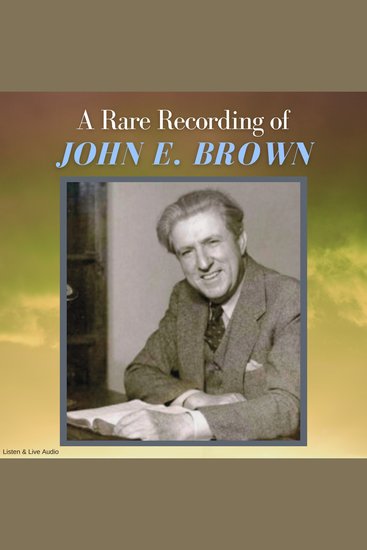
  • A Rare Recording of John E Brown - cover

    A Rare Recording of John E Brown

    John E. Brown

    • 0
    • 0
    • 0
    John E. Brown (April 2, 1879 – February 12, 1957) was a prominent Methodist evangelist, publisher, radio pioneer, and educator in the first half of the twentieth century. In 1919, he established John Brown University, one of Arkansas’ leading private universities to provide an interdenominational, Christian education for needy students. He was also the leading figure in securing passage of a law prohibiting the sale of alcohol in Benton County, a ban that continued into the twenty-first century.
    Show book
  • English History: 1000 Interesting Facts About England - cover

    English History: 1000...

    Ahoy Publications

    • 0
    • 0
    • 0
    Discover the fascinating story of England through 1000 Interesting Facts! 
    This audiobook takes you on an intriguing journey through time, from the Roman invasion to Brexit. Whether you're a history enthusiast or just curious about England's rich heritage, this comprehensive guide has something for everyone! 
    You'll explore:The captivating tales of Roman Britain and the struggles they facedThe epic Anglo-Saxon invasion and the impact on English cultureThe fearsome Vikings and their relentless raids on English soilThe influential Norman Conquest and the changes it broughtThe Plantagenet Dynasty and the challenges they faced during their reignThe bloody Wars of the Roses and the impact on English societyThe dramatic English Reformation and the birth of the Church of EnglandThe glorious Elizabethan Era and the rise of ShakespeareThe Age of Discovery and England's role in exploring the worldThe tumultuous English Civil War and the battle for powerThe transformative Industrial Revolution and its impact on societyThe inspiring fight against slavery and its eventual abolitionThe struggle for political reform and the fight for suffrageThe resilience of England during both World Wars and their aftermath 
    This audiobook is perfect for history buffs, students, or anyone who wants to expand their knowledge of England. Packed with fascinating facts, this comprehensive guide covers everything from battles and conquests to political movements and cultural milestones. You'll be amazed by the incredible stories and significant moments that make up England's rich and complex history. 
    Experience the vibrant history of England like never before. Click the "add to cart" button and embark on this thrilling adventure!
    Show book
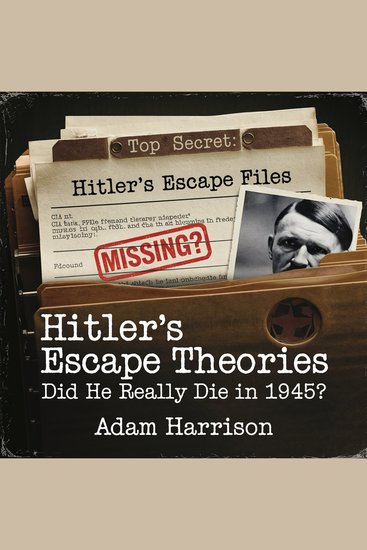
  • Hitler’s Escape Theories – Did He Really Die in 1945? - Declassified Files Eyewitness Testimonies and the Mystery of His Final Days - cover

    Hitler’s Escape Theories – Did...

    Adam Harrison

    • 0
    • 0
    • 0
    Did Adolf Hitler really die in his Berlin bunker in 1945, or did he escape under the cover of war? Over the years, declassified intelligence files, witness testimonies, and strange sightings have fueled one of history’s most debated conspiracy theories. 
    This audiobook dives deep into top-secret FBI and CIA documents, Nazi escape routes, and rumored hideouts in South America and beyond. Was there a secret Nazi base in Antarctica? Did high-ranking Nazi officials help Hitler flee? And why do some witnesses claim to have seen him alive decades after the war? 
    Hitler’s Escape Theories – Did He Really Die in 1945? is a must-listen for history buffs, conspiracy theorists, and anyone fascinated by the hidden side of World War II.
    Show book
  • Creating the KGB and CIA: The Establishment of the World’s Most Famous Intelligence Agencies - cover

    Creating the KGB and CIA: The...

    Editors Charles River

    • 0
    • 0
    • 0
    The KGB is one of the most famous abbreviations of the 20th century, and it has become synonymous with the shadowy and often violent actions of the Soviet Union’s secret police and internal security agencies. In fact, it is often used to refer to the Soviet state security agencies throughout its history, from the inception of the inception of the Cheka (Extraordinary Commission) in 1917 to the official elimination of the KGB in 1992. Whether it’s associated with the Russian Civil War’s excesses, Stalin’s purges, and even Vladimir Putin, the KGB has long been viewed as the West’s biggest bogeyman during the second half of the 20th century. However, the KGB did not appear out of thin air. Naturally, the earliest Soviet leaders utilized intelligence agencies that collected information both abroad and within the Soviet Union, targeting foreign opponents and domestic opponents alike. Lenin did not imagine the scale of the opposition he would have to face after the revolution, and he quickly came to the conclusion that "a special system of organized violence" must be created to implement the dictatorship of the proletariat. 
    Though it might be hard to believe, the Americans did not have a covert operations organization when they joined World War II, and like the British, it took them some time to realize it could be a powerful tool. As a result, the Office of Strategic Services (OSS) was not established until June 13, 1942, six months after the attack on Pearl Harbor. This would all chart a path for the early days of America’s most famous intelligence agency, the CIA. Although plagued by its own share of problems in its early existence during World War II and the early Cold War years, the agency’s early problems, smoothed over by a string of tenured presidents, paled in comparison to those it would face in the coming decades.
    Show book