Unisciti a noi in un viaggio nel mondo dei libri!
Aggiungi questo libro allo scaffale
Grey
Scrivi un nuovo commento Default profile 50px
Grey
Iscriviti per leggere l'intero libro o leggi le prime pagine gratuitamente!
All characters reduced
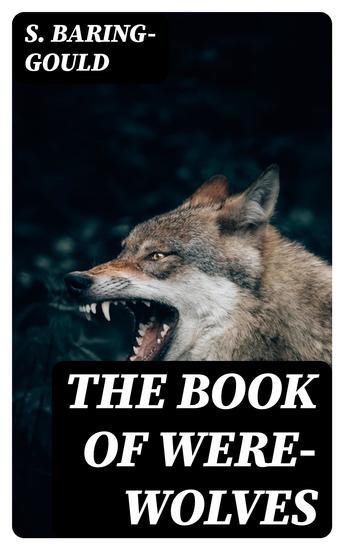
The Book of Were-Wolves - cover

The Book of Were-Wolves

S. Baring-Gould

Casa editrice: DigiCat

  • 0
  • 0
  • 0

Sinossi

S. Baring-Gould's "The Book of Were-Wolves" is a seminal text in the study of lycanthropy and its cultural manifestations, weaving together folklore, history, and acute psychological insight. Written in the late 19th century, the book is characterized by a meticulous blend of empirical research and captivating narrative style, reflecting the era's burgeoning interest in the paranormal as well as the romantic ideals of the Gothic. Baring-Gould examines a plethora of werewolf legends from various cultures, grounding supernatural lore in tangible reality and exploring the psychological implications of such transformations, thus enriching the literary context of horror and the uncanny that thrived during the Victorian period. S. Baring-Gould was not only a prolific writer but an astute scholar with a deep-seated fascination for mythology and folklore, having published extensively on various topics, including religious studies and local history. His diverse background and interests informed his examination of lycanthropy; witnessing the complexities of human nature and history led him to explore how mythologies evolve from societal fears and desires. Baring-Gould's insight into the human psyche, combined with his thorough research, allows readers to encounter werewolves not merely as monsters but as reflections of deeper truths. In "The Book of Were-Wolves," readers are invited to traverse the thin boundary between reality and myth. The book serves well both scholars of folklore and casual readers who crave a deeper understanding of the mythos surrounding werewolves. Baring-Gould's exploration will captivate anyone interested in the darker aspects of human nature and the lore that emerges from it, making this an essential read for those drawn to the enigmatic and the eerie.
Disponibile da: 16/09/2022.
Lunghezza di stampa: 136 pagine.

Altri libri che potrebbero interessarti

  • When the Last One Fell Silent - Stories of Extinct Creatures - cover

    When the Last One Fell Silent -...

    P Agrawal

    • 0
    • 0
    • 0
    This audiobook is narrated by an AI Voice.   
    When the Last One Fell Silent: Stories of Extinct Creatures is a haunting yet deeply human exploration of extinction—told not as dry statistics, but as a series of vivid portraits that bring lost creatures back to life through story, imagery, and reflection. From the island forests where dodos once waddled without fear, to the endless skies once blackened by passenger pigeons, to the misty rainforests where golden toads shimmered like jewels, each chapter of this book immerses readers in the world as it once was—and as it might never be again. 
    Extinction is as old as life itself, but in the last few centuries its rhythm has changed. Where once climate, asteroids, and ice shaped life and loss, today extinction bears the clear mark of one species—our own. This book moves tenderly through history, telling the stories of animals we have lost: the thylacine of Tasmania, hunted more by rumor than truth; the great auk and Steller’s sea cow, slaughtered out of utility and curiosity; the Pyrenean ibex, which briefly flickered back into life through cloning before disappearing again; the mammoths, whose heavy footfalls once trembled across frozen steppes; and the baiji dolphin, the gentle goddess of the Yangtze, drowned beneath the noise of factories and boats. 
    Each chapter does more than recount the facts of extinction. It lingers on the silences that follow. Silence of forests once filled with birds. Silence of oceans where seals no longer bark. Silence of mountains where goats no longer leap. Readers are invited not only to see the loss but to feel it—the grief of the final call, the heaviness of absence, the weight of knowing that these lives were here, and now they are not. 
    At the same time, When the Last One Fell Silent is not simply an elegy. It is also a mirror and a warning. Chapters on myths and legends show how humans carry the memory of vanished animals in stories of dragons, thunder birds, and mermaids.
    Mostra libro
  • A Classic Interview of Rock Musician Jimi Hendrix - cover

    A Classic Interview of Rock...

    Jimi Hendrix

    • 0
    • 0
    • 0
    James Marshall "Jimi" Hendrix (born Johnny Allen Hendrix; November 27, 1942 - September 18, 1970), born in Seattle, WA, was an American guitarist, songwriter and singer. Though his mainstream career spanned only four years, he is widely regarded as the greatest and one of the most influential electric guitarists in the history of popular music, and one of the most celebrated musicians of the 20th century. The following recording is from his final interview before his death in September 1970.
    Mostra libro
  • The 38 Billion Year Story of Life and Evolution - cover

    The 38 Billion Year Story of...

    Ylia Callan

    • 0
    • 0
    • 0
    This audiobook is narrated by an AI Voice.   
    The 3.8 Billion Year Story of Life and Evolution takes listeners on an awe-inspiring journey through the vast history of life on Earth. From the mysterious origins of the first microbes to the great evolutionary leaps that gave rise to complex organisms, this audiobook unfolds the sweeping saga of our planet’s living tapestry. 
    Discover the Oxygen Revolution that transformed the atmosphere, the icy grip of Snowball Earth, the explosive diversification of the Cambrian Period, and the rise and fall of mighty species through cataclysmic mass extinctions. Walk alongside the earliest land plants, giant insects of the Carboniferous swamps, colossal dinosaurs, and finally, the remarkable emergence of mammals and humans. 
    Written in a clear, engaging narrative style, this audiobook blends science and storytelling to reveal how life has endured, adapted, and flourished against unimaginable odds. Whether you are fascinated by biology, geology, or the human story itself, The 3.8 Billion Year Story of Life and Evolution offers a grand perspective on the interwoven forces that shaped every creature alive today - including us.
    Mostra libro
  • The Republic - cover

    The Republic

    Plato

    • 0
    • 0
    • 0
    The Republic (Greek: Politeia) is a Socratic dialogue, written by Plato around 380 BC, concerning the definition of (justice), the order and character of the just city-state and the just man, reason by which ancient readers used the name On Justice as an alternative title (not to be confused with the spurious dialogue also titled On Justice). The dramatic date of the dialogue has been much debated and though it must take place some time during the Peloponnesian War, "there would be jarring anachronisms if any of the candidate specific dates between 432 and 404 were assigned".    It is Plato's best-known work and has proven to be one of the most intellectually and historically influential works of philosophy and political theory. In it, Socrates along with various Athenians and foreigners discuss the meaning of justice and examine whether or not the just man is happier than the unjust man by considering a series of different cities coming into existence "in speech", culminating in a city (Kallipolis) ruled by philosopher-kings; and by examining the nature of existing regimes.    The participants also discuss the theory of forms, the immortality of the soul, and the roles of the philosopher and of poetry in society. Short Summary (Epilogue): X.1—X.8. 595a—608b. Rejection of Mimetic Art X.9—X.11. 608c—612a. Immortality of the Soul X.12. 612a—613e. Rewards of Justice in Life X.13—X.16. 613e—621d. Judgment of the Dead The paradigm of the city — the idea of the Good, the Agathon — has manifold historical embodiments, undertaken by those who have seen the Agathon, and are ordered via the vision. The centre piece of the Republic, Part II, nos. 2–3, discusses the rule of the philosopher, and the vision of the Agathon with the allegory of the cave, which is clarified in the theory of forms.    The centre piece is preceded and followed by the discussion of the means that will secure a well-ordered polis (City). Part II, no. 1, concerns marriage, the community of people and goods for the Guardians, and the restraints on warfare among the Hellenes. It describes a partially communistic polis. Part II, no. 4, deals with the philosophical education of the rulers who will preserve the order and character of the city-state. In Part II, the Embodiment of the Idea, is preceded by the establishment of the economic and social orders of a polis (Part I), followed by an analysis (Part III) of the decline the order must traverse. The three parts compose the main body of the dialogues, with their discussions of the "paradigm", its embodiment, its genesis, and its decline. The Introduction and the Conclusion are the frame for the body of the Republic.    The discussion of right order is occasioned by the questions: "Is Justice better than Injustice?" and "Will an Unjust man fare better than a Just man?" The introductory question is balanced by the concluding answer: "Justice is preferable to Injustice". In turn, the foregoing are framed with the Prologue (Book I) and the Epilogue (Book X). The prologue is a short dialogue about the common public doxai (opinions) about "Justice". Based upon faith, and not reason, the Epilogue describes the new arts and the immortality of the soul.
    Mostra libro
  • White Allies Matter - Conversations about Racism and How to Effect Meaningful Change - cover

    White Allies Matter -...

    Vanisha Parmar, Aseia Rafique

    • 0
    • 0
    • 0
    Why do organizations and individuals in the UK and other countries still deny the realities of structural racism and unconscious bias? And when there is an acknowledgement of the problem, why are long-term solutions constantly avoided?
    Mostra libro
  • Diversify - cover

    Diversify

    June Sarpong

    • 0
    • 0
    • 0
    ‘A handbook for these troubled times’ Psychologies Magazine 
    ’Engaging and informative … highlights our common humanity’ Kofi Annan 
    ‘A passionately written polemic’ You MagazineThe truth is, INCLUSION is better for EVERYONE. 
    In this empowering call to arms, June Sarpong MBE proves why. 
    Putting the spotlight on groups who are often marginalised in our society, including women, ethnic minorities, those living with disabilities, and the LGBTQ+ community, Diversify uncovers the hidden cost of exclusion and shows how a new approach to how we learn, live and do business can solve some of the most stubborn challenges we face. 
    With unshakeable case studies, brand-new research from Oxford University, and six revolutionary steps to help you overcome unconscious bias, this book will help you become part of a better society. 
    The old way isn’t working. This is a case for change. 
    In Diversify, June Sarpong delves into the heart of social and economic disparity, shedding light on the discrimination faced by minority classes. The book is a top pick for those interested in understanding the intersection of race, ethics, and public policy. 
    For fans of Mary Ann Sieghart (The Authority Gap), Steve Silberman (Skeleton Key), Reni Eddo-Lodge (Why I’m No Longer Talking to White People About Race), Laura Bates (Fix the System, Not the Women), and Darren Chetty (How to Disagree).
    Mostra libro