Unisciti a noi in un viaggio nel mondo dei libri!
Aggiungi questo libro allo scaffale
Grey
Scrivi un nuovo commento Default profile 50px
Grey
Iscriviti per leggere l'intero libro o leggi le prime pagine gratuitamente!
All characters reduced
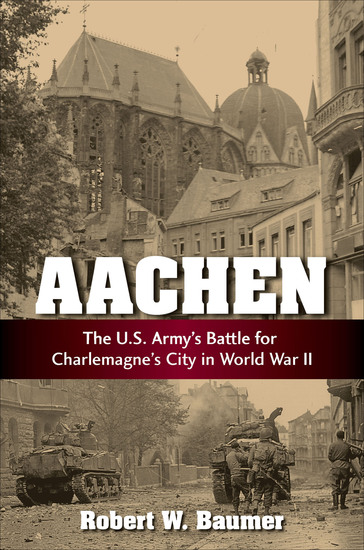
Aachen - The US Army's Battle for Charlemagne's City in World War II - cover

Aachen - The US Army's Battle for Charlemagne's City in World War II

Robert W Baumer

Casa editrice: Rowman & Littlefield Publishers

  • 0
  • 0
  • 0

Sinossi

“Outstanding. . . . details all of the horrific . . . 1944 battle fought by GIs to capture the first major German city in World War II's European Theater.” —Jerry D. Morelock, Armchair General magazine   By September 1944, the Allied advance across France and Belgium had turned into attrition along the German frontier. Standing between the Allies and the Third Reich's industrial heartland was the city of Aachen, once the ancient seat of Charlemagne's empire and now firmly entrenched within Germany's Siegfried Line fortifications. The city was on the verge of capitulating until Hitler forbade surrender. ·       Dramatic story of the American battle for Aachen, the first city on German soil to fall to the Allies in World War II. ·       Chronicles the six weeks of hard combat for the city, culminating in eight days of fighting in the streets ·       Details the involvement of some of the U.S. Army's finest units, including the 1st Infantry Division (“Big Red One”), the 30th Infantry Division (“Roosevelt’s SS”), and the 2nd Armored Division (“Hell on Wheels”)  
Disponibile da: 14/06/2023.
Lunghezza di stampa: 560 pagine.
Altri libri che potrebbero interessarti

  • The Lonely Voice - A Study of the Short Story - cover

    The Lonely Voice - A Study of...

    Frank O'Connor

    • 0
    • 0
    • 0
    Frank O'Connor was one of the twentieth century's greatest short story writers, and one of Ireland's greatest authors. Lilliput Press are now delighted to continue our publishing of O'Connor's writing by bringing his seminal work on the art of the short story back into print.   
    The Lonely Voice is the definitive work of Irish non-fiction on the art of writing short fiction, and has long been held up as one of the greatest works in global literature on the short form. We are delighted to bring The Lonely Voice back into print with a brand new introduction by Kevin Barry, internationally recognised as one of Ireland's greatests short story writers, whose work - like O'Connor's before him - appears frequently in the New Yorker. Barry engages and parrys with O'Connor's writing, bringing about a meeting of great Irish short story writers from the twentieth and twenty-first centuries, and bringing this foundational piece of Irish writing to a new generation.   
    The ideal companion to works such as George Saunders A Swim in a Pond in the Rain or John Yorke's Into the Woods: How Stories Work and Why we Tell Them.   
    Mostra libro
  • Value Price and Profit - cover

    Value Price and Profit

    Karl Marx

    • 0
    • 0
    • 0
    **Value, Price, and Profit** by Karl Marx is a seminal work that distills the core principles of Marxist economic theory into a concise and accessible format. Originally delivered as a speech to the General Council of the First International in 1865, the text examines the dynamics of labor, wages, and profit within a capitalist system. Marx explains how the value of commodities is rooted in the labor required for their production, and he critiques the mechanisms by which capitalists extract surplus value from workers to generate profit. In doing so, he challenges the notion that raising wages alone can resolve systemic inequality, emphasizing the structural exploitation inherent in capitalism. This work serves as both an introduction to Marx's economic ideas and a call to action for addressing labor exploitation and economic injustice.
    Mostra libro
  • Balancing Life: Work Family and Shaping Our Future - Master Balancing Life: Engage with dynamic audio lessons for peak work family and future planning! - cover

    Balancing Life: Work Family and...

    Ethan Voss

    • 0
    • 0
    • 0
    Balancing Life: Work, Family, and Shaping Our Future – Your Essential Journey to Harmony 
    Seeking to excel in your career while mastering the art of juggling work and family life?  
    Looking for a comprehensive resource that helps you seamlessly navigate these aspects and envision a brighter future? 
    Your journey ends here! 
    This guide is your ultimate companion for deepening your understanding, honing your skills, and engaging in practical exercises, equipping you for triumph in balancing life. 
    Updated for the latest insights in achieving life harmony. 
    Key features of this insightful guide: 
    - Profound reflections on balancing work, family, and future-shaping 
    - In-depth explanation of how to embrace balance and enrich every facet of life 
    - Effective strategies for preparation and tackling life challenges 
    Our guide stands out with its thorough coverage, which is crucial for your success in achieving balance. Concepts are not merely glossed over; they are explored with precision and depth. 
    Please note that this guide is an independent resource designed purely for your benefit and is not associated with any official entity. 
    Crafted with a clear structure and easy-to-understand language, our guide on balancing life ensures a seamless transition between topics. Say goodbye to complex jargon and embrace clear, precise, and accurate content. 
    Why wait? Click the BUY NOW button, get your guide, and embark on your path to balancing life successfully!
    Mostra libro
  • Secret Agenda - Watergate Deep Throat and the CIA - cover

    Secret Agenda - Watergate Deep...

    Jim Hougan

    • 0
    • 0
    • 0
    The exposé that reveals “a prostitution ring, heavy CIA involvement, spying on the White House as well as on the Democrats, and plots within plots” (The Washington Post) Ten years after the infamous Watergate scandal that brought down the Nixon presidency, Jim Hougan—then the Washington editor of Harper’s Magazine—set out to write a profile of Lou Russell, a boozy private-eye who plied his trade in the vice-driven underbelly of the nation’s capital. Hougan soon discovered that Russell was “the sixth man, the one who got away” when his boss, veteran CIA officer Jim McCord, led a break-in team into a trap at the Watergate. Using the Freedom of Information Act to win the release of the FBI’s Watergate investigation—some thirty-thousand pages of documents that neither the Washington Post nor the Senate had seen—Hougan refuted the orthodox narrative of the affair. Armed with evidence hidden from the public for more than a decade, Hougan proves that McCord deliberately sabotaged the June 17, 1972, burglary. None of the Democrats’ phones had been bugged, and the spy-team’s ostensible leader, Gordon Liddy, was himself a pawn—at once, guilty and oblivious. The power struggle that unfolded saw E. Howard Hunt and Jim McCord using the White House as a cover for an illicit domestic intelligence operation involving call-girls at the nearby Columbia Plaza Apartments. A New York Times Notable Book, Secret Agenda “present[s] some valuable new evidence and explored many murky corners of our recent past . . . The questions [Hougan] has posed here—and some he hasn’t—certainly deserve an answer” (The New York Times Book Review). Kirkus Reviews declared the book “a fascinating series of puzzles—with all the detective work laid out.”
    Mostra libro
  • The Last Best Hope - A History of American Realism - cover

    The Last Best Hope - A History...

    John Hulsman

    • 0
    • 0
    • 0
    In this brilliant exploration of American history and contemporary conservative politics, foreign policy expert John Hulsman draws on his years at the heart of Washington to present a compelling new vision of conservative realism. 
    In our current Age of Insecurity, Hulsman suggests, there has never been a bigger need for the re-ascendance of realist principles in conservative circles. By drawing on U.S. history to illustrate realist precepts at the heart of the American story, The Last Best Hope provides a practical, realist foreign policy for a new age of American politics. 
    There has never been a greater time to re-claim the primacy of conservative thought. By fusing the populist Jacksonian base of the GOP with the more libertarian Jeffersonian school of thought, this cogently argued manifesto hopes to grasp that opportunity, and to act as a clarion call for a new dominant realist foreign policy.
    Mostra libro
  • Phoenician Language and Writing: The History and Legacy of the Ancient World’s Most Influential Script - cover

    Phoenician Language and Writing:...

    Editors Charles River

    • 0
    • 0
    • 0
    There is no doubt that the alphabets and forms of writing employed by most European languages comes directly from the Phoenicians, but the process by which that took place is still a mystery. Some of the ancient historians provided theories concerning how the Phoenicians gave their alphabet and system of writing to the Greeks, and Herodotus offered an account that is probably more accurate than most. He claimed, “The Phoenicians who came with Cadmus – amongst whom were the Gephyraei – introduced into Greece, after their settlement in the country, a number of accomplishments, of which the most important was writing, an art till then, I think, unknown to the Greeks. At first, they used the same characters as all the other Phoenicians, but as time went on, and they changed their language, they also changed the shape of their letters. At that period most of the Greeks in the neighborhood were Ionians; they were also taught these letters by the Phoenicians and adopted them, with a few alterations, for their own use, continuing to refer to them as Phoenician characters – as was only right, as the Phoenicians had introduced them.”  
    Like many of Herodotus’ other passages in Histories, there is truth wrapped with some errors. The Greeks certainly knew of the concept of writing before the Phoenicians, as the Mycenaeans used the Linear B script, but that knowledge had vanished at the end of the Bronze Age (Morkot 1996, 18). Perhaps what makes Herodotus’ account accurate and most interesting is his description of how the writing evolved. He mentions how the Greeks “changed the shape of their letters”, which is the normal course when any group of people adopts a script to write their native language. For example, there are slight variations in the Latin script employed by most modern Western European languages, such as the umlauts in German or the various accents in French and Spanish.
    Mostra libro