

Unisciti a noi in un viaggio nel mondo dei libri!
Aggiungi questo libro allo scaffale
Grey
Scrivi un nuovo commento Default profile 50px
Grey
Iscriviti per leggere l'intero libro o leggi le prime pagine gratuitamente!
All characters reduced
AWS CDK Essentials - A Beginner's Guide to Infrastructure as Code - cover

AWS CDK Essentials - A Beginner's Guide to Infrastructure as Code

Robert Johnson

Casa editrice: HiTeX Press

  • 0
  • 0
  • 0

Sinossi

"AWS CDK Essentials: A Beginner's Guide to Infrastructure as Code" offers an authoritative introduction to the AWS Cloud Development Kit (CDK), a powerful tool that transforms cloud infrastructure management by enabling developers to define resources using familiar programming languages. Designed for beginners, this book elegantly bridges the gap between complex cloud architectures and accessible, programmatic infrastructure development. Through comprehensive chapters, readers will gain a foundational understanding of Infrastructure as Code and how AWS CDK simplifies and automates the provisioning and management process.The book delves into setting up the development environment, the intricacies of constructs, and best practices for building, deploying, and maintaining scalable AWS applications. Each chapter provides clear, detailed explanations complemented by real-world use cases, ensuring that readers not only understand the theoretical aspects but also gain practical insights into leveraging AWS CDK effectively. With additional focus on security, permissions, and troubleshooting, "AWS CDK Essentials" equips readers with the essential tools and strategies to confidently manage and optimize their cloud infrastructure, driving innovation within their organizations.
Disponibile da: 07/01/2025.
Lunghezza di stampa: 326 pagine.


Altri libri che potrebbero interessarti

  • William Stanek's The Living Zion Biography - Water Stone and a Sanctuary in the Desert - cover

    William Stanek's The Living Zion...

    The Editors of Our American...

    • 0
    • 0
    • 0
    Zion was made by water working against stone.
    
    Layer by layer, uplift raised the plateau and the river deepened its path. Cliffs emerged. Hanging gardens found water. Life occupied narrow bands between heat, flood, rock, and height. Human communities moved through and named a country later transformed by settlement, roads, tourism, and preservation.
    
    William Stanek's The Living Zion Biography tells that larger story.
    
    It follows sandstone and river, Indigenous homeland and changing names, sanctuary and development, access and danger, protection and the challenge of caring for a canyon loved by millions.
    
    Zion's walls appear immovable. Its biography reveals a place created through movement-and still being changed by water, gravity, climate, people, and time.
    Mostra libro
  • War in the Smartphone Age - Conflict Connectivity and the Crises at Our Fingertips - cover

    War in the Smartphone Age -...

    Matthew Ford

    • 0
    • 0
    • 0
    Thanks to smartphones, war is everywhere, all the time. Anyone can view, analyze, and comment on photos, videos, or other warzone media. Where did this technology come from? And what does it mean for the future of war?This book explains why you see what you do on your phone, and how these devices shape our knowledge, conduct, and representation of war in the 2020s. It shows why smartphones are indispensable in peace and wartime: every device is a potential weapon, lines blur between war and daily life, and conflict becomes a shared digital experience. Social media platforms displace state-controlled narratives, amplifying violence and shaping war's legitimacy. Apps democratize conflict, enabling anyone to identify and attack perceived enemies. As the Ukraine war has shown, this new reality involves complex, unevenly distributed infrastructures, merging civilian communication with military targeting.With war accelerating beyond our comprehension, militaries have raced to benefit from and adapt to the smartphone age. Matthew Ford explores critical questions about today's hyper-connected battlefield.
    Mostra libro
  • Southwest Foraging for Beginners - Unveiling Nature's Hidden Treasures – Your Essential Field Guide to Wild Edibles - cover

    Southwest Foraging for Beginners...

    Dion Rosser

    • 0
    • 0
    • 0
    Ready to Explore Nature's Gifts in the Southwest?
     
    Do you dream of gathering wild, edible plants and herbs right from nature?
     
    Ever wished you could identify plants easily and know just when they're best to pick?
     
    Looking for a simple guide that brings the world of Southwest foraging to life?
     
    If you're eager to discover edible and healing plants in the Southwest, Southwest Foraging for Beginners is your perfect guide. With over  80 images, simple steps, and a seasonal Foraging Calendar, this book makes it easy to enjoy nature's offerings confidently and responsibly.
    Inside, you'll discover:
    
    - Step-by-Step Basics:  Get started on your foraging journey, even if you're new to it all 
    - Identify and Harvest:  Learn to find local plants like prickly pear cactus and desert sage 
    - Seasonal Foraging Calendar:  Know exactly when each plant is ready to pick 
    - Wild Mushroom Guide:  Safely add mushrooms to your meals with clear instructions 
    - Easy, Delicious Recipes:  Enjoy tasty dishes made from your foraged finds 
    - Healing Properties of Plants:  Discover the natural benefits of native Southwest plants 
    
    Why This Book?
    With so much to explore, foraging in the Southwest can feel overwhelming. This guide gives you everything in one place—clear images, seasonal guidance, recipes, and helpful tips to make foraging easy and enjoyable. Don't let another season pass by without discovering the gifts of the Southwest!
     
    Start your adventure with Southwest Foraging for Beginners. Click "Add to Cart" and make the most of nature's amazing resources today! 
    Mostra libro
  • Hearing Happiness - Deafness Cures in History - cover

    Hearing Happiness - Deafness...

    Jaipreet Virdi

    • 0
    • 0
    • 0
    Weaving together lyrical history and personal memoir, Virdi powerfully examines society’s—and her own—perception of life as a deaf person in America. 
     
    At the age of four, Jaipreet Virdi’s world went silent. A severe case of meningitis left her alive but deaf, suddenly treated differently by everyone. Her deafness downplayed by society and doctors, she struggled to “pass” as hearing for most of her life. Countless cures, treatments, and technologies led to dead ends. Never quite deaf enough for the Deaf community or quite hearing enough for the “normal” majority, Virdi was stuck in aural limbo for years. It wasn’t until her thirties, exasperated by problems with new digital hearing aids, that she began to actively assert her deafness and reexamine society’s—and her own—perception of life as a deaf person in America. 
      
    Through lyrical history and personal memoir, Hearing Happiness raises pivotal questions about deafness in American society and the endless quest for a cure. Taking us from the 1860s up to the present, Virdi combs archives and museums in order to understand the long history of curious cures: ear trumpets, violet ray apparatuses, vibrating massagers, electrotherapy machines, airplane diving, bloodletting, skull hammering, and many more. Hundreds of procedures and products have promised grand miracles but always failed to deliver a universal cure—a harmful legacy that is still present in contemporary biomedicine. 
     
    Weaving Virdi’s own experiences together with her exploration into the fascinating history of deafness cures, Hearing Happiness is a powerful story that America needs to hear.
    Mostra libro
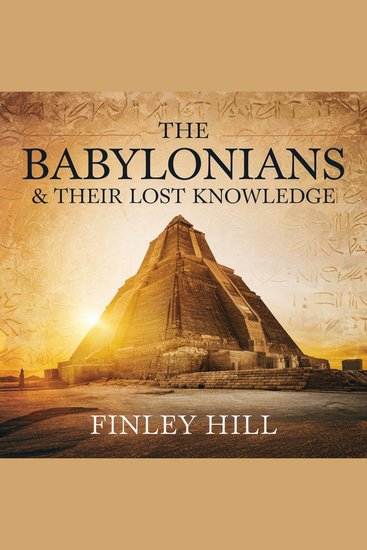
  • The Babylonians & Their Lost Knowledge - How One of the Oldest Civilizations Shaped Science Astronomy and Mathematics - cover

    The Babylonians & Their Lost...

    Finley Hill

    • 0
    • 0
    • 0
    The Babylonians—one of the most advanced civilizations of the ancient world—developed groundbreaking knowledge in astronomy, mathematics, and engineering. But much of their wisdom was lost to time. How did they predict eclipses? What secrets were hidden in their cuneiform tablets? 
    This audiobook explores the achievements, discoveries, and mysteries of the Babylonian civilization. From their sophisticated number system to their influence on modern science, uncover the forgotten knowledge that shaped history. 
    The Babylonians & Their Lost Knowledge is a must-listen for history lovers, archaeology enthusiasts, and those fascinated by ancient intelligence.
    Mostra libro
  • So What Does It All Mean? - The Secrets of Life: From Big Bang to Trump - cover

    So What Does It All Mean? - The...

    Ss O'Connor

    • 0
    • 0
    • 0
    Why are humans neither 'good' nor 'bad'? How can so much chaos and confusion in the world actually lead to order? Why are we so often wrong when we're asked if the world's getting better? In this, the last book in The Secrets of Life quartet, SS O'Connor pulls together the threads of genetic and cultural evolution, and then adds to these the conclusions of evolutionary game theory. As he does this, he ends with an intertwined narrative that explains why so many of the phenomena of our existence may not be the mysteries we think they are, but could in fact have the same underlying logic to them. By examining the great currents at work in our collective story, the role that competition and cooperation have always played in the development of the world, and why each behavioural strategy is rational in what it's attempting to achieve, the book shows that the same cycles of collaboration and destruction have been present since time began. But while the success of these strategies may ebb and flow, it is their interaction that results in the balance and order we see around us. This current is also the consistent vector of our human history. Although we may have animal origins, and are also driven by the same need to respond to the profound Laws of Thermodynamics, we have developed our culture to the point where we can now choose to overrule so many of the instructions of our genes. Why do we do this? What are the problems that arise from our free will? How have we come to realise that self-interest is quite different from selfishness? Why have we become obsessed with the need for fairness and trust in our societies? And how have these forces resulted in us making the world a better place? Few of us believe this can be the case. But as the evidence of our progress becomes ever clearer, the series concludes by showing us why we are often wrong in our view of each other, and why we're so frequently mistaken in our pessimism about the future.
    Mostra libro