Unisciti a noi in un viaggio nel mondo dei libri!
Aggiungi questo libro allo scaffale
Grey
Scrivi un nuovo commento Default profile 50px
Grey
Iscriviti per leggere l'intero libro o leggi le prime pagine gratuitamente!
All characters reduced
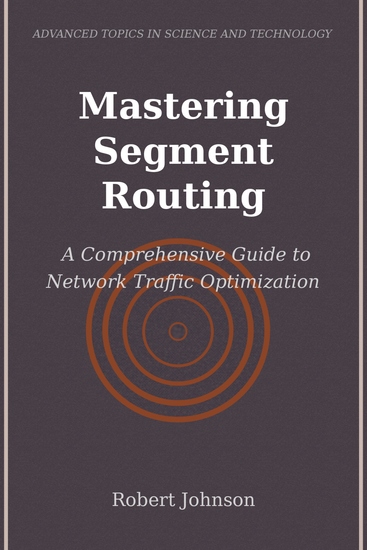
Mastering Segment Routing - A Comprehensive Guide to Network Traffic Optimization - cover

Mastering Segment Routing - A Comprehensive Guide to Network Traffic Optimization

Robert Johanson

Casa editrice: HiTeX Press

  • 0
  • 0
  • 0

Sinossi

"Mastering Segment Routing: A Comprehensive Guide to Network Traffic Optimization" is an essential resource for networking professionals and enthusiasts seeking to enhance their understanding and implementation of cutting-edge routing technologies. This book delves into the transformative potential of segment routing, offering a detailed examination of its architecture, key components, and integration within modern network infrastructures. Designed for both beginners and seasoned experts, it presents complex concepts in an accessible manner, ensuring readers grasp the fundamentals before progressing to advanced topics.The book covers a wide array of subjects, from the fundamentals of Internet Protocols and MPLS to the intricacies of traffic engineering, path computation, and network security in segment routing contexts. Each chapter is meticulously structured to build upon the previous, facilitating a comprehensive learning experience. With insights into deploying segment routing within IPv6 networks and its seamless integration with Software-Defined Networking (SDN), readers will be equipped with practical strategies for optimizing network performance and efficiency. This guide is an indispensable tool for anyone looking to excel in the field of network traffic management and segment routing.
Disponibile da: 31/01/2025.
Lunghezza di stampa: 304 pagine.

Altri libri che potrebbero interessarti

  • The Wingsnappers - Lessons from an Exuberant Tropical Bird - cover

    The Wingsnappers - Lessons from...

    Barney A. Schlinger

    • 0
    • 0
    • 0
    Birds, hormones, and extraordinary behavior: The story of the tiny but mighty golden-collared manakin of Panama 


    This book is the story of a remarkable bird, the golden-collared manakin (Manacus vitellinus) of Panama. Males of this species perform one of the most elaborate, physically complex, and noisy courtship displays of any animal on the planet. Barney A. Schlinger delves into the specialized neurons, muscles, bones, and hormonal systems underlying the manakin's unique courtship behavior, creating a rich life-history account that integrates field observations and evolutionary biology with behavioral ecology, anatomy, physiology, biomechanics, and general ornithology. 


    The personal lives of investigators and the natural history of the Panamanian rainforest provide context for this account of the bird's fascinating behavior. Schlinger clearly and approachably explains basic concepts in disciplines such as avian anatomy, endocrinology, sexual differentiation, and the neurobiology of song and aeroacoustics, offering listeners a window into the biology of this exuberant bird. 


    This enhanced audiobook edition includes two short clips of the bird sounds described in the book.
    Mostra libro
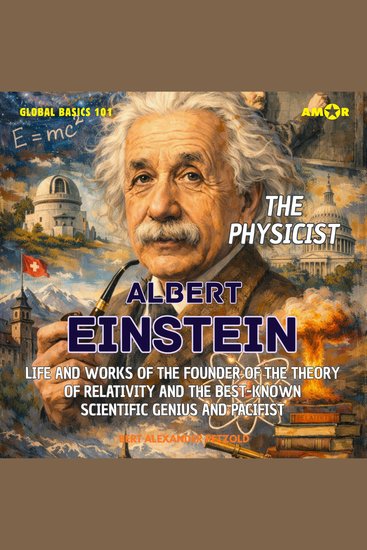
  • Physicist Albert Einstein The - Life and Works of the Founder of the Theory of Relativity and the Best-Known Scientific Genius and Pacifist - Global Basics 101 - Your Series for Modern Knowledge Folge 7 (unabridged) - cover

    Physicist Albert Einstein The -...

    Bert Alexander Petzold

    • 0
    • 0
    • 0
    Anyone who knows Albert Einstein only as a tousle haired face on a poster has seen only the surface. How could a physicist so fundamentally change the Newtonian view of the world that time and space suddenly became mobile and the twentieth century learned a new way of thinking. This non fiction book shows why Einstein, as the originator of the theory of relativity, became the very image of the scientist, the genius and the pacifist, and why his ideas still shape research, technology and everyday life.
    
    You follow a fact rich cultural journey through classroom, patent office, lecture hall and world politics, explained in a way that is accessible, entertaining and clearly structured. The text explains the major terms of theoretical physics without haze, relativity, spacetime, the speed of light, energy and mass, and at the same time introduces Einstein's contributions to quantum physics. In this way, knowledge takes shape that gives you confidence when it comes to placing modern natural science and understanding the impact of scientific revolutions, and it equips you with arguments for any discussion.
    
    Einstein grew up in Germany, sought his own path early on, and found in Switzerland the intellectual freedom he needed. After his studies and first posts, he ended up at the patent office in Bern, a seemingly unremarkable place that gave him time to think. This was the setting for the famous year 1905, in which he published several papers and opened new doors in physics, including on the nature of light, on the motion of the smallest particles, and on the relationship between energy and mass.
    
    In 1905 Einstein published the 'Special Theory of Relativity' and in doing so called the familiar order of time and motion into question. Out of this very radical thinking grew worldwide recognition. At the latest, when observations during a solar eclipse in 1919 made his predictions about the bending of light famous, he became an international icon. He gave lectures and worked within a network of scientists and research institutes that shaped the global scientific world. The book shows how this interconnectedness accelerated research and how Einstein's methods created a new language for physics.
    
    Even beyond the early breakthroughs, Einstein remained a driving force of progress. His contributions to quantum physics were extraordinary, and in 1922 he received the Nobel Prize. At the same time, his public weight grew because he never understood science as an isolated ivory tower, but as part of society, bound up with fears, ambitions and the values people want to stand for. This makes clear why he was not only a researcher, but also a voice of his time.
    
    When the National Socialists came to power in 1933, Einstein had to emigrate and went to the United States. From there, his political and social influence continued to grow. He became a prominent advocate of freedom of expression and peace between nations and vehemently opposed the use of atomic bombs. This non fiction book makes it tangible how a scientist took responsibility without betraying the core of his work, and why Einstein's name still stands for insight and conscience.
    
    The author of the book is Bert Alexander Petzold, and it is ideally suited to preparation for examinations leading to the higher education entrance qualification and for study at university.
    
    Secure this book and discover Albert Einstein as a person and thinker who pushed back the limits of what can be imagined. Anyone who wants not only to have heard of relativity and quantum physics, but to have understood them, will find clarity, context and a perspective that lasts.
    Mostra libro

  • Man In My Head Has Lost His Mind The (What Makes Us Conscious?) - A thought experiment exploring consciousness and free will identity and the moral self - cover

    Man In My Head Has Lost His Mind...

    Carter Blakelaw

    • 0
    • 0
    • 0
    The howl of the bedside clock-radio carves through your dreams like a buzz-saw through butter, and you are awake. In another place. 
    Never mind the bright yellow sunlight that flecks your pillow and warms your face; you are rudely awake, and resent it. Gah! 
    You roll onto your side, cantilever your legs over the side of the bed and plant your feet squarely on the carpet. You rub your face. Massage your neck. Oh, what it is to be alive!--and conscious--oh oh oh, indeed. 
    But what is it to be alive, and conscious? 
    Alive, we have some inkling of; you eat, you sleep, you exercise. You stay healthy and keep your body going as best you can. But conscious? What even is that? 
    A good question is what that is, and a question for which this book has an answer. 
    So in this text, first I set the scene:Did our consciousness evolve?Does consciousness give us free will?Which animals do we think are conscious?Where does consciousness go when we sleep?How does consciousness deliver meaning?What might a theory of consciousness look like? 
    Then I propose:A model for consciousness at the macro scaleA mechanism for consciousness at the micro scale 
    Finally, I suggest some real world tests that science will one day be able to perform which will either corroborate or invalidate the theory I present here. This is a workable, testable theory. Science and philosophy demand nothing less. 
    A must-listen for the curious-minded, which you are, are you not? So listen on...
    Mostra libro
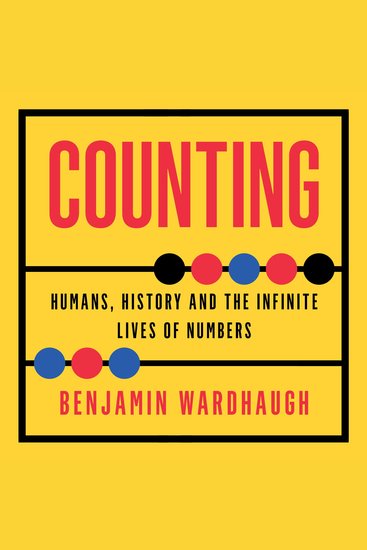
  • Counting: Humans History and the Infinite Lives of Numbers - cover

    Counting: Humans History and the...

    Benjamin Wardhaugh

    • 0
    • 0
    • 0
    SHORTLISTED FOR THE BRITISH SOCIETY FOR THE HISTORY OF SCIENCE PRIZE 2025 
    SHORTLISTED FOR THE NEUMANN PRIZE 2025 
    WHAT DOES IT MEAN TO COUNT? WHY ARE HUMANS THE ONLY SPECIES ON EARTH THAT CAN DO IT? WHERE DID COUNTING COME FROM? HOW HAS IT SHAPED SOCIETIES ALONG THE WAY? AND WHY DOES IT MATTER? 
    Counting is an innovative, erudite, world-wrapping journey through humanity’s marvellous ability to impose numbers on things. Acclaimed historian and mathematician Benjamin Wardhaugh draws on stories from the Stone Age to cyberspace in pursuit of the elusive, fascinating, endlessly diverse history of human counting. 
    Starting with the roots of counting in human brains, bodies and environments, Wardhaugh tours us around the world and through time while exploring the different flavours of counting that have developed over millennia. We meet the makers of bead necklaces in ancient South Africa, the inventors of writing in the world ’ s first metropolis, and the ‘counter culture’ of classical Athens. We see counting used – and changed – by Indian scholars, Chinese peasants and Papuan shopkeepers; we meet the distinctive numerate agendas of Mayan kings, US governments and Korean vloggers. 
    Weaving these stories together, Wardhaugh shows how cultures have shaped counting, and how counting has shaped culture, in a rich tapestry spanning thousands of years. This is the vast story of human attempts to find some order in an unruly world; or, perhaps, to impose on a reluctant world the order that humans find within themselves. It is a history as wide, deep and tangled as that of humanity itself 
    In Counting, Benjamin Wardhaugh masterfully intertwines philosophy, science, and anthropology to further delve into the intricacies of our numerical world. The book not only explores the mathematical aspects of counting but also its social and cultural implications, making it a must-read for anyone interested in the evolution of civilisation. 
    For fans of David Spiegelhalter (The Art of Uncertainty), Cat Bohannon (Eve), Rory Stewart (The Marches), Anne Applebaum (Autocracy, Inc), and Peter Frankopan (The New Silk Roads). 
    HarperCollins 2024
    Mostra libro
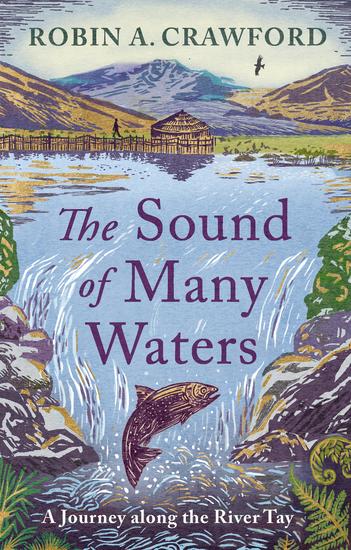
  • The Sound of Many Waters - A Journey along the River Tay - cover

    The Sound of Many Waters - A...

    Robin A. Crawford

    • 0
    • 0
    • 0
    Join Robin Crawford on a personal journey from the source of the River Tay to the sea.
    With the widest catchment area of any river in Britain, the Tay drains much of the lower Highlands of Scotland. A vast network of lochs and smaller bodies of water feed the Isla, Garry, Tummel, Almond and Earn, which all flow into this mighty river.
    As Robin Crawford walks along the banks of the Tay, we delve into the history of this landscape and his personal connection with it, from hill walks with friends into the mountains of the Tay's source to his student days in Dundee, where the Tay eventually spills out into the North Sea.
    Along the route we dip into the river's story: the gold-panners on the river Cononish, the Earthquake House outside Comrie, Beatrix Potter's holiday home near Dunkeld. Throughout, the river is our constant companion, connecting the small moments on which events turn and lives are changed forever.
    Mostra libro
  • On the Origin of Species - cover

    On the Origin of Species

    Charles Darwin

    • 0
    • 0
    • 0
    'It is not the strongest of the species that survive, nor the most intelligent, but the one most responsive to change.'
    
    Considered as the foundation of evolutionary biology, Charles Darwin's groundbreaking On the Origin of Species profoundly transformed the field of biology at the time, as well as contemporary religious beliefs.
    
    First published in 1859, On the Origin of Species presents Darwin's theory of evolution by natural selection. Darwin argues that species evolve over time; individuals with superior traits better suited to their environment are more likely to survive and reproduce. These favourable traits become more common in subsequent generations, leading to the gradual development of a new species. Darwin draws upon extensive evidence from biology, geology and the animal kingdom to support his theory, challenging the idea that species are fixed and unchanging. Revolutionary in its influence, On the Origin of Species laid the foundation for modern evolutionary biology, genetics and ecology. This audiobook edition is skilfully narrated by Mark Elstob.
    Charles Darwin (1809 – 1882) was an English biologist, naturalist and geologist. Initially studying medicine and theology, Darwin became drawn to natural science, wherein he developed the pioneering theory of evolution via natural selection. He remains a hugely respected figure in science to this day.
    Mostra libro