Unisciti a noi in un viaggio nel mondo dei libri!
Aggiungi questo libro allo scaffale
Grey
Scrivi un nuovo commento Default profile 50px
Grey
Iscriviti per leggere l'intero libro o leggi le prime pagine gratuitamente!
All characters reduced
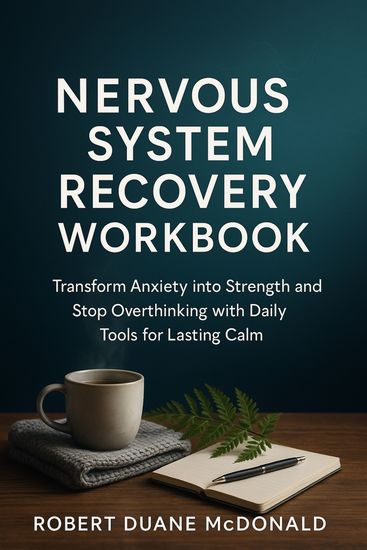
Nervous System Recovery Workbook - Transform Anxiety into Strength and Stop Overthinking with Daily Tools for Lasting Calm - cover

Nervous System Recovery Workbook - Transform Anxiety into Strength and Stop Overthinking with Daily Tools for Lasting Calm

Robert Duane McDonald

Casa editrice: Jstone Publishing

  • 0
  • 0
  • 0

Sinossi

Transform Anxiety Into Lasting Strength With Science-Based Nervous System Recovery
 
Your nervous system holds the key to breaking free from anxiety, overthinking, and chronic stress. This comprehensive workbook teaches you to work with your body's natural healing capacity instead of fighting against anxious thoughts and feelings.
 
What makes this workbook different:
 
Nervous system-focused approach that addresses anxiety at its biological root
 
Daily tools designed for busy lives - no hour-long meditation required
 
Step-by-step exercises to interrupt overthinking cycles before they spiral
 
Body-based techniques that calm your fight-or-flight response fast
 
Proven strategies to transform anxiety into mental resilience and confidence
 
Inside you'll discover: ✓ How your nervous system creates anxiety (and how to reset it naturally) ✓ 5-minute daily practices that build long-term nervous system resilience ✓ Somatic exercises to discharge stored stress and tension ✓ Breathing techniques that activate your body's natural calm response ✓ Overthinking interrupt methods you can use anywhere, anytime ✓ Progressive tracking system to monitor your nervous system recovery
 
This workbook includes practical tools for:
 
Panic attack recovery and prevention strategies
 
Grounding techniques for anxiety and overwhelm
 
Sleep restoration methods for anxious minds
 
Workplace stress management without anyone noticing
 
Social anxiety navigation with confidence-building exercises
 
Physical symptoms relief through nervous system regulation
 
Unlike traditional anxiety books focused on positive thinking, this guide teaches you to heal anxiety through nervous system recovery. Learn to recognize your body's stress signals early and respond with targeted techniques that create lasting change.
 
Each chapter builds on the previous one, creating a complete system for nervous system health. The exercises are designed for real life: quick enough for morning routines, discreet enough for office breaks, and powerful enough to create measurable improvements in your daily stress levels.
 
Perfect for anyone experiencing:
 
Racing thoughts and mental loops
 
Physical anxiety symptoms like rapid heartbeat or tight chest
 
Chronic stress affecting sleep, digestion, or energy
 
Overwhelm from daily responsibilities and decisions
 
Difficulty relaxing even in safe environments
 
Burnout from trying to manage anxiety through willpower alone
 
Stop managing anxiety symptoms and start healing your nervous system. Build the foundation for lasting calm, mental clarity, and emotional resilience.
Disponibile da: 11/09/2025.
Lunghezza di stampa: 100 pagine.

Altri libri che potrebbero interessarti

  • Gaius Marcus - The Controversial General Who Led the Roman Armies to Victory - cover

    Gaius Marcus - The Controversial...

    Kelly Mass

    • 0
    • 0
    • 0
    Gaius Marius was one of the most influential military commanders and statesmen of the late Roman Republic. Born into a well-off, provincial Italian family in Arpinum, Marius rose from relatively humble beginnings to become a key figure in Rome’s transformation from a republic to an empire. Known for his military prowess and political savvy, Marius served as consul an unprecedented seven times, a record that set him apart from other Roman leaders. 
    His career began in earnest during the Siege of Numantia in 134 BC, where he gained valuable military experience under the command of Scipio Aemilianus. Marius was not born into the traditional aristocracy of Rome but quickly ascended through the ranks of Roman politics. In 119 BC, he was elected as tribune of the plebs, where he passed significant legislation that aimed to curb the influence of the aristocracy in Roman elections. His political career continued to build momentum as he was elected praetor in 115 BC and later became the governor of Further Spain, where he fought against bandit forces. Marius’s personal life also intertwined with the leading families of Rome—he married Julia, the aunt of the future dictator Julius Caesar, cementing ties with one of Rome’s most powerful clans. 
    Marius’s most famous military achievements came in the course of the Jugurthine War in Numidia, which he brought to a successful conclusion in 107 BC. That same year, he was appointed to command Roman forces in the war against the Germanic tribes, the Cimbri and Teutones, who threatened Rome’s existence. He was elected consul for the second time in 104 BC, a post he would hold consecutively for five years. His victories at the battles of Aqua Sextiae in 102 BC and Vercellae in 101 BC cemented his reputation as one of Rome’s greatest military leaders, and he was hailed as the “third founder of Rome,” a title that reflected his role in securing the republic’s future.
    Mostra libro
  • The Involuntary American - A Scottish Prisoner's Journey to the New World - cover

    The Involuntary American - A...

    Carol Gardner

    • 0
    • 0
    • 0
    In the winter of 1650–51, 150 ragged Scottish prisoners of war arrived at Massachusetts Bay Colony, where they were sold as indentured laborers for twenty to thirty pounds each. Among them was Thomas Doughty, a common foot soldier who had survived the Battle of Dunbar. Doughty was among some 420 Scottish soldiers who were captured during the War of the Three Kingdoms, transported to America, and sold between 1650 and 1651. Their experiences offer a fresh perspective on seventeenth-­century life. 


    The Involuntary American: A Scottish Prisoner's Journey to the New World describes Doughty's life as a soldier, prisoner of war, exile, servant, lumberman, miller, and ultimately free landowner. It follows him and his peers through critical events: the apex of the Little Ice Age, the War of the Three Kingdoms, the colonization of New England, the burgeoning transatlantic trade in servants and slaves, King Philip's and King William's wars, and the Salem witch crisis. 


    The Involuntary American demonstrates how even indi­viduals of humble circumstances were swept into the mael­strom of the First Global Age. It expands our understanding of immigration to the colonies, colonial servitude, the link­ages and tensions between Europe, Massachusetts Bay, and America's northeastern frontier, and of New England socie­ty in the early colonial period.
    Mostra libro
  • Epistemology - The Theory of Knowledge and Wisdom - cover

    Epistemology - The Theory of...

    Hector Davidson

    • 0
    • 0
    • 0
    Epistemology, the theory of knowledge, explores the nature, scope, and limits of human understanding. It is concerned with questions such as "What is knowledge?" "How do we acquire it?" and "What can we truly know?" While these questions may seem straightforward, they are deeply complex and have fascinated philosophers for centuries. The study of epistemology is central to philosophy because it examines the very foundation upon which all other knowledge rests. 
    At its core, epistemology is concerned with defining what it means to "know" something. Historically, philosophers have often defined knowledge as "justified true belief." This classic view holds that for someone to know a proposition, it must be true, they must believe it, and they must have sufficient justification for that belief. However, challenges to this definition have led to new theories about knowledge, suggesting that there may be more to understanding than simply having belief grounded in truth. 
    The importance of epistemology extends beyond abstract theory. In daily life, we rely on knowledge to make decisions, solve problems, and navigate our understanding of the world. Whether it is scientific research, moral reasoning, or even personal belief systems, the way we define and assess knowledge influences how we engage with reality. Epistemological questions therefore shape not only philosophical discussions but also practical outcomes in various fields such as education, science, and politics.
    Mostra libro
  • A Hundred Reasons Why People Believe In Stupid Things - English to Spanish - cover

    A Hundred Reasons Why People...

    Science-Based Language Learning Lab

    • 0
    • 0
    • 0
    Introduction to the 100 Somethings Language Learning Series


    Welcome to a fresh, captivating way to learn a new language! The "A Hundred Reasons Why..." series helps you master Spanish through topics that interest you, such as art, science, and history. Each book offers 100 carefully selected reasons that serve as concise knowledge nuggets in both English and Spanish.


    How It Works:
     
      - Each reason is first presented in Spanish for you to interpret.
     
    - The next page provides the English translation and then repeats the reason in Spanish to help you understand unfamiliar terms. The second half of the book presents the content in English, then in the target language, and finally in English again, giving you the chance to translate in both directions and demonstrate true mastery of the material.
     
    - This format is repetitive to aid memorization and concise, ensuring streamlined learning.


    Benefits:
     
    - Concise Learning: The brief, one-sentence reasons are easy to remember and relate directly to your interests.
     
    - Reinforced Learning: Switching between English and Spanish solidifies your vocabulary and grammar naturally.
     
    - Engaged Learning: Associating new words with topics you're passionate about keeps your learning dynamic and engaging.
     
    - Dual Knowledge: You not only learn a new language but also deepen your knowledge of the specific subject matter.


    Ideal for those who thrive on clear and targeted information, this series makes learning both educational and enjoyable. Whether you're a beginner or looking to expand your linguistic skills, these books are crafted to enhance your journey effectively. Embrace this innovative approach and let your passions fuel your progress in mastering Spanish!
    Mostra libro
  • The Lion of Round Top - The Life and Military Service of Brigadier General Strong Vincent in the American Civil War - cover

    The Lion of Round Top - The Life...

    H.G. Myers, Dr. Frank P. Varney

    • 0
    • 0
    • 0
    The story of the true savior of Little Round Top at Gettysburg—a twenty-six-year-old Harvard-educated lawyer, who paid with his life to defend that hill. 


    Citizen-soldier Strong Vincent was many things: Harvard graduate, lawyer, political speaker, descendant of pilgrims and religious refugees, husband, father, brother. But his greatest contribution to history is as the savior of the Federal left on the second day at Gettysburg, when he and his men held Little Round Top against overwhelming Confederate numbers. Forgotten by history in favor of his subordinate, Joshua Lawrence Chamberlain, Vincent has faded into relative obscurity in the decades since his death. 


    This book restores Vincent to his rightful place among the heroes of the battle of Gettysburg: presenting his life story using new, never-before-published sources and archival material to bring the story of one of the most forgotten officers of the American Civil War back to the attention of listeners and historians.
    Mostra libro
  • The Norman Sicily - A Crossroads of Cultures - cover

    The Norman Sicily - A Crossroads...

    Harris Ropes

    • 0
    • 0
    • 0
    The Norman conquest of Sicily was a transformative period that reshaped the island’s political, social, and cultural landscape. The Normans, originally of Viking descent, had settled in northern France and became known for their military prowess and adaptability. By the 11th century, ambitious Norman adventurers turned their attention to southern Italy, seeking wealth and power. Among them, the Hauteville family played a crucial role in the conquest of Sicily, led by Robert Guiscard and his younger brother Roger.  
    The campaign to seize Sicily from Muslim control began in 1061, as the Normans took advantage of internal divisions among the island’s Muslim rulers. At the time, Sicily was a prosperous and diverse society, ruled by various Arab and Berber factions who had governed the island for over two centuries. Despite their dominance, infighting among the Muslim emirs weakened their hold, providing the Normans with an opportunity to launch a well-planned invasion. Robert Guiscard and Roger initially captured the strategic town of Messina, using it as a foothold for further expansion. Over the next three decades, the Normans steadily advanced across the island, engaging in fierce battles and sieges. 
    One of the most significant victories came in 1072 when the Normans captured the capital city of Palermo, a major cultural and economic center. Palermo’s fall marked a turning point in the conquest, as it solidified Norman authority in the region. However, complete control of Sicily was not achieved until 1091 when Roger seized Noto, the last stronghold of Muslim resistance. With this final victory, the Normans established their rule over the entire island, bringing an end to Muslim governance while incorporating many aspects of its administrative and cultural systems.
    Mostra libro