

Unisciti a noi in un viaggio nel mondo dei libri!
Aggiungi questo libro allo scaffale
Grey
Scrivi un nuovo commento Default profile 50px
Grey
Iscriviti per leggere l'intero libro o leggi le prime pagine gratuitamente!
All characters reduced
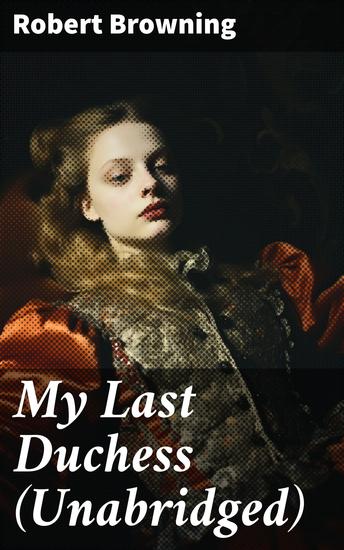
My Last Duchess (Unabridged) - Exploring jealousy power and art in Renaissance Italy through dramatic dialogue and intricate verse - cover

My Last Duchess (Unabridged) - Exploring jealousy power and art in Renaissance Italy through dramatic dialogue and intricate verse

Robert Browning

Casa editrice: Good Press

  • 0
  • 0
  • 0

Sinossi

In "My Last Duchess," Robert Browning masterfully employs dramatic monologue to explore themes of power, jealousy, and the objectification of women. Set within a Renaissance context, the poem presents a Duke who reveals his emotions and past transgressions as he converses with a visitor about a portrait of his deceased wife. Browning'Äôs use of enjambment and iambic pentameter creates a flowing rhythm that mirrors the Duke'Äôs self-involved narrative, while the juxtaposition of beauty and darkness poignantly highlights the interplay of love and control. The poem can be situated within the broader Victorian literary movement, where explorations of psychological complexities in character were gaining prominence. Robert Browning, a preeminent figure in Victorian poetry, was deeply influenced by his own experiences with love and loss, particularly his tumultuous relationship with Elizabeth Barrett Browning. His fascination with the psychological dimensions of character is evident in his body of work, which often grappled with moral ambiguity. "My Last Duchess" stands out as a prime example of Browning's keen insight into human nature and the darker facets of desire that can compel individuals to commit unspeakable acts. This poem is highly recommended for readers interested in psychological depth and the intricacies of human relationships. Browning'Äôs vivid characterization and vivid imagery invite readers to reflect on the moral implications of power dynamics, making it a timeless piece that resonates with contemporary themes of gender and authority. Whether one is a lover of poetry or simply curious about human motivations, "My Last Duchess" promises a rich literary experience.
Disponibile da: 06/01/2024.
Lunghezza di stampa: 482 pagine.
Altri libri che potrebbero interessarti

  • The Poetry of John Milton - Sparkling poems from the famed man behind Paradise Lost - cover

    The Poetry of John Milton -...

    John Milton

    • 0
    • 0
    • 0
    John Milton was born in Bread Street, London, on December 9th, 1608.  His early years were privately tutored before gaining a place at St Paul’s School and in 1625 he matriculated at Christ's College, Cambridge, earning a BA in 1629 and an MA in 1632. At Cambridge he had developed a reputation for poetic skill but also experienced alienation from his peers and university life as a whole.  
    The next 6 years were spent in private study. He read both ancient and modern works of theology, philosophy, history, politics, literature and science, in preparation for a poetical career.  Milton mastered Latin, Greek, Hebrew, French, Spanish, and Italian. To these he would add Old English (whilst researching his History of Britain) and also acquired more than a passing acquaintance in Dutch.  
    Although he was studying, some of his poetry from this time is remarkable; L’Allegro and Il Penseroso in 1631 and Lycidias in 1638. 
    In May 1638, Milton embarked upon a 15 month tour of France and Italy. These travels added a new and direct experience of artistic and religious traditions, especially Roman Catholicism.  He cut the journey short to return home during the summer of 1639 because of what he claimed were "sad tidings of civil war in England."  
    Once home, Milton wrote prose tracts against episcopacy, in the service of the Puritan and Parliamentary cause.  
    He married 16-year-old Mary Powell in June 1643 but she left him after only a few months during which he wrote and published several writings on divorce. Mary did return after 3 years and their life thereafter seemed harmonious.  Milton received a hostile response to the divorce tracts and drove him to write Areopagitica, his celebrated attack on pre-printing censorship.  
    With the parliamentary victory in the Civil War, Milton wrote The Tenure of Kings and Magistrates (1649) which defended popular government and implicitly sanctioned the regicide which led to his appointment as Secretary for Foreign Tongues by the Council of State.  
    On 24 February 1652 Milton published his Latin defense of the English People, Defensio Pro Populo Anglicano, also known as the First Defense. Milton's Latin prose and intellectual sweep, quickly gained him a European reputation.  
    Tragically his first wife, Mary, died on May 5th, 1652 following the birth of their fourth child.   The following year Milton had become totally blind, probably due to glaucoma.  He then had to dictate his verse and prose to helpers, one of whom was the poet Andrew Marvell. 
    He married again to Katherine Woodcock but she died in February 1658, less than four months after giving birth to a daughter, who also tragically died.  
    Though Cromwell’s death in 1658 caused the English Republic to collapse Milton stubbornly clung to his beliefs and in 1659 he published A Treatise of Civil Power, attacking the concept of a state-dominated church. Upon the Restoration in May 1660, Milton went into hiding for his life. An arrest warrant was issued and his writings burnt. He re-emerged after a general pardon was issued, but was nevertheless arrested and briefly imprisoned before influential friends, such as Marvell, now an MP, intervened 
    His third marriage was to Elizabeth Mynshull. Despite a 31-year age gap, the marriage seemed happy and Milton spent the remaining decade of his life living quietly in London, apart from a short spell in Chalfont St. Giles, during the Great Plague of London.  
    Milton was to now publish his greatest works, which had been gestating for many years.
    Mostra libro
  • Intimately Speaking - cover

    Intimately Speaking

    Ludy Wooten

    • 0
    • 0
    • 0
    A book of poetry that speaks from the heart of the author based on her life experiences. The author travels to past, present and future to touch on topics that speak to her and hope speaks to you. She writes about the highs, lows and the in-between cycles of life. You are in for a treat, so buckle up and take this journey with Ludy. Enjoy.
    Mostra libro
  • When We Were Very Young - Winnie-the-Pooh Series Book #2 - Unabridged - cover

    When We Were Very Young -...

    A. A. Milne

    • 0
    • 0
    • 0
    "When We Were Very Young" is a book of poetry for children by the legendary British author A.A. Milne and marks the first appearance of the "silly old bear" who would soon become a worldwide sensation: Winnie-the-Pooh.   In these poems, the narrator - a young boy named Christopher Robin (after Milne's own son) - navigates the world of adolescence, imagining kings and queens, questing knights, talking bears, imaginary friends and explores the curiosity and wonder of the grown-up world seen through the eyes of a child.   "When We Were Very Young" - the first book of the Winnie-the-Pooh series - was an immediate hit when it was first published in 1924 and spawned the next three Pooh books: Winnie-the-Pooh, Now We Are Six and The House at Pooh Corner. It is presented here in its original and unabridged format.
    Mostra libro
  • The Reason I Love Flower - cover

    The Reason I Love Flower

    Lee Jeon-Rok

    • 0
    • 0
    • 0
    This collection is the second poetry collection by author, Lee and consists of 173 poems in 5 parts as follows:The reason I Love FlowersI Call Them GodsHappiness is GrowingI will Love Even After I DieThe Flower That the Wind LoversThis poetry collection visualizes love as a flower , and compares all the emotions felt through love to flowers , and it is a portry collection filled with poems that sing love is realizing being human. 
    Author told that the realization of love is the realization of being human. He sh.eds endless tears while contemplation the flowers blooming sadly. Hi is desperately wating for the flowers to boom and fully bloom. Can the song of flowers be this beautiful? To love is to discover the pure self within , Pure flowers beautifully purify our Hearts. Flowers are being that brighten up the worn-out world. This is the reason he loves flowers.
    Mostra libro
  • Life Unresolved and Other Short Plays - cover

    Life Unresolved and Other Short...

    Susan C. Hunter

    • 0
    • 0
    • 0
    This collection of short, contemporary plays by award-winning playwright Susan C. Hunter provides a wide range of thought-provoking listening. Each play is a stand-alone gem, yet experienced together, they are eloquently connected, often mirroring the humorous and dramatic sides of the same themes. Alternately hilarious and moving, it is read by a full cast of talented narrators.
    Mostra libro
  • (the) Woman - cover

    (the) Woman

    Jean Upton

    • 0
    • 0
    • 0
    M is a writer. M is a mother. M is a woman.
    The triumph of M's hit play is hijacked by motherhood. She is burnt out, angry, lonely, craving intimacy but disengaged, and terrified of the future.
    She wants to tell her story, her way. But everyone keeps giving her their opinions on who she is, who she ought to be, and how she's fucking everything up.
    Fiercely funny and brutally honest, Jane Upton's play (the) Woman shatters the glossy veneer of motherhood, exposing its raw, messy truth and what happens when a woman dares to question the definition of (her)self. It was shortlisted for the Bruntwood Prize for Playwriting, and first performed by New Perspectives on tour of the UK in 2025.
    Mostra libro
