Join us on a literary world trip!
Add this book to bookshelf
Grey
Write a new comment Default profile 50px
Grey
Subscribe to read the full book or read the first pages for free!
All characters reduced
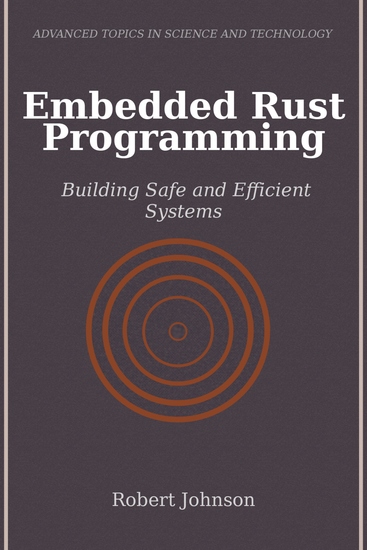
Embedded Rust Programming - Building Safe and Efficient Systems - cover

Embedded Rust Programming - Building Safe and Efficient Systems

Robert A. Johnson

Publisher: HiTeX Press

  • 0
  • 0
  • 0

Summary

"Embedded Rust Programming: Building Safe and Efficient Systems" is a comprehensive guide for developers eager to leverage Rust's unique capabilities in the realm of embedded systems. This book meticulously unravels the intricacies of using Rust in embedded environments, from crafting reliable real-time applications to effectively interfacing with hardware. By focusing on Rust's memory safety, concurrency features, and powerful programming paradigms, readers will gain a deep understanding of how to build robust, efficient, and secure embedded applications.Throughout this book, readers will explore practical case studies, providing a bridge between theoretical concepts and real-world applications. With detailed chapters addressing every critical aspect of embedded Rust development—setting up a development environment, managing concurrency, optimizing performance, and more—this book is an essential resource for both newcomers and seasoned professionals. Packed with insights and best practices, it is designed to elevate your understanding and skill in developing cutting-edge embedded systems using Rust.
Available since: 10/26/2024.
Print length: 264 pages.


Other books that might interest you

  • How to Make a Killing - Blood Death and Dollars in American Medicine - cover

    How to Make a Killing - Blood...

    Tom Mueller

    • 0
    • 0
    • 0
    Six decades ago, visionary doctors achieved the impossible: the humble kidney, acknowledged since ancient times to be as essential to life as the heart, became the first human organ to be successfully replaced with a machine. Yet huge dialysis corporations, ambitious doctor-entrepreneurs, and Beltway lobbyists soon turned this medical miracle into an early experiment in for-profit medicine—and one of the nation's worst healthcare catastrophes. 


    With powerful insight and on-the-ground reporting, Tom Mueller introduces an unforgettable cast of characters. Heroic patients risk their lives to blow the whistle on how they've been mistreated. An unpaid activist living in a south Georgia trailer park fights to save patients from involuntary discharge from their lifesaving care. Industry insiders put their careers on the line to speak out about the endemic wrongs and pervasive inequality they've witnessed—and about dialysis executives who dress as musketeers and Star Wars characters to exhort their employees to more aggressive profit-seeking. 


    How to Make a Killing reveals dialysis as a microcosm of American medicine and poses a vital challenge: find a way to fix dialysis, and we'll have a fighting chance of fixing our country's dysfunctional healthcare system as a whole, restoring patients, not profits, as its true purpose.
    Show book
  • Unraveling - What I Learned About Life While Shearing Sheep Dyeing Wool and Making the World’s Ugliest Sweater - cover

    Unraveling - What I Learned...

    Peggy Orenstein

    • 0
    • 0
    • 0
    “Orenstein is such a breezy, funny writer, it’s easy to forget she’s an important thinker too.”—People 
    In this lively, funny memoir, Peggy Orenstein sets out to make a sweater from scratch—shearing, spinning, dyeing wool—and in the process discovers how we find our deepest selves through craft. Orenstein spins a yarn that will appeal to everyone.   
    The COVID pandemic propelled many people to change their lives in ways large and small. Some adopted puppies. Others stress-baked. Peggy Orenstein, a lifelong knitter, went just a little further. To keep herself engaged and cope with a series of seismic shifts in family life, she set out to make a garment from the ground up: learning to shear sheep, spin and dye yarn, then knitting herself a sweater. 
    Orenstein hoped the project would help her process not just wool but her grief over the recent death of her mother and the decline of her dad, the impending departure of her college-bound daughter, and other thorny issues of aging as a woman in a culture that by turns ignores and disdains them. What she didn’t expect was a journey into some of the major issues of our time: climate anxiety, racial justice, women’s rights, the impact of technology, sustainability, and, ultimately, the meaning of home. 
    With her wry voice, sharp intelligence, and exuberant honesty, Orenstein shares her year-long journey as daughter, wife, mother, writer, and maker—and teaches us all something about creativity and connection.  
    Supplemental enhancement PDF accompanies the audiobook. 
    Unraveling is a memoir that explores Peggy Orenstein's journey into the world of knitting as a way to cope with the pandemic and other personal struggles. Through her exploration of the cultural history of wool dying, carding, and spinning, she provides readers with a deeper understanding of the true meaning of creativity and the importance of pursuing hobbies. This book is a perfect gift for anyone looking for inspiration and insight into the power of DIY projects.
    Show book
  • In-Memory Computing - Revolutionizing Data Processing and Analytics for Real-Time Decision-Making in the Age of Big Data - cover

    In-Memory Computing -...

    James Henry

    • 0
    • 0
    • 0
    In-Memory Computing: Revolutionizing Data Processing and Analytics for Real-Time Decision-Making in the Age of Big Data offers an in-depth exploration of one of the most transformative technologies shaping modern data management. As organizations grapple with the explosive growth of data and the need for instantaneous insights, in-memory computing emerges as a critical solution to enhance data processing speed and efficiency. 
    This comprehensive guide delves into the core principles of in-memory computing, explaining how it leverages the power of RAM to dramatically reduce latency and improve performance. Readers will discover the architecture and technologies that underpin in-memory systems, including data grids, analytics platforms, and real-time processing frameworks. 
    Through insightful case studies and practical examples, this book highlights the diverse applications of in-memory computing across industries such as finance, e-commerce, telecommunications, and healthcare. It reveals how businesses are using this technology to make informed, timely decisions that drive growth and innovation. 
    As the demand for real-time analytics continues to grow, this book serves as an essential resource for data professionals, IT leaders, and decision-makers looking to stay ahead in the data-driven landscape. Join the revolution in data processing and analytics, and discover how in-memory computing can transform your organization’s decision-making capabilities in the age of big data. 
     
    Show book
  • An Engineer Imagines - cover

    An Engineer Imagines

    Peter Rice

    • 0
    • 0
    • 0
    The long-awaited reissue of the autobiography of Peter Rice, one of the main structural engineers behind the Sydney Opera House, the Pompidou Centre, the Menil Collection and Lloyd's of London.
    
    'I am an engineer. Often people will call me an 'architect engineer' as a compliment. It is meant to signify a quality of engineer who is more imaginative and design-orientated than a normal engineer... To call an engineer an 'architect engineer' because he comes up with unusual or original solutions is essentially to misunderstand the role of the engineer in society.'
    An Engineer Imagines is a rare look into the professional creativity and philosophy of Peter Rice, who was widely acclaimed as the greatest structural engineer of his generation. He was a man who, in Renzo Piano's words, could design structures 'like a pianist who can play with his eyes shut'. Working with many of the world's greatest architects on buildings that became icons of contemporary architecture, he brought a uniquely poetic feeling to his work.
    Joining Ove Arup & Partners in 1956, Rice had heard that 'it was a place where an oddball could fit in.' Taking on Arup's theory of Total Design to heart, Rice writes about the role of the engineer in society, and how he himself applied his creativity to various projects. He admits he became an engineer by accident, tentatively feeling his way through a career without a natural instinct. But as he takes you through each of his projects, one-by-one, you can trace his development from graduate to veteran.
    Written in clear and poetic language, Rice's autobiography is perfect for those who want to better understand postwar buildings, our concrete environment, or are budding students of engineering and architecture.
    Show book
  • The UFO Experience - Evidence Behind Close Encounters Project Blue Book and the Search for Answers - cover

    The UFO Experience - Evidence...

    J. Allen Hynek, Paul Hynek

    • 0
    • 0
    • 0
    The case against UFOs and unidentified aerial phenomena (UAP) has not been put to rest. Although UFOs "officially" did not exist for decades according to the government, reports of sightings continue to be made, and the latest releases from the government and related hearings have surprised the world. While the scientific community has put UFOs out to pasture, the evidence used to dismiss them is rare and unscientific. 


    Dr. Hynek, a scientist himself, and the only government-paid ufologist in history, looks at the decisions made by officialdom in the early days of ufology and how these decisions have held us back—to the point that we are still naively talking about UFOs as we were in the 1950s. Has seventy years of research made no difference at all in our understanding? 


    Dr. Hynek proves that there is a conspiracy afoot to hide the facts and that there are many cases that still need to be explained by mainstream science—not dismissed with facile jokes and stupid logic. Citing specific cases, Hynek challenges those in the ivory tower by raising questions that have still not been answered and refuting mainstream arguments that have yet to be proven.
    Show book
  • Israel and the Cyber Threat - How the Startup Nation Became a Global Cyber Power - cover

    Israel and the Cyber Threat -...

    Charles D. Freilich, Gabi...

    • 0
    • 0
    • 0
    In Israel and the Cyber Threat, Charles D. ("Chuck") Freilich, Matthew S. Cohen, and Gabi Siboni provide a detailed and comprehensive study of Israel's cyber strategy, tracing it from its origins to the present. They analyze Israel's highly advanced civil and military cyber capabilities and organizational structures to offer insights into what other countries can learn from Israel's experience. To achieve this, they explore how and why Israel has been able to build a remarkable cyber ecosystem and turn itself, despite its small size, into a global cyber power. The book further examines the major cyber threats facing Israel, including the most in-depth look at Iranian cyber policies and attacks; Israel's defensive and offensive capabilities and the primary attacks it has conducted; capacity building; international cooperation; and the impact of Israel's strategic culture on its cyber prowess. By placing Israel's actions in the realm of international relations theory, the book sheds light on many of the major questions in the field regarding cyber policies. 


    The most authoritative work to date on Israeli cyber strategy, this book provides a comprehensive look at the major actions Israel has taken in cyberspace. It also places them in the broader context of global cyber developments to help listeners understand state behavior in cyberspace.
    Show book