Join us on a literary world trip!
Add this book to bookshelf
Grey
Write a new comment Default profile 50px
Grey
Subscribe to read the full book or read the first pages for free!
All characters reduced
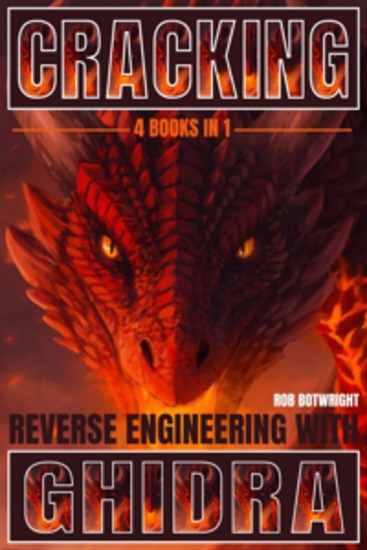
Cracking - Reverse Engineering with Ghidra - cover

Cracking - Reverse Engineering with Ghidra

Rob Botwright

Publisher: Rob Botwright

  • 0
  • 1
  • 0

Summary

🔥 CRACKING 🔍Reverse Engineering with Ghidra🛠️ The Ultimate 4-Book Hacker Toolkit for Beginners to ProsAre you ready to pull back the curtain on software?Do you want to understand how malware hides, how binaries behave, and how hackers tear systems apart—and put them back together?Welcome to CRACKING: Reverse Engineering with Ghidra, the definitive 4-book series built to take you from curious beginner to terminal-slinging, byte-chasing, shell-mastering reverse engineer. 💻🧠📘 Book 1: Cracking GhidraFoundations of Reverse Engineering Using Ghidra for Beginners➡️ Start here, even if you’ve never reversed anything before. You’ll install Ghidra, learn how to load binaries, explore functions, decompile code, and uncover what really happens behind the scenes of an executable.✅ Learn disassembly & decompilation✅ Understand memory layout & strings✅ Build your intuition for binary logic📙 Book 2: Cracking BinariesPractical Reverse Engineering with Ghidra, Debuggers, and Real-World MalwareNow the real fun begins. Dive into live malware samples, crack protections, analyze shellcode, and combine Ghidra with tools like x64dbg and Radare2 for hybrid analysis.🦠 Reverse malicious payloads🔍 Discover hidden logic & obfuscation🛠️ Use Ghidra + debuggers for deep insight📗 Book 3: Cracking the Command LineMastering Linux CLI: From Shell Basics to Automation and ScriptingEvery hacker needs a fluent command of the terminal. You’ll go from basic navigation to scripting powerful tools, automating workflows, parsing logs, and chaining commands like a pro.📂 Navigate & manipulate file systems🔁 Automate tasks with Bash scripting⚡ Build tools, fuzzers, and filters📕 Book 4: Cracking Like an ExpertAdvanced CLI Techniques, Reverse Engineering Workflows, and Hacker Tools UnleashedHere’s where you join the elite. Build your hacker terminal, automate Ghidra headless workflows, integrate Radare2 and x64dbg, build parsing pipelines, and craft CLI tools that work for you.🧰 Create your own reverse engineering toolkit🧪 Automate malware triage & reporting⚙️ Build seamless CLI workflows with style💡 Whether you're prepping for CTFs, studying malware, breaking binaries, or building your own toolchain, Cracking gives you everything you need to work like a professional—without wasting your time on fluff.🎯 Perfect for:Aspiring reverse engineersCybersecurity studentsEthical hackersRed teamersCTF competitorsTerminal nerds & toolsmiths🛒 Grab the full 4-book bundle and get hands-on with Ghidra, terminals, malware, and tools that real-world hackers use.📦 Available in digital + print📁 Linux and Windows-friendly⏳ No experience needed—just curiosity and caffeine🖥️ Tap into your inner analyst.🔓 Crack the binary.🚀 Crack the system.🔥 CRACKING starts now.💥 Learn it. Script it. Crack it. 💥
Available since: 04/11/2025.

Other books that might interest you

  • We Are the ARK - Returning Our Gardens to Their True Nature Through Acts of Restorative Kindness - cover

    We Are the ARK - Returning Our...

    Mary Reynolds

    • 0
    • 0
    • 0
    “Reynolds gives us a much-needed reason for hope. The gardener, the conservationist, the city planner, and the nature lover will all be inspired for this wonderful book shows how thousands of even small wildlife friendly gardens can provide habitat for embattled wildlife around the world.” —Jane Goodall, Phd, DBE, Founder of the Jane Goodall Institute & UN Messenger of Peace  Individuals can’t save the world alone. But if millions of us work together to save our own patch of earth—then we really have a shot. How do we do it?  With Acts of Restorative Kindness (ARK). An ARK is a restored, native ecosystem. It’s a thriving patch of native plants and creatures that have been allowed and supported to re-establish in the earth's intelligent, successional process of natural restoration. Over time, this becomes a pantry and a habitat for our pollinators and wild creatures who are in desperate need of support. These ARKs will become the seeding grounds for our planet’s new story. They will be sanctuaries for our shared kin—the rooted and unrooted—and safe havens for the magic and abundance of the natural world. Most importantly, the ARK-building actions are within our control and laid out here in We Are the ARK. In these inspiring pages, discover how one person’s actions can effect big change in this world. Even the tiniest postage stamp patch of land matters! Together we are building a patchwork quilt of life that will wrap its way around this planet.  
    Show book
  • Ecommerce Fraud Prevention - The 7 Worst Scams and How to Stop Them (10 Prevention Tools) - cover

    Ecommerce Fraud Prevention - The...

    Vines Graener

    • 0
    • 0
    • 0
    To complicate matters, ecommerce merchants must defend against fraud on two fronts. First, you need to safeguard your business from schemes that target merchants directly, such as fraudulent chargebacks and website impersonation. 
    Additionally, it’s crucial to protect your customers from scams, as having scammers on your site can be detrimental to your reputation—even if you’re just as much a victim as they are. 
    The good news is that ecommerce fraud prevention is advancing rapidly, with strategies as sophisticated as the scams themselves. In this article, we’ll explore the seven most common fraud scams in ecommerce: how they operate, the warning signs to watch for, effective defenses, and ten essential tools to enhance your security. 
    Let’s dive in!
    Show book
  • James Watson and Francis Crick Discuss the Structure of DNA - cover

    James Watson and Francis Crick...

    James Watson, Francis Crick

    • 0
    • 0
    • 0
    James Dewey Watson (April 6, 1928 - November 6, 2025) was an American molecular biologist, geneticist, and zoologist. Francis Harry Compton Crick (June 8, 1916 – July 28, 2004) was an English molecular biologist, biophysicist, and neuroscientist. In 1953, Watson and Crick co-authored an academic paper in Nature proposing the double helix structure of the DNA molecule, building on research by Rosalind Franklin and Raymond Gosling. In 1962, Watson, Crick, and Maurice Wilkins were awarded the Nobel Prize in Physiology or Medicine "for their discoveries concerning the molecular structure of nucleic acids and its significance for information transfer in living material." The following TV interview is from 1993.
    Show book
  • Saving The Planet By Design - Reinventing Our World Through Ecomimesis - cover

    Saving The Planet By Design -...

    Ken Yeang

    • 0
    • 0
    • 0
    Can we ‘save the Planet’? For a resilient, durable and sustainable future for human society, we need to repurpose, reinvent, redesign, remake and recover our human-made world so that our built environment is benignly and seamlessly biointegrated with Nature to function synergistically with it. These are the multiple tasks that humanity must carry out imminently if there is to be a future for human society and all lifeforms and their environments on the Planet. Addressing this is the most compelling question for those whose daily work impacts on Nature, such as architects, engineers, landscape architects, town planners, environmental policy makers, builders and others, but it is a question that all of humanity needs to urgently address.Presented here are two key principles as the means to carry out these tasks – ‘ecocentricity’ being guided by the science of ecology, and ‘ecomimesis’ as designing and making the built environment including all artefacts based on the emulation and replication of the ‘ecosystem’ concept. Designing with ecology is contended here as the authentic approach to green design from which the next generation of green design will emerge, going beyond current use of accreditation systems. For those who subscribe to this principle, this is articulated here, showing how it can be implemented by design. Adopting these principles is fundamental in our endeavour to save our Planet Earth, and changes profoundly and in entirety the way we design, make, manage and operate our built environment.
    Show book
  • Alone but Not Lonely - Exploring for Extraterrestrial Life - cover

    Alone but Not Lonely - Exploring...

    Louis Friedman

    • 0
    • 0
    • 0
    Humans have always been fascinated by the possibility of extraterrestrial life, often wondering if we are alone in the universe. Drawing on nearly fifty years as a leader in planetary exploration, Louis Friedman brings into focus the subject of extraterrestrial life, separating knowledge from conjecture, fact from fiction, to draw scientific and technical conclusions that answer this enduring question. 


    Friedman argues that intelligent life is probably rare in the universe (maybe even uniquely on Earth) but that simple life is likely abundant on millions or billions of planets waiting now to be discovered. He asserts that studying and searching for extraterrestrial life cannot be done by interstellar probes—due to the vastness of space and the comparative brevity of human lifespans—but it can be done remotely by a new technique involving the solar gravity lens that can magnify exoplanets by tens of billions. This technique will allow humankind to explore exoplanets and open up an exciting new field of comparative astrobiology. 


    Wide-ranging in scope, this book discusses the history of searching for extraterrestrial life, the scientific evidence thereof, and finally his own conclusions on what's next.
    Show book
  • The AI Engineering Bootcamp - Build Ship Share - cover

    The AI Engineering Bootcamp -...

    Greg Loughnane, Chris Alexiuk

    • 0
    • 0
    • 0
    In The AI Engineering Bootcamp: Build, Ship, Share, AI Makerspace cofounders "Dr. Greg" Loughnane and Chris "The Wiz" Alexiuk guide the listener through the foundational concepts and code needed to build production-grade Large Language Model (LLM) applications using leading open-source tooling. The book explains the four primary design patterns of generative AI―prompt engineering, Retrieval Augmented Generation (RAG), fine-tuning, and agentic reasoning―and how to leverage them as first principles to build scalable LLM applications that are high-performance and efficient. 
    You'll find classroom-tested lessons that offer immediate insights into building LLM applications, as well as example projects to give you hands-on experience that can be immediately applied within our company or with your clients today. The AI Engineering Bootcamp provides everything you need, from your initial AI-assisted Interactive Development Environment (IDE) set up and first deployment to the boilerplate Python code you need to prototype LLM, RAG, agent, and multi-agent applications. The book also covers how to prepare your prototypes for production by setting up open-source LLM and embedding model endpoints, leveraging caching for prompts and embeddings, what you need to host and deploy your application on premise, and more.
    Show book