Unisciti a noi in un viaggio nel mondo dei libri!
Aggiungi questo libro allo scaffale
Grey
Scrivi un nuovo commento Default profile 50px
Grey
Iscriviti per leggere l'intero libro o leggi le prime pagine gratuitamente!
All characters reduced
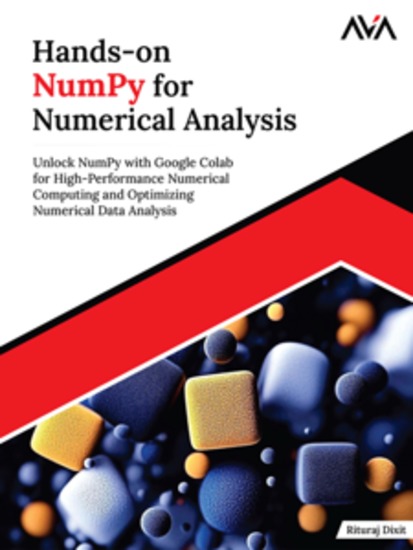
Hands-on NumPy for Numerical Analysis: Unlock NumPy with Google Colab for High-Performance Numerical Computing and Optimizing Numerical Data Analysis - cover

Hands-on NumPy for Numerical Analysis: Unlock NumPy with Google Colab for High-Performance Numerical Computing and Optimizing Numerical Data Analysis

Rituraj Dixit

Casa editrice: Orange Education Pvt Ltd

  • 0
  • 0
  • 0

Sinossi

Unlock the Power of NumPy to Accelerate Data Analysis and Computing.Key Features● Master NumPy concepts with hands-on examples and real-world use cases.● Learn efficient numerical data analysis and performance optimization.● Explore advanced NumPy functions for data science and ML workflows.Book DescriptionNumPy is the backbone of numerical computing in Python, powering everything from scientific research to machine learning and AI applications. Mastering NumPy is essential for anyone working with data, enabling faster computations, efficient data structures, and seamless integration with advanced analytical tools.Hands-on NumPy for Numerical Analysis is a comprehensive guide that takes you from the fundamentals of NumPy to its advanced applications. Through hands-on examples and real-world scenarios, this book equips data scientists, analysts, and machine learning engineers with the practical skills needed to manipulate large datasets and optimize performance. Key topics include array operations, linear algebra, signal processing, and machine learning implementations, all covered with detailed explanations and step-by-step guidance.Whether you're building your foundation in numerical computing or looking to enhance your data analysis workflows, this book will give you a competitive edge. Don't get left behind—harness the full power of NumPy to supercharge your data science and machine learning projects today!What you will learn● Master NumPy array operations for high-performance numerical computing.● Optimize data analysis workflows with efficient NumPy techniques.● Perform advanced linear algebra and matrix operations using NumPy.● Conduct statistical and exploratory data analysis with NumPy tools.● Build end-to-end data processing pipelines with NumPy.● Leverage NumPy for predictive modeling and machine learning tasks.
Disponibile da: 18/03/2025.
Lunghezza di stampa: 358 pagine.


Altri libri che potrebbero interessarti

  • The Vibe Coding Business Model - Sell Apps You Built Without Knowing How to Code - cover

    The Vibe Coding Business Model -...

    Erica Thompson

    • 0
    • 0
    • 0
    This audiobook is narrated by an AI Voice. Build and Sell Profitable Apps Without Writing a Single Line of Code 
     
    What if you could turn your business ideas into real, revenue-generating software applications in just 48 hours, without any programming knowledge? The AI revolution has made this possible, and thousands of entrepreneurs are already capitalizing on it. 
     
    The Vibe Coding Business Model reveals the complete system for building, launching, and selling micro SaaS businesses using AI-powered tools like Lovable, Bolt.new, and Replit. This is not a theory. This is a proven framework that non-technical founders are using right now to create passive-income software and sell their apps for five- and six-figure exits. 
     
    Inside This Step-by-Step Guide: 
     
    The 48-Hour MVP Framework - Transform any business idea into a functional, deployable application using no-code app development tools. Learn the exact prompting techniques that generate production-ready code, not just demos. 
     
    Profitable Niche Discovery - Use the three-circle framework to identify micro SaaS startup opportunities in tiny markets where you can become the default solution fast. Includes specific research techniques using Reddit, Indie Hackers, and proven market validation methods. 
     
    AI Business Automation Systems - Master authentication, Stripe payment processing, and database design without technical expertise. Every business requirement is explained in plain English with specific prompts you can use immediately. 
     
    Launch Strategies That Work - Multi-channel approaches across Product Hunt, Reddit, LinkedIn, and email that generate your first users without spending money on ads. Learn the building-in-public tactics that create invested audiences before you launch. 
     
    The App Flipping Model - Build applications specifically for acquisition and achieve 3 to 5 times annual profit valuations on marketplaces like Flippa. Understand what buyers look for and how to structure deals that close quickly.
    Mostra libro
  • Identity Security for Software Development - Best Practices That Every Developer Must Know - cover

    Identity Security for Software...

    Matt Barker, Uzi Ailon, John Walsh

    • 0
    • 0
    • 0
    Maintaining secrets, credentials, and machine identities in secure ways is an important, though often overlooked, aspect of secure software development. DevOps security often addresses vulnerabilities, but it neglects broader discussions like authentication, authorization, and access control, potentially leaving the door open for breaches. That's where an identity security strategy integrated in your code, infrastructure, and environments from day one can help. 


    In this practical book, authors John Walsh, Uzi Ailon, and Matt Barker provide conceptual frameworks, technology overviews, and useful code snippets to bridge the gap between development, IT, and security to integrate robust identity security across apps, CI/CD pipelines, Kubernetes and cloud native, hybrid and multicloud, process automation, IoT, and more. You'll learn: 


    ● What developers need to know about managing secrets and identity to build safer apps 


    ● What machine identities, secrets, and credentials are—and how to secure them 


    ● How to secure the software supply chain to build safer apps 


    ● How identity security fits into modern software development practices
    Mostra libro
  • Illustrated Seamanship - Ropework Boat Handling & Anchoring - cover

    Illustrated Seamanship -...

    Ivar Dedekam

    • 0
    • 0
    • 0
    For any sailor, in a yacht or motorboat, the passage from one place to another is relatively easy, particularly with modern navigation equipment. What can be more of a challenge (and a potential source of anxiety for skipper and crew) is the start and end of a passage – how to leave and arrive safely, particularly if it's a cramped marina or crowded anchorage. In Illustrated Seamanship, Ivar Dedekam takes you through the techniques required to achieve a safe departure and arrival. Starting with the fundamentals of ropework he then moves on to manoeuvring, berthing, making fast and then leaving. All types of berthing are covered from coming alongside, stern to, bow to, between finger pontoons and using piles and buoys. There is advice about dealing with different wind and current directions as well as using springs. Ivar then turns to anchoring and offers guidance on setting and weighing anchor in many different circumstances: under sail and under power, using one or two anchors and coping with changes in wind and tide while anchored. You probably won't experience all the scenarios that Ivar so carefully describes, but you will certainly come across quite a few. Knowing what to do when a new situation comes up could be invaluable, increasing your confidence and leading to greater enjoyment and use of your boat. With over 500 diagrams, this slim volume is a perfect reminder of frequently used techniques and could be your get-out-of-jail card when a new circumstance arises. This new edition has an improved layout and the eBook's functionality has been improved significantly.
    Mostra libro
  • Gödel's Proof - cover

    Gödel's Proof

    James Newman, Ernest Nagel,...

    • 0
    • 0
    • 0
    An accessible explanation of Kurt Gödel's groundbreaking work in mathematical logic 
     
    In 1931 Kurt Gödel published his fundamental paper, "On Formally Undecidable Propositions of Principia Mathematica and Related Systems." This revolutionary paper challenged certain basic assumptions underlying much research in mathematics and logic. Gödel received public recognition of his work in 1951 when he was awarded the first Albert Einstein Award for achievement in the natural sciences―perhaps the highest award of its kind in the United States. The award committee described his work in mathematical logic as "one of the greatest contributions to the sciences in recent times." 
     
    However, few mathematicians of the time were equipped to understand the young scholar's complex proof. Ernest Nagel and James Newman provide a readable and accessible explanation to both scholars and non-specialists of the main ideas and broad implications of Gödel's discovery. It offers every educated person with a taste for logic and philosophy the chance to understand a previously difficult and inaccessible subject. 
     
    New York University Press is proud to publish this special edition of one of its bestselling books. With a new introduction by Douglas R. Hofstadter, this book will appeal students, scholars, and professionals in the fields of mathematics, computer science, logic and philosophy, and science. 
     
    This audiobook is expertly read by Dennis Kleinman, with audio engineering by Blake Rook. It was produced and published by Echo Point Books & Media, an independent bookseller in Brattleboro, Vermont. 
     
    PLEASE NOTE: The audiobook includes a supplemental PDF. It will be provided on purchase.
    Mostra libro
  • Not What the Doctor Ordered - Liberating Caregivers and Empowering Consumers for Successful Health Reform - cover

    Not What the Doctor Ordered -...

    Jeffrey C. Bauer

    • 0
    • 0
    • 0
    This twenty-fifth anniversary edition completely updates the powerful insights and policy recommendations of Not What the Doctor Ordered, first published in 1993 by renowned healthcare futurist and medical economist the author. It presents specific solutions to serious problems of cost, quality, access, and outcomes by allowing all Americans to purchase services directly from caregivers who provide an expanding array of medical services at least as well as physicians—at lower cost. 
     
    Focusing on new realities of the twenty-first century, the author shows not only why giving consumers the right to choose advanced practitioners is the top priority for improving our overpriced, underperforming medical care delivery system, but also how to make the necessary changes. As he clearly and concisely explains from medical and economic perspectives, the key is eliminating physicians' monopoly powers over advanced practice nurses, clinical pharmacists, physical therapists, clinical psychologists, and other advanced practice (AP) health professionals who now rival physicians in scientific knowledge and caregiving skills within well-defined scopes of practice regulated by state governments.
    Mostra libro
  • How To Think About AI - A Guide For The Perplexed - cover

    How To Think About AI - A Guide...

    Richard Susskind

    • 0
    • 0
    • 0
    In recent years, there has been massive public and professional interest in Artificial Intelligence. But people are confused about what AI is, what it can and cannot do, what is yet to come, and whether AI is good or bad for humanity and civilization—whether it will provide solutions to mankind's major challenges or become our gravest existential threat. There is also confusion about how we should regulate AI and where we should draw moral boundaries on its use. 


    In How To Think About AI, Richard Susskind draws on his experience of working on AI since the early 1980s. For Susskind, balancing the benefits and threats of artificial intelligence is the defining challenge of our age. He explores the history of AI and possible scenarios for its future. His views on AI are not always conventional. He positions ChatGPT and generative AI as no more than the latest chapter in the ongoing story of AI and claims we are still at the foothills of developments. He argues that to think responsibly about the impact of AI requires us to look well beyond today's technologies, suggesting that not-yet-invented technologies will have far greater impact on us in the 2030s than the tools we have today. This leads Susskind to discuss the possibility of conscious machines, magnificent new AI-enabled virtual worlds, and the impact of AI on the evolution of biological humans.
    Mostra libro