Unisciti a noi in un viaggio nel mondo dei libri!
Aggiungi questo libro allo scaffale
Grey
Scrivi un nuovo commento Default profile 50px
Grey
Iscriviti per leggere l'intero libro o leggi le prime pagine gratuitamente!
All characters reduced
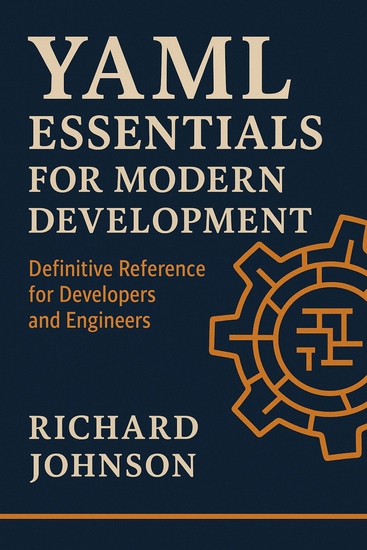
YAML Essentials for Modern Development - Definitive Reference for Developers and Engineers - cover

YAML Essentials for Modern Development - Definitive Reference for Developers and Engineers

Richard Johnson

Casa editrice: HiTeX Press

  • 0
  • 0
  • 0

Sinossi

"YAML Essentials for Modern Development""YAML Essentials for Modern Development" is an authoritative guide designed to equip engineers, DevOps practitioners, and software architects with comprehensive mastery of YAML—the language that powers modern configuration and data serialization. The book opens with an in-depth exploration of YAML fundamentals, including its data model, human-centric design, and nuanced syntax. Readers will quickly gain confidence through a structured understanding of foundational elements such as scalars, sequences, mappings, and best practices for authoring maintainable and unambiguous YAML documents.Progressing from the basics, the book delves into advanced topics and practical integration, covering programmatic processing, schema management, and robust security techniques. Through detailed comparisons of YAML libraries across major programming languages, performance benchmarks, and real-world serialization patterns, it empowers professionals to leverage YAML confidently for complex applications. Extended sections on linting, validation, and continuous integration illustrate how YAML quality can be upheld automatically across distributed teams, while anti-patterns and pitfalls highlight common traps and emerging best practices.The latter chapters examine YAML’s pivotal role in today’s DevOps, cloud-native, and application development ecosystems. With expert coverage of Kubernetes, Docker Compose, CI/CD pipelines, and Infrastructure as Code, the book outlines scalable strategies for managing large configurations, parameterized templates, and secure secrets management. The closing chapters survey the future of YAML, mapping its evolution against new specification proposals, alternative configuration languages, and the rapidly advancing requirements of edge, microservices, and AI-powered infrastructures. This definitive resource ensures that readers are well prepared to design, implement, and maintain high-quality YAML-based systems in any modern development context.
Disponibile da: 09/06/2025.
Lunghezza di stampa: 250 pagine.

Altri libri che potrebbero interessarti

  • Particle Physics - A Very Short Introduction - cover

    Particle Physics - A Very Short...

    Frank Close

    • 0
    • 0
    • 0
    Following the discovery of the Higgs boson, Frank Close has produced this major revision to his classic and compelling introduction to the fundamental particles that make up the universe. Frank Close takes us on a journey into the atom to examine known particles such as quarks, electrons, and the ghostly neutrino, and explains the key role and significance of the Higgs boson. Along the way he provides fascinating insights into how discoveries in particle physics have actually been made, and discusses how our picture of the world has been radically revised in the light of these developments. He concludes by looking ahead to new ideas about the mystery of antimatter and massive neutrinos, and to what the next fifty years of research might reveal about the nature of the Higgs field which molds the fundamental particles and forces.
    Mostra libro
  • The Center of the Star - Understanding and Changing the US Healthcare System - cover

    The Center of the Star -...

    Judith Kunisch

    • 0
    • 0
    • 0
    How do we fix a healthcare system that’s too complex, costly, and often unequal? In The Center of the Star, Judith Kunisch offers a groundbreaking perspective on reform, introducing a practical framework that makes sense of healthcare’s tangled web of consumers, providers, payers, policymakers, and the health industrial complex.
    Mostra libro
  • Neural Networks for Beginners - An Easy-to-Follow Introduction to Artificial Intelligence and Deep Learning - cover

    Neural Networks for Beginners -...

    Brian Murray

    • 0
    • 0
    • 0
    "Neural Networks for Beginners: An Easy-to-Follow Introduction to Artificial Intelligence and Deep Learning" is an essential guide to understanding the basics of neural networks, the fundamental technology behind artificial intelligence and deep learning. This book provides an in-depth exploration of neural network architectures and how they can be used to solve complex real-world problems in a variety of fields, including image and speech recognition, natural language processing, and time series analysis. 
    Written for beginners, this book provides a clear and concise introduction to the concepts and techniques of neural networks, including the basics of machine learning and deep learning. It covers a range of topics, from the fundamentals of neural networks to building and training models using popular frameworks like TensorFlow and PyTorch, as well as advanced topics like transfer learning and reinforcement learning. 
    With practical examples and clear explanations, "Neural Networks for Beginners" is a valuable resource for anyone looking to learn about this exciting field. Whether you are a student, a professional, or simply interested in the technology behind artificial intelligence, this book will help you understand the basics of neural networks and how they are used to solve real-world problems.
    Mostra libro
  • Artificial Integrity - The Paths to Leading AI Toward a Human-Centered Future - cover

    Artificial Integrity - The Paths...

    Hamilton Mann

    • 0
    • 0
    • 0
    Navigating the transitions to the future of AI—Integrity over Intelligence 


    Envision a world where artificial intelligence can deliver integrity-led outcomes seamlessly, adapting to diverse cultural context, value models, and situational nuances, countering subconscious biases, all while operating in an advanced human-centered manner. This is the promise of Artificial Integrity. 


    In Artificial Integrity, digital strategist, technologist, doctoral researcher, acclaimed management thinker, and seasoned business executive Hamilton Mann emphasizes that the challenge of AI is in ensuring systems that exhibit integrity-led capabilities over the pursuit of mere general or super intelligence. 


    Mann tackles the inadequacies of traditional ethical frameworks in handling the complexities of new AI technologies to make them trustworthy and reliable as they profoundly impact human lives. 


    Introducing the transformative concept of "artificial integrity," Mann proposes a paradigm shift, defining a "code of design" to ensure AI systems align with, amplify, and sustain human values and societal norms, maximizing integrity-led AI outcomes. 


    Artificial Integrity discusses practical insights into driving a future where AI enhances, without replacing, human capabilities while being inclusive and reflective of diverse human experiences, emphasizing human agency. 


    The book offers: 


    ● Guiding posts and step-by-step solutions for designing, implementing and continuously aligning AI development to responsibly advance human and artificial co-intelligence 


    ● Strategies and actionable advice for integrating AI into business and societal structures 


    ● Practical paths toward managing the transition to the future of AI for human productivity and decision-making while maintaining sustainable trustworthiness 


    Artificial Integrity is essential for anyone involved in AI development, from executives, business leaders, and managers to entrepreneurs, tech enthusiasts and policymakers. It's also perfect for laypeople interested in how AI intersects with society. Dive into this compelling and thought provoking listen to ensure you are prepared for the challenges and opportunities that lie ahead in a human-centered AI-driven future.
    Mostra libro
  • Forgiving Humanity - How the Most Innovative Species Became the Most Dangerous - The Curse of Exponential Change - cover

    Forgiving Humanity - How the...

    Peter Russell

    • 0
    • 0
    • 0
    Why has the most innovative of species become so dangerous? The answer, suggests Peter Russell, lies in humanity’s accelerating pace of development. He shows how innovation breeds further innovation—a positive feedback loop leading to exponential rates of change. But our minds cannot grasp the full implications of exponential growth. We think more in terms of linear change, leading to a blind spot on the future.  
    However fast the pace of change may be today, it will be even faster in the years to come, bringing ever more rapid scientific and technological advances. But ever-accelerating change also creates stress on the systems involved. The faster the change, the greater the stress, and the more likely systemic breakdown. We are heading into a future with technology beyond our dreams, but in a world that is breaking at the seams. 
    Russell argues there is no blame for this. Spiraling rates of development, with all their consequences, positive and negative, are the inevitable fate of any intelligent, technologically-empowered species.  
    How do we live with such unsettling conclusions? How can we prepare for a world that is becoming increasingly unpredictable? What does it mean for the future of humanity? 
    Peter Russell, the widely acclaimed author of The Global Brain and other pioneering works, earned an honors degree in theoretical physics and psychology —as well as a masters degree in computer science —at the University of Cambridge. He subsequently went to India where he explored meditation and Eastern philosophy, and was one of the first people to introduce personal development programs to corporations in the 1970s. His other books include The TM Technique, The Upanishads, Waking Up in Time, From Science to God, and Letting Go of Nothing.
    Mostra libro
  • Celestial Ghosts - Dark Matter's Invisible Influence on Stars - cover

    Celestial Ghosts - Dark Matter's...

    Dirk Fallon

    • 0
    • 0
    • 0
    Dark matter is one of the most elusive and mysterious components of the universe. It is invisible, yet its existence is inferred from the gravitational effects it has on visible matter, such as stars and galaxies. Despite being a significant part of the cosmos, dark matter has yet to be directly detected, which makes it an intriguing subject for astrophysicists. It is believed to make up about 27% of the universe's total mass and energy, far outpacing the visible matter that forms stars, planets, and galaxies. 
    The name “dark matter” was coined to reflect the fact that it does not emit, absorb, or reflect any form of electromagnetic radiation, making it invisible to current instruments. This absence of interaction with light or other electromagnetic forces is why it cannot be seen directly. However, dark matter’s presence is undeniable when looking at the way galaxies move. Without dark matter, galaxies would not have the gravitational pull necessary to prevent their stars from flying apart as they spin. This leads scientists to believe that dark matter provides the gravitational glue that holds galaxies, and indeed the entire universe, together. 
    One of the key pieces of evidence for dark matter comes from the study of galaxy clusters. When observing these massive cosmic structures, scientists noticed that the visible matter within them didn’t account for the full gravitational force required to keep the clusters intact. This discrepancy suggested the presence of an unseen substance, later named dark matter, that was exerting additional gravitational pull. Another significant clue comes from the phenomenon of gravitational lensing, where light from distant objects bends around large masses. Dark matter’s influence on this bending further supports the idea that it is present in quantities far larger than what we can observe.
    Mostra libro