Unisciti a noi in un viaggio nel mondo dei libri!
Aggiungi questo libro allo scaffale
Grey
Scrivi un nuovo commento Default profile 50px
Grey
Iscriviti per leggere l'intero libro o leggi le prime pagine gratuitamente!
All characters reduced
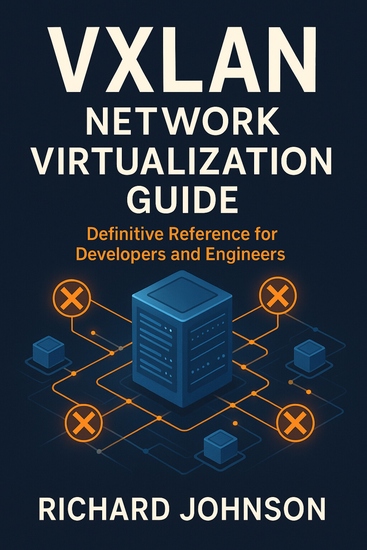
VXLAN Network Virtualization Guide - Definitive Reference for Developers and Engineers - cover

VXLAN Network Virtualization Guide - Definitive Reference for Developers and Engineers

Richard Johnson

Casa editrice: HiTeX Press

  • 0
  • 0
  • 0

Sinossi

"VXLAN Network Virtualization Guide"The "VXLAN Network Virtualization Guide" is a comprehensive resource that demystifies the rapidly evolving landscape of network overlays and data center virtualization. Beginning with a robust foundation in the evolution of data center architecture, the book critically examines the limitations of traditional VLANs, the fundamental concepts of overlay and underlay networking, and positions VXLAN alongside other leading protocols. Through methodical exploration, readers gain insight into the motivations that have propelled VXLAN to the forefront of scalable, cloud-ready, and service provider-grade network designs.Delving into the technical core, the guide meticulously covers the structural and operational mechanics of VXLAN, from encapsulation details and packet workflows to the pivotal role of UDP transport and the complexity of address mappings. It provides authoritative coverage of control plane mechanisms, including legacy flood-and-learn techniques and the transformative adoption of EVPN for large-scale deployments. Recognizing the operational realities of modern infrastructures, the book presents real-world implementation strategies, integration scenarios with SDN controllers, microsegmentation, high availability, monitoring, troubleshooting, and automation within both enterprise and service provider environments.With a forward-looking perspective, the guide addresses the critical challenges of security, compliance, and risk management in VXLAN-enabled architectures, offering actionable strategies for encryption, trust, monitoring, and incident response. It further explores advanced topics and the future direction of VXLAN, including protocol extensions, segment routing integrations, programmability, and cloud-native networking paradigms. Whether you are a network architect, engineer, or IT strategist, this guide offers an indispensable roadmap for designing, deploying, and evolving scalable, secure, and agile network infrastructures with VXLAN.
Disponibile da: 10/06/2025.
Lunghezza di stampa: 250 pagine.

Altri libri che potrebbero interessarti

  • Design Thinking - A comprehensive guide to design thinking and its applications - cover

    Design Thinking - A...

    Et Tu Code

    • 0
    • 0
    • 0
    Unlock the power of design thinking! This comprehensive guide takes you on a journey to understand the fundamentals and applications of design thinking, a revolutionary approach to innovation and problem-solving. 
    Learn how to think creatively, empathize with users, and develop innovative solutions that meet their needs. Dive into real-world examples and case studies from various industries, including technology, healthcare, education, and more. 
    Explore the five stages of design thinking: Empathize, Define, Ideate, Prototype, and Test. Discover how to: 
    * Develop a user-centered mindset 
    * Challenge assumptions and biases 
    * Foster collaboration and creativity 
    * Overcome obstacles and risks 
    * Measure success and iterate 
    Whether you're a designer, entrepreneur, or simply looking to innovate in your work or personal life, this book will provide you with the tools and knowledge to apply design thinking principles and bring your ideas to life.
    Mostra libro
  • Construction - Handbook for Project Management and Building Technology - cover

    Construction - Handbook for...

    Phil Gilberts

    • 0
    • 0
    • 0
    Construction management involves overseeing the planning, design, and construction of a project, ensuring it's completed on time, within budget, and to the desired quality standards. It involves coordinating various stakeholders, managing resources, and mitigating risks throughout the construction process. 
      
    Construction management encompasses a wide range of responsibilities and tasks aimed at efficiently executing construction projects. This includes: 
      
    Project Planning: Developing comprehensive project plans outlining the scope, schedule, budget, and resources required for successful completion. 
      
    Contract Administration: Administering contracts, managing subcontractors, and resolving disputes to maintain positive relationships and ensure contractual obligations are fulfilled. 
      
    Communication and Stakeholder Management: Facilitating effective communication among project team members, clients, regulatory agencies, and other stakeholders to promote collaboration and address concerns. 
      
    Health and Safety: Implementing safety measures and protocols to protect workers, visitors, and the public from hazards and ensure compliance with health and safety regulations. 
      
    Overall, construction management plays a critical role in orchestrating all aspects of a construction project to deliver a successful outcome that meets client objectives while adhering to time, cost, and quality constraints.
    Mostra libro
  • The AI Factor - How to Apply Artificial Intelligence and Use Big Data to Grow Your Business Exponentially - cover

    The AI Factor - How to Apply...

    Asha Saxena, Seth Dobrin

    • 0
    • 0
    • 0
    Have you heard about artificial intelligence (AI) and big data but felt they are technologies too big or too complicated for you or your business? Do you imagine AI as a Hollywood science fiction stereotype or something in the far and distant future? 


    Take heart. AI is none of those things. It's part of our everyday lives, and it has the power to transform your business. 


    This book will put AI, big data, the cloud, robotics, and smart devices in context. It will reveal how these technologies can dramatically multiply any businesses—including yours—by strategically using your data's latent, transformative potential. 


    Noted business leader, data consultant, and Columbia professor Asha Saxena has distilled her twenty-seven years of experience teaching Fortune 500 leaders in this powerful and insightful book. In The AI Factor, business leaders will learn how to understand the data they already have and how to use it innovatively to grow their businesses using Saxena's unique methodology.
    Mostra libro
  • Tech Innovations - Breakthroughs Shaping the Future - cover

    Tech Innovations - Breakthroughs...

    Craig Dames

    • 0
    • 0
    • 0
    Artificial Intelligence (AI) and Machine Learning (ML) are at the forefront of technological innovation, transforming nearly every sector and redefining how we live, work, and interact. These technologies, once confined to science fiction, now power tools and systems that many people use daily—from personalized recommendations on streaming platforms to virtual assistants and advanced data analysis in business and healthcare. 
    The rise of generative AI, such as large language models and image synthesis tools, marks a new era in machine intelligence. These systems can create human-like text, generate realistic images, compose music, and even design products. They're not just mimicking human creativity—they're expanding it, offering new ways for people to ideate and innovate across disciplines. Businesses are leveraging generative AI to automate content creation, improve customer service, and enhance productivity. While the creative potential is staggering, it also brings up questions about authorship, originality, and the future of creative professions. 
    AI is also becoming deeply embedded in everyday applications. Smartphones use AI to improve photos, optimize battery life, and enable voice recognition. In healthcare, AI helps doctors diagnose diseases with higher accuracy by analyzing medical images and patient data. Financial institutions use it to detect fraud and make investment decisions. Meanwhile, retailers personalize shopping experiences by analyzing customer behavior. In essence, AI is becoming the silent partner in many human decisions, making systems smarter, faster, and more adaptive.
    Mostra libro
  • The New Empire of AI - The Future of Global Inequality - cover

    The New Empire of AI - The...

    Rachael Adams

    • 0
    • 0
    • 0
    As AI takes hold across the planet and wealthy nations seek to position themselves as global leaders of this new technology, the gap is widening between those who benefit from it and those who are subjugated by it. As Rachel Adams shows in this hard-hitting book, growing inequality is the single biggest threat to the transformative potential of AI. Not only is AI built on an unequal global system of power, it stands poised to entrench existing inequities, further consolidating a new age of empire. 


    AI's impact on inequality will not be experienced in poorer countries only: it will be felt everywhere. The effects will be seen in intensified international migration as opportunities become increasingly concentrated in wealthier nations; in heightened political instability and populist politics; and in climate-related disasters caused by an industry blind to its environmental impact across supply chains. 


    We need to act now to address these issues. Only if the current inequitable trajectory of AI is halted, the incentives changed, and the production and use of AI decentralized from wealthier nations will AI be able to deliver on its promise to build a better world for all.
    Mostra libro
  • Geology - The Earth's Secrets Understanding Rocks Minerals and Time - cover

    Geology - The Earth's Secrets...

    Mike Crawford

    • 0
    • 0
    • 0
    The Earth’s formation is a story of cosmic collisions, immense heat, and gradual cooling that set the stage for the planet we know today. Approximately 4.6 billion years ago, the solar system emerged from a vast cloud of dust and gas. This cloud, known as the solar nebula, began to collapse under gravity, forming the Sun at its center. Around this young star, particles of dust and rock started clumping together, eventually leading to the creation of planets, including Earth. 
    In its early years, Earth was a molten sphere, continuously bombarded by asteroids and comets. These impacts contributed to the planet’s mass and introduced essential elements like water. As gravitational forces compressed Earth’s interior, temperatures soared, causing heavy materials such as iron and nickel to sink toward the core while lighter elements like silicon and oxygen remained near the surface. This process, known as planetary differentiation, led to the formation of Earth’s three primary layers: the core, mantle, and crust. 
    The early atmosphere of Earth was vastly different from what it is today. Initially, it consisted of hydrogen and helium, but solar winds stripped these gases away. Volcanic activity and ongoing collisions released vast amounts of carbon dioxide, water vapor, methane, and ammonia, forming a thick and toxic atmosphere. Over time, as volcanic eruptions continued, water vapor condensed to form clouds, eventually leading to heavy rainfall that lasted for thousands of years. These rains filled low-lying areas, giving rise to the first oceans.
    Mostra libro