Unisciti a noi in un viaggio nel mondo dei libri!
Aggiungi questo libro allo scaffale
Grey
Scrivi un nuovo commento Default profile 50px
Grey
Iscriviti per leggere l'intero libro o leggi le prime pagine gratuitamente!
All characters reduced
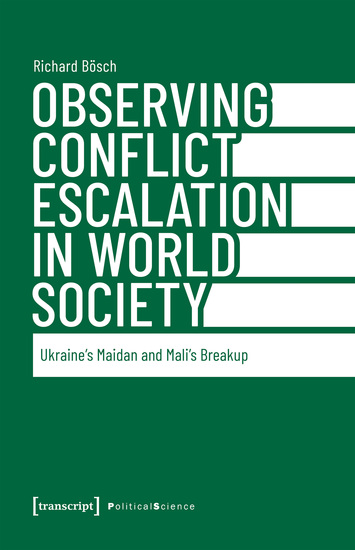
Observing Conflict Escalation in World Society - Ukraine's Maidan and Mali's Breakup - cover

Observing Conflict Escalation in World Society - Ukraine's Maidan and Mali's Breakup

Richard Bösch

Casa editrice: transcript Verlag

  • 0
  • 0
  • 0

Sinossi

How do conflicts escalate? This is one of the major questions in conflict research. To offer further answers, Richard Bösch follows a tripartite agenda: First, he develops a constructivist methodology for the study of conflict escalation embedded in a Luhmannian systems theoretical world society perspective. Bösch argues that conflicts can be observed as social systems and he looks at the process of conflict escalation by analysing communication. Second, this analysis offers two case studies: the Maidan protests in Ukraine 2013-2014 and Mali's crisis 2010-2012. Third, it gives insights on how systems theoretical research can be beneficial for Peace and Conflict Studies.
Disponibile da: 31/10/2023.

Altri libri che potrebbero interessarti

  • Trial Of "Athens Three" - cover

    Trial Of "Athens Three"

    John Warwick Montgomery

    • 0
    • 0
    • 0
    In May, 1986, at the Court of Appeals in Athens, Dr. Montgomery successfully defended three evangelical missionaries who had been given three-and-a half year prison terms for "proselytizing." The President of the United States and many congressional leaders had written to the Greek government in support of the defendants. Following the trial, Dr. Montgomery was asked to deliver a lecture on the subject at the International Christian Embassy in Jerusalem (June 19, 1986). Here is the recording of that account of one of the major Christian human rights trials of our time.
    Mostra libro
  • Fighting Terrorism - How Democracies Can Defeat Domestic and International Terrorists - cover

    Fighting Terrorism - How...

    Benjamin Netanyahu

    • 0
    • 1
    • 0
    In this innovative and concise work, Israeli politician Benjamin Netanyahu offers a compelling approach to understanding and fighting the increase in domestic and international terrorism throughout the world. Citing diverse examples from around the globe, Netanyahu demonstrates that domestic terrorist groups are usually no match for an advanced technological society which can successfully roll back terror without any significant curtailment of civil liberties. But Netanyahu sees an even more potent threat from the new international terrorism which is increasingly the product of Islamic militants, who draw their inspiration and directives from Iran and its growing cadre of satellite states. The spread of fundamentalist Islamic terrorism, coupled with the possibility that Iran will acquire nuclear weapons, poses a more frightening threat from an adversary less rational and therefore less controllable than was Soviet Communism. How democracies can defend themselves against this new threat concludes this provocative book.
    Mostra libro
  • The Phoenix Solution - Getting Serious about America's Drug War - cover

    The Phoenix Solution - Getting...

    Vincent Bugliosi

    • 0
    • 0
    • 0
    Not just a searing indictment of American drug policy, but a step-by-step guide to addressing it once and for all!Respected attorney Vincent Bugliosi, who successfully prosecuted Charles Manson, directs his attention to a national epidemic— the chronic drug crisis in America. An analysis of the drug policy in the United States, this critical review reveals a disturbing level of ineptness in drug control practices. But Bugliosi also presents a program for bringing the drug crisis in our nation to an end. He sets forth a detailed, step-by-step plan for solving this seemingly endless problem. Controversial but comprehensive, The Phoenix Solution provides an actual blueprint for bringing the crisis to an end.
    Mostra libro
  • Citizen of the World: Soon-Young and the UN (Abridged) - Abridged - cover

    Citizen of the World: Soon-Young...

    Soon-Young Yoon

    • 0
    • 0
    • 0
    From North Korean Refugee to the United Nations: A Courageous and Compassionate Memoir Soon-Young Yoon understood from an early age that people's destinies are connected to international events. This book is a collection of her reflections as a women's human rights advocate speaking up to end violence against women and change the world to ensure gender equality, sustainable development, and peace. Yoon has seen the struggle for human rights in all corners of the world, meeting with people in urban slums and the offices of the United Nations. She urges us to look at the world through women's eyes to understand why gender equality and women's empowerment, particularly for the poorest and most vulnerable populations, is essential to our collective good. In Citizen of the World, you'll be inspired by Yoon's stories on Ending violence against women and girls Finding the Earth's balance Claiming the right to social and economic development Portraits of great women leaders Collective voices that are changing the world Challenges working as a feminist anthropologist inside and outside the United Nations Written through the lens of an anthropologist, these essays reflect her belief that one needs to understand a wide range of issues to shape our common future. Students, academics, and activists in the fields of women's studies, international relations, anthropology, and social justice will find Citizen of the World both unique and eye-opening—and filled with hope for a better future for us all.
    Mostra libro
  • Occupy - Three Inquiries in Disobedience - cover

    Occupy - Three Inquiries in...

    Bernard E. Harcourt, W.J.T....

    • 0
    • 0
    • 0
    Mic check! Mic check! Lacking amplification in Zuccotti Park, Occupy Wall Street protestors addressed one another by repeating and echoing speeches throughout the crowd. In Occupy, W. J. T. Mitchell, Bernard E. Harcourt, and Michael Taussig take the protestors’ lead and perform their own resonant call-and-response, playing off of each other in three essays that engage the extraordinary Occupy movement that has swept across the world, examining everything from self-immolations in the Middle East to the G8 crackdown in Chicago to the many protest signs still visible worldwide. “You break through the screen like Alice in Wonderland,” Taussig writes in the opening essay, “and now you can’t leave or do without it.” Following Taussig’s artful blend of participatory ethnography and poetic meditation on Zuccotti Park, political and legal scholar Harcourt examines the crucial difference between civil and political disobedience. He shows how by effecting the latter—by rejecting the very discourse and strategy of politics—Occupy Wall Street protestors enacted a radical new form of protest. Finally, media critic and theorist Mitchell surveys the global circulation of Occupy images across mass and social media and looks at contemporary works by artists such as Antony Gormley and how they engage the body politic, ultimately examining the use of empty space itself as a revolutionary monument. Occupy stands not as a primer on or an authoritative account of 2011’s revolutions, but as a snapshot, a second draft of history, beyond journalism and the polemics of the moment—an occupation itself.
    Mostra libro
  • Revolution and Terror - cover

    Revolution and Terror

    Graeme Gill

    • 0
    • 0
    • 0
    This book is a study of the relationship between revolution and terror. Historically many have claimed that revolution inevitably devolves into terror, best reflected in the way in which after coming to power the revolutionary elite turns on itself, and one section of it uses terrorist means to eliminate another section. Graeme Gill argues that in order to understand the relationship between revolution and terror, it is necessary to distinguish between different types of terror. There are three such types: revolutionary terror, in which the aim is to destroy enemies and thereby consolidate the regime; transformational terror, designed to drive the politico-socio-economic transformation of society that is the purpose of the 'great' revolutions; and inverted terror, which is when terror is turned against part of the elite and regime more broadly. The analysis explains how these different types of terror are related to the revolutionary seizure of power, showing that revolutionary and transformational terror are organically connected to revolution while for inverted terror the connection is mediated through the leader. The argument is prosecuted through detailed analysis of the French, Russian, and Chinese revolutions. The study ends by assessing the contemporary salience of the lessons of the great revolutions in the light of the low level of violence in the negotiated revolutions of 1989.
    Mostra libro