Unisciti a noi in un viaggio nel mondo dei libri!
Aggiungi questo libro allo scaffale
Grey
Scrivi un nuovo commento Default profile 50px
Grey
Iscriviti per leggere l'intero libro o leggi le prime pagine gratuitamente!
All characters reduced
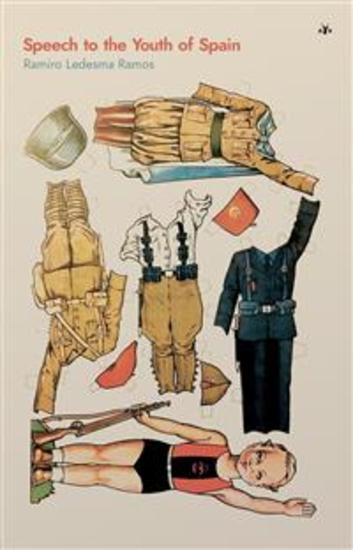
Speech to the Youth of Spain - cover

Speech to the Youth of Spain

Ramiro Ledesma Ramos

Casa editrice: Antelope Hill Publishing LLC

  • 0
  • 0
  • 0

Sinossi

Fascism in its various iterations swept through continental Europe like a tidal wave in the 1920s and 30s. While Hitler’s Germany and Mussolini’s Italy tend to steal the show in historical examinations of the topic, Spain was also one of its most fruitful strongholds. Ramiro Ledesma Ramos, born in Spain at the beginning of the 20th century, made a name for himself as one of the most fervent pioneers of Fascism in his country, combining what he saw as the best elements of Mussolini’s and Hitler’s philosophies in order to create the ideal synthesis for Spain.
 
Instrumental in the formation of the Falange, the leading Spanish Fascist political organization, Ledesma personally designed the yoke and arrows symbol that would remain in use after the organization's assimilation by the Francoist government. It is often said that the war of ideas finds its seeds in the young, and Speech to the Youth of Spain implored the next generation to raise Spain up to be a great European power once more. In this appeal to the young men and women of Spain, the author draws upon the lessons learned from his country’s ideologically aligned neighbors, as well as from its own rich history.
 
Caught in enemy territory at the outbreak of the Spanish Civil War, Ramiro Ledesma Ramos was arrested and ultimately executed by the Republicans, but his ideas would go on to shape the subsequent decades of Spanish history. Antelope Hill is privileged to publish the work of this preeminent political philosopher, translated into English for the first time.
Disponibile da: 22/04/2024.

Altri libri che potrebbero interessarti

  • Gaslights and Dog Whistles - Standing Up for Facts Over Fiction in a Fearful and Divided World - cover

    Gaslights and Dog Whistles -...

    Jim Morris, with Rianna Moore

    • 0
    • 0
    • 0
    The U.S. is suffering from toxic polarization. It’s fueled by the abdication of the truth in favor of an alternative reality that now divides us along ideological lines. Race is one of our most polarizing issues, and along with it, critical race theory (CRT), which examines how systems and policies perpetuate racism. Critical race theory is a specialized intellectual field established in the 1980s by legal scholars that describes how discrimination and racism in the United States is not a coincidence, but rather an outcome that is the result of the biased and slanted policies and practices that have disadvantaged non-white people in the U.S. for more than three centuries. 
    Now, many conservative lawmakers are latching on to the concept of CRT as a way to stoke fear of inclusion and change, using CRT as a catch-all phrase for restricting how racism and history are taught in schools. Currently, at least 35 states have passed or considered legislation on race education. 
    The goal of this book is to create some clarity out of the chaos and panic surrounding CRT, and to provide intervention strategies, tactics, and approaches to address the critiques and assertions of CRT skeptics and the anti-CRT lobby. Gaslights and Dog Whistles - Upholding Critical Race Theory and the Real History of Racism in the U.S. illuminates the path we can take to engage our peers in constructive dialogue to both understand their point of view and open up a world of new possibilities for them to move from fear to partnership.
    Mostra libro
  • Nato's Role - An International Coalition During the War in Afghanistan - cover

    Nato's Role - An International...

    Vince Bywaters

    • 0
    • 0
    • 0
    NATO, or the North Atlantic Treaty Organization, is a military alliance formed in 1949 to provide collective defense against aggression, primarily focused on safeguarding the democratic values and security of its member nations. Over time, its role has expanded from traditional defense to addressing global security challenges, including the fight against terrorism and the stabilization of conflict zones. The War in Afghanistan became a key test for NATO's evolving mission, showcasing its capabilities in out-of-area operations far beyond the traditional borders of its members. 
    The decision to involve NATO in Afghanistan followed the September 11, 2001, terrorist attacks on the United States, which were planned and orchestrated by al-Qaeda, a terrorist group harbored by Afghanistan's Taliban regime. In response, NATO invoked Article 5 of its founding treaty for the first time in its history, declaring an attack on one member as an attack on all. The alliance's commitment to fighting terrorism led to the deployment of NATO forces in Afghanistan, initially through Operation Enduring Freedom, and later through the more expansive International Security Assistance Force (ISAF) mission. 
    NATO’s intervention was multi-faceted, aiming not only to eliminate terrorist threats but also to assist in rebuilding a war-torn nation. The alliance’s involvement extended beyond military operations, focusing on stabilizing Afghanistan by promoting security, governance, and economic development. This commitment was based on the understanding that military force alone would not bring lasting peace. NATO recognized that its mission required close collaboration with local Afghan forces, international organizations, and governments, all working together to achieve a stable and secure Afghanistan.
    Mostra libro
  • The Venlo Sting - MI6's Deadly Fiasco - cover

    The Venlo Sting - MI6's Deadly...

    Norman Ridley

    • 0
    • 0
    • 0
    "I would recommend the book to intelligence practitioners, scholars, and other persons interested in World War II intelligence history." —Michael Nady, American Intelligence JournalOn 9 November 1939, two unsuspecting British agents of the Special Intelligence Services walked into a trap set by German Spymaster Reinhard Heydrich. Believing that they were meeting a dissident German general for talks about helping German military opposition to bring down Hitler and end the war, they were instead taken captive in the Dutch village of Venlo and whisked away to Germany for interrogation by the Gestapo. The incident was a huge embarrassment for the Dutch government and provided the Germans with significant intelligence about SIS operations throughout Europe.  The incident itself was an intelligence catastrophe but it also acts as a prism through which a number of other important narrative strands pass. Fundamental to the subterfuge perpetrated at Venlo were unsubstantiated but insistent rumours of high-ranking German generals plotting to overthrow the Nazi regime from within. After the humiliation suffered when Hitler tore up the Munich Agreement, British Prime Minister Neville Chamberlain was anxious to see just how much truth there was in these stories; keen to rehabilitate his reputation through one last effort to find a peaceful rapprochement with Germany.  When Franz Fischer, a small-time petty crook and agent provocateur, persuaded British SIS operatives in the Netherlands that he could act as a go-between for the British government with disaffected German generals, the German Security chief Reinhard Heydrich stepped in and quietly took control of the operation. Heydrich’s boss, head of the Gestapo Heinrich Himmler, was anxious to explore the possibility of peace negotiations with Britain and saw an opportunity to exploit the situation for his personal benefit.  On the day before a crucial meeting of conspirators and British agents on the Dutch-German border, a bomb exploded in the Bürgerbräukeller in Munich in the exact spot where Hitler had stood to deliver a speech only minutes earlier. The perpetrator was quickly arrested, and Hitler demanded that Himmler find evidence to show that the two events were intimately connected—the British agents were snatched hours later.  While the world was coming to terms with the fearsome power of German military might the British intelligence capability in northern Europe was consigned to the dustbin in the sleepy Dutch town of Venlo. This first full account of the Venlo incident explores the wider context of this German intelligence coup, and its consequences.
    Mostra libro
  • Capitalism and Inequality - Exploring the Economic Divide in a Capitalist Society - cover

    Capitalism and Inequality -...

    Arlo Holders

    • 0
    • 0
    • 0
    Capitalism, as an economic system, is based on private ownership of the means of production and the creation of goods or services for profit. In capitalist societies, market forces—supply and demand—determine the distribution of resources and wealth. This system is characterized by competition, limited government intervention, and the pursuit of profit. Over time, capitalism has evolved in response to global events, technological advancements, and changes in social and political structures. However, a fundamental aspect of capitalism that persists is the inherent inequality it creates. 
    Inequality in capitalist societies can be understood in several forms: wealth inequality, income inequality, and social inequality. Wealth inequality refers to the uneven distribution of assets like property, stocks, and savings, where a small percentage of the population controls a large share of the wealth. Income inequality, on the other hand, concerns the differences in wages and salaries among workers, managers, and capital owners. Social inequality arises from disparities in access to resources like education, healthcare, and housing, which are often shaped by economic factors. 
    At the heart of capitalist inequality is the idea that economic success is determined by individual effort, entrepreneurship, and market performance. While this promotes competition and innovation, it also leads to stark divides between the wealthy and the poor. Those who control capital—such as land, factories, or intellectual property—are in a position to accumulate wealth far faster than those who rely solely on their labor. This uneven accumulation of wealth deepens the divide between rich and poor, creating a cycle where the wealthy continue to grow their resources, while those at the bottom struggle to access basic needs.
    Mostra libro
  • Deer Hunting with Jesus - Dispatches from America's Class War - cover

    Deer Hunting with Jesus -...

    Joe Bageant

    • 0
    • 0
    • 0
    By turns tender, incendiary, and seriously funny, this book is a call to arms for fellow progressives with little real understanding of "the great beery, NASCAR-loving, church-going, gun-owning America that has never set foot in a Starbucks." 


    Deer Hunting with Jesus is Joe Bageant's report on what he learned when he moved back to his hometown of Winchester, Virginia. Like countless American small towns, it is fast becoming the bedrock of a permanent underclass. Two in five of the people in his old neighborhood do not have high school diplomas or health care. Alcohol, overeating, and Jesus are the preferred avenues of escape. 


    He writes of: 


    ● His childhood friends who work at factory jobs that are constantly on the verge of being outsourced 


    ● The mortgage and credit card rackets that saddle the working poor with debt 


    ● The ubiquitous gun culture—and why the left doesn't get it 


    ● Scots Irish culture and how it played out in the young life of Lynddie England
    Mostra libro
  • Boycott Divestment Sanctions - The Global Struggle for Palestinian Rights - cover

    Boycott Divestment Sanctions -...

    Omar Barghouti

    • 0
    • 0
    • 0
    "Barghouti is the future. He is intelligent, empowered, and non-violent. He is completely impressive. It would help Americans to see such a picture of Palestinian political engagement, when they have such a distorted image of who Palestinians are. Some day they will know him." —Phillip Weiss, author of Mondoweiss: The War of Ideas in the Middle East 


    THIRTY YEARS ago, an international movement utilizing boycott, divestment, and sanction (BDS) tactics rose in solidarity with those suffering under the brutal apartheid regime of South Africa. The historic acts of BDS activists from around the world isolated South Africa as a pariah state and heralded the end of apartheid. 


    Now, as awareness of the apartheid nature of the State of Israel continues to grow, Omar Barghouti, founding member of the Palestinian Civil Society Boycott, Divestment, and Sanctions (BDS) campaign against Israel, presents a renewed call to action. Aimed at forcing the State of Israel to uphold international law and universal human rights for the Palestinian people, here is a manifesto for change.
    Mostra libro