Join us on a literary world trip!
Add this book to bookshelf
Grey
Write a new comment Default profile 50px
Grey
Subscribe to read the full book or read the first pages for free!
All characters reduced
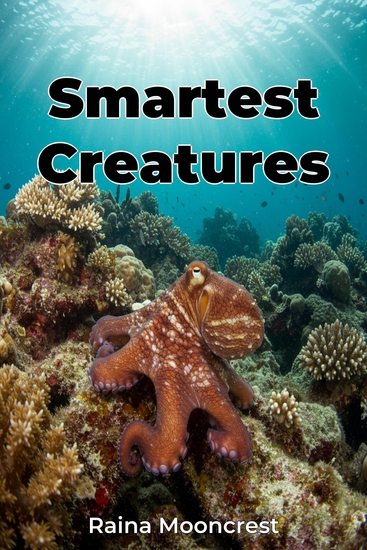
Smartest Creatures - cover

Smartest Creatures

Raina Mooncrest

Translator A AI

Publisher: Publifye

  • 0
  • 0
  • 0

Summary

Smartest Creatures explores the fascinating realm of animal cognition, questioning the notion that complex thought is exclusive to humans. Delving into the cognitive abilities of dolphins, chimpanzees, crows, and octopuses, the book reveals how these animals exhibit intelligence through tool use, intricate social structures, and problem-solving skills. For instance, dolphins possess complex communication systems and self-awareness, while crows demonstrate remarkable problem-solving abilities. 

 
The book begins by outlining the principles of animal cognition research and then dedicates chapters to each of the selected species, detailing their unique cognitive strengths. By adopting a comparative approach, Smartest Creatures highlights both the commonalities and differences in intellectual strategies across these distantly related species.

 
 Ultimately, the book challenges anthropocentric views and broadens our understanding of intelligence as a diverse phenomenon shaped by evolution and comparative cognition.
Available since: 03/05/2025.
Print length: 67 pages.

Other books that might interest you

  • The Voice of Animals - cover

    The Voice of Animals

    Pilar Badía, Diego J. Hernández

    • 0
    • 0
    • 0
    The most common way we come to know animals is usually by rote learning the specific features that certain kind of animals have according to a textbooks. We learn that they are mammals, birds or fish; but at school we rarely mention that they have a personality of their own and even less do we analyze whether we treat them well or badly. Have you ever wondered how animals actually feel?
    Have you thought about how they are treated in our society?
    The Voice of Animals promotes reflection through critical thinking on different issues related to animal ethics. By raising questions it paves the way to analyze the most common themes that emerge in adolescence regarding the lives of animals, both free and captive.
    Show book
  • How Software Fails - The Hidden Laws of Complex Systems - cover

    How Software Fails - The Hidden...

    Engin Yöyen

    • 0
    • 0
    • 0
    This audiobook is narrated by an AI Voice.   
    How Software Fails: A Field Guide to Understanding Complex System Disasters 
    Software failures aren't accidents, they're inevitabilities. In a universe governed by probability rather than certainty, even cosmic rays from distant stars can flip bits in computer memory, causing election machines to miscount votes or video game characters to jump impossibly high. But cosmic interference is just the beginning of how our most critical systems fail in spectacular and unpredictable ways. 
    Through gripping real-world case studies, this field guide reveals the hidden laws governing complex system disasters. Discover how Knight Capital lost $460 million in 45 minutes due to a single misplaced software flag. Learn why the Therac-25 radiation machine killed patients despite passing every safety test.Understand how a 40-kilobyte configuration file crashed 8.5 million computers worldwide, grounding flights and shuttering hospitals across the globe. 
    What You'll Learn 
    Based on complexity theorist Richard Cook's groundbreaking principles, you'll discover: 
    - Why testing can never guarantee perfection, and what to do instead 
    - How "reasonable" decisions combine to create unreasonable disasters 
    - Why complex systems always run in degraded mode, and why that's actually normal 
    - How scale transforms rare impossibilities into daily certainties 
    - Why the search for "root causes" consistently leads us astray 
    But this isn't just about understanding failure, it's about building resilience. Explore practical strategies from organizations that have learned to thrive in chaos: 
    - NASA's Mars rovers that adapt and learn from component failures, operating decades beyond their planned lifetimes 
    - The internet's routing protocols that automatically heal themselves when damaged 
    - Netflix's chaos engineering that deliberately breaks their own servers to build antifragile systems 
    - The ethical frameworks for deciding what level of failure is acceptable when lives are at stake
    Show book
  • Astrobiology - Exploring Life beyond Earth and the Mysteries of the Universe - cover

    Astrobiology - Exploring Life...

    Mike Crawford

    • 0
    • 0
    • 0
    Astrobiology is the scientific study of life in the universe. It seeks to answer profound questions about the origins, evolution, distribution, and future of life beyond Earth. As a highly interdisciplinary field, astrobiology combines biology, chemistry, astronomy, geology, and planetary science to explore the potential for life on other planets and moons. This field is not merely about searching for intelligent extraterrestrial civilizations but also about understanding the fundamental processes that make life possible and where these conditions might exist beyond Earth. 
    One of the primary goals of astrobiology is to investigate the origins of life. Scientists study early Earth environments to understand how life first emerged, using this knowledge to determine where similar conditions might exist elsewhere in the cosmos. The discovery of extremophiles—organisms that thrive in extreme environments such as deep-sea hydrothermal vents, acidic lakes, and polar ice caps—has expanded the understanding of life’s resilience. If life can persist in such harsh conditions on Earth, it raises the possibility that microbial life may exist on planets or moons with extreme environments, such as Mars, Europa, or Enceladus. 
    Astrobiologists also examine the habitability of other planets by identifying key factors necessary for life. The presence of liquid water, an energy source, and essential chemical elements like carbon, hydrogen, oxygen, and nitrogen are considered fundamental prerequisites for life as we know it. The concept of the "habitable zone"—the region around a star where conditions might allow liquid water to exist—has become central to the search for exoplanets that could support life. Recent discoveries of thousands of exoplanets, some of which are Earth-like, have fueled optimism about finding life beyond our solar system.
    Show book
  • The Phantom Cosmos - Decoding the Dark Energy That Expands the Universe - cover

    The Phantom Cosmos - Decoding...

    Dirk Fallon

    • 0
    • 0
    • 0
    The universe is a vast expanse filled with enigmas that have intrigued scientists and philosophers for millennia. In the wake of the Big Bang, the cosmos burst into existence, unleashing a torrent of energy and matter that set the stage for the formation of everything we know today. From the very first moments, the universe exhibited a complexity that would eventually lead to the emergence of galaxies, stars, and planets. Yet, amid this wondrous creation, a peculiar and subtle force began to assert its influence—one that would later be identified as dark energy. This mysterious component, largely invisible and poorly understood, is now believed to be responsible for the accelerating expansion of the universe, challenging our conventional understanding of gravity and the evolution of cosmic structures. 
    In the early epochs of the universe, conditions were extremely volatile and unpredictable. Subatomic particles collided with tremendous energy, and the nascent fabric of space-time was in constant flux. As the universe cooled and matter began to coalesce, forces that governed particle interactions and the formation of atoms started to take hold. It was during this formative period that the seeds of cosmic structure were planted, and the universe embarked on a long, gradual journey towards complexity. However, it was also during this time that the presence of dark energy, although not yet recognized, began to subtly influence the behavior of the cosmos. This influence was initially hidden in the chaotic interplay of energy and matter but would later emerge as one of the most critical factors in cosmic evolution.
    Show book
  • The Exciting World of Web 30 - The Future of Internet - cover

    The Exciting World of Web 30 -...

    Vicky V. Choudhary

    • 0
    • 0
    • 0
    The Exciting World of Web 3.0 series is a captivating exploration into the most revolutionary technological shift of our time. This series demystifies the next evolution of the internet, where virtual reality, decentralised systems, and digital ownership redefine how we connect, create, and interact. 
    In Book 1: The Metaverse, uncover how immersive technologies like VR, AR, and blockchain are shaping a parallel digital universe — the Metaverse. Learn how this interconnected ecosystem will transform everything from workspaces to social life. 
    In Book 2: Non-Fungible Tokens (NFTs), delve into the booming world of digital collectibles and crypto assets. Discover how NFTs are empowering creators, reshaping ownership, and driving the future of decentralised economies. 
    Perfect for curious minds, tech enthusiasts, and forward-thinkers, this series is your gateway to understanding the innovations that are building the internet of tomorrow. 
    Happy learning! Enjoy your book!
    Show book
  • IT Fundamentals : Everything you need to know about IT - A Comprehensive Guide to Information Technology - cover

    IT Fundamentals : Everything you...

    Imran Afzal

    • 0
    • 0
    • 0
    Welcome to "IT Fundamentals: Everything You Need to Know About IT"! This book is like a friendly guide into the big world of computers and the internet, made especially for beginners, people who love technology, and anyone who wants to know more about how digital stuff works.Think of this book as a treasure map that leads you through the land of Information Technology (IT). We'll start with the basics, like how computers work, what software is, and why operating systems are important. Its like learning the ABCs of technology.Then, well get into how computers talk to each other through networks, and why that's super important for things like surfing the web or sending emails. Plus, well cover how to keep your computer safe from viruses and hackers because nobody wants their personal stuff stolen.Well also peek into the cloud, which is not the one in the sky but a place on the internet where you can store your photos, videos, and files so you can get to them from anywhere. And well explore big data and why it's a big deal for making smart decisions in business and life.But that's not all! We're also looking into the future at cool stuff like artificial intelligence (AI), which is how computers can learn to think a bit like us, and the Internet of Things (IoT), which is about connecting everyday things like fridges and lights to the internet.Heres what youll discover inside:The very basics of computers and software.How the internet and networks work.Ways to protect your computer from bad guys.What the cloud is and how to use it.Exciting future tech like AI and smart devices.This book is for anyone who wants to get comfortable with technology, upgrade their tech skills, or just have a handy guide to help understand the tech world better. With simple explanations and real-life examples, "IT Fundamentals" is your ticket to becoming tech-savvy.Start your tech adventure with us and see how exciting and useful the world of IT can be!
    Show book