Join us on a literary world trip!
Add this book to bookshelf
Grey
Write a new comment Default profile 50px
Grey
Subscribe to read the full book or read the first pages for free!
All characters reduced
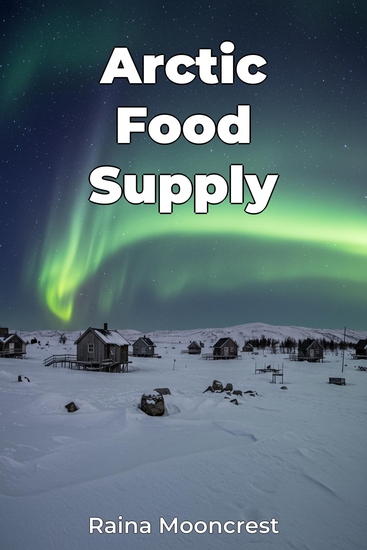
Arctic Food Supply - cover

Arctic Food Supply

Raina Mooncrest

Translator A AI

Publisher: Publifye

  • 0
  • 0
  • 0

Summary

Arctic Food Supply explores how remote Arctic communities secure and sustain their food supply in one of the most challenging environments on Earth. It examines traditional hunting and gathering practices, innovative food storage technologies, and the impact of climate change on food security. Historically, Arctic communities have developed sophisticated hunting techniques, passing down intricate knowledge of local ecosystems through generations. The book highlights how understanding the vulnerabilities of Arctic food systems can inform policies promoting sustainable development.

 
The book uniquely integrates traditional ecological knowledge with modern technological advancements, arguing that this approach is crucial for community resilience in the face of climate change. For example, traditional ice cellars contrast with modern community freezers, each playing a role in food preservation.

 
The book progresses by first establishing a geographic and environmental foundation, then exploring traditional practices, investigating food storage technologies, and finally, analyzing the impact of climate change on these food systems.
Available since: 03/11/2025.
Print length: 69 pages.

Other books that might interest you

  • PCCN Study Guide 2024-2025 - Review Book with 375 Practice Questions and Answers for the Progressive Care Certified Nurse Exam - cover

    PCCN Study Guide 2024-2025 -...

    Shawn Blake

    • 0
    • 0
    • 0
    Why 1 in 4 nurses fail the PCCN exam on their first try (and what you can do differently)... 
    Success on the PCCN exam requires more than just rote memorization or sharp test-taking skills. 
      
    It requires strategy. A systematic approach that helps you break down and translate each question into familiar terms, so you can make full use of your clinical judgment and silence exam anxiety. 
      
    This book provides you with that strategy. 
       
    Inside, you’ll discover: 
      
    ●     A simple 4-step approach that lets you dissect each question on the exam and narrow down your options by tapping into your clinical expertise 
    ●     Which biological systems and diseases make up the most significant portion of the exam 
    ●     The core components of the AACN’s Synergy Model, and which aspects you’re likely to be tested on 
    ●     What to know before you start studying — this is vital to helping you squeeze the most out of your study prep 
    ●     Three full-length practice test that includes 125 unique questions and detailed answer explanations, plus 50 extra practice questions to help reinforce your knowledge for each section on the PCCN 
      
    And much more! 
      
    By the end, you’ll know what to expect on every section of the exam, including the most critical points many nurses forget about. So even if you’re still starting to build out your career, you’ll have a winning strategy that can help maximize your chances of passing the PCCN on your first try. 
      
    Take the next step toward earning your PCCN certification
    Show book
  • Fly Fishing Small Streams - cover

    Fly Fishing Small Streams

    John Gierach

    • 0
    • 0
    • 0
    Small-stream fishing wisdom with the same insight and pungent humor that has become Gierach's trademark. Advice on tackle selecting, reading water, and scouting.
    Show book
  • A World Without Soil - The Past Present and Precarious Future of the Earth Beneath Our Feet - cover

    A World Without Soil - The Past...

    Jo Handelsman, Kayla Cohen

    • 0
    • 0
    • 0
    A scientist's manifesto addressing a soil loss crisis accelerated by poor conservation practices and climate change 


    This book by celebrated biologist Jo Handelsman lays bare the complex connections among climate change, soil erosion, food and water security, and drug discovery. 


    Humans depend on soil for 95 percent of global food production, yet let it erode at unsustainable rates. In the United States, China, and India, vast tracts of farmland will be barren of topsoil within this century. The combination of intensifying erosion caused by climate change and the increasing food needs of a growing world population is creating a desperate need for solutions to this crisis. 


    Writing for a nonspecialist audience, Jo Handelsman celebrates the capacities of soil and explores the soil-related challenges of the near future. She begins by telling soil's origin story, explains how it erodes and the subsequent repercussions worldwide, and offers solutions. She considers lessons learned from indigenous people who have sustainably farmed the same land for thousands of years, practices developed for large-scale agriculture, and proposals using technology and policy initiatives.
    Show book
  • CNA Success Blueprint: Unleash Your Potential for Certification - "Elevate your certification journey! Dive into dynamic audio lessons that empower you to excel in your CNA exam" - cover

    CNA Success Blueprint: Unleash...

    Orson Bramblewood

    • 0
    • 0
    • 0
    CNA Success Blueprint: Unleash Your Potential for Certification 
    ⭐⭐ Simplified Guide & Explanations Included ⭐⭐ 
    Are you ready to advance your career and bolster your knowledge to successfully pass the CNA certification exam in 2024-2025?  
    Are you in need of a comprehensive resource that covers everything you need to excel in your CNA exam?  
    Look no further!  
    This guide is your ultimate partner in enhancing your understanding, honing your skills, and engaging in practical exercises. With this resource, you're on the path to achievement. 
    Updated for the CNA 2024-2025 Exam Structure. 
    Key features of this enhanced guide include: 
    - In-depth insights about the CNA Certification Exam 2024-2025  
    - Thorough explanations of Master CNA skills for confident exam success!  
    - Effective strategies for exam preparation and tackling challenges 
    What sets our guide apart is its extensive coverage, crucial for your victory. We dive deep into each concept, ensuring clarity and precision in every explanation.  
    Please note that this guide is an independent resource and has no affiliation with any official CNA entity.  
    Crafted with a clear structure and easy-to-understand language, our CNA Exam Guide 2024-2025 facilitates seamless transitions between topics. Say goodbye to complicated jargon and embrace clear, precise, and technically accurate information. 
    So, why hesitate? Click the BUY NOW button, secure your guide, and embark on your journey to CNA Exam 2024-2025 success!
    Show book
  • Data Mesh - Principles and Logical Architecture - cover

    Data Mesh - Principles and...

    Alexa Campbell

    • 0
    • 0
    • 0
    Gain a broader understanding of Data Mesh and logical architecture. 
    Have you ever asked yourself why you need to learn about Data Mesh? 
    What is their use in our daily life? 
    Have you ever wondered what the logical architecture is for a data mesh? 
    Your data is like a mesh. It's everywhere, and it's connected. 
    This book will help you understand the root causes of this problem and how to solve them using today's most advanced techniques in data management. 
    It is a book about the structure of a data mesh. It defines data mesh, how it works, and why you might want to use it. 
    This book was written for anyone who wants to learn more about this technology. Whether you're an engineer or developer working with a data mesh, someone who's just curious about how they work, or an entrepreneur looking at ways to improve your company's efficiency or productivity—this book will help you understand what these technologies are all about! 
    In this book, you will:Learn the Data Mesh, its state, and its futureLearn about the practical uses of Data MeshGet background knowledge about Data Mesh with concrete examplesMaster Domain Ownership PrincipleDiscover the principle behind the self-serve data platformLearn about the federated computational government principleDiscover the point of inflectionMaster the logical architecture 
    Data Mesh is not just a framework; it's an approach to data modeling that emphasizes simplicity, clarity, and scalability. This book will teach you how to use Data Mesh to build a logical architecture that scales. 
    Don't wait another second; click the “Add to Cart” button now, and the possibilities are endless!
    Show book
  • Introduction to Solid State Physics - The Basics of Solid State Physics - cover

    Introduction to Solid State...

    Mark Hedges

    • 0
    • 0
    • 0
    Crystal structure and bonding are fundamental to understanding the physical properties of solid materials. A crystal is a solid material whose atoms, ions, or molecules are arranged in a highly ordered, repeating pattern extending in all three spatial dimensions. The smallest repeating unit of this structure is called the unit cell. The unit cell defines the crystal’s lattice parameters, including the edge lengths a,b,ca, b, c and the angles between them α,β,γ\alpha, \beta, \gamma. The crystal lattice is generated by translating the unit cell along its edges, forming the complete crystalline structure. 
    Crystals are classified according to their symmetry into seven crystal systems: cubic, tetragonal, orthorhombic, monoclinic, triclinic, hexagonal, and rhombohedral. Each system is characterized by specific symmetry elements such as mirror planes, rotation axes, and inversion centers. The Bravais lattices describe the 14 distinct lattice types that can fill three-dimensional space using translational symmetry. The atomic positions within a unit cell are described by fractional coordinates relative to the lattice vectors. In a face-centered cubic (FCC) lattice, atoms are located at the corners and the centers of the faces of the cube, while in a body-centered cubic (BCC) lattice, an additional atom is placed at the center of the cube.
    Show book