Unisciti a noi in un viaggio nel mondo dei libri!
Aggiungi questo libro allo scaffale
Grey
Scrivi un nuovo commento Default profile 50px
Grey
Iscriviti per leggere l'intero libro o leggi le prime pagine gratuitamente!
All characters reduced
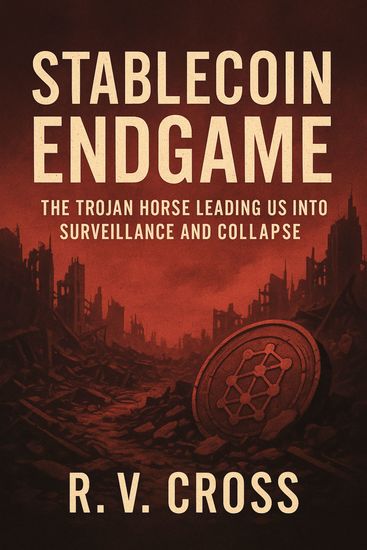
Stablecoin Endgame - The Trojan Horse Leading Us Into Surveillance and Collapse - cover

Stablecoin Endgame - The Trojan Horse Leading Us Into Surveillance and Collapse

R. V. Cross

Casa editrice: Knowledge Lighthouse

  • 0
  • 0
  • 0

Sinossi

What if the very tools we hailed as the future of financial freedom were quietly dismantling its foundation?
 
In Stablecoin Endgame, R. V. Cross delivers a sharp, deeply researched analysis of how stablecoins—once celebrated as innovation's answer to crypto volatility—are evolving into instruments of control. Behind the rhetoric of decentralization and disruption lies a hidden architecture of dependency, surveillance, and engineered collapse. This is not a book about price charts or speculative tokens. It’s about power, architecture, and the consequences of replacing public money with corporate IOUs dressed as digital assets.
 
Drawing from economic history, monetary theory, and real-world policy shifts, the book exposes the subtle erosion of autonomy baked into stablecoins and their surrounding ecosystems. From the illusion of full reserves to the trap of algorithmic collateral, each chapter builds a compelling argument: stability was never the goal—it was the bait.
 
Whether you're a crypto enthusiast, a policymaker, a financial professional, or a concerned citizen navigating the digital economy, Stablecoin Endgame challenges you to rethink what “innovation” really means—and what we risk losing in the name of convenience.
 
This is not just a warning. It’s a map of how we got here, and what the next collapse may look like—unless we change course.
Disponibile da: 20/08/2025.
Lunghezza di stampa: 150 pagine.


Altri libri che potrebbero interessarti

  • The Eurasian Century - Hot Wars Cold Wars and the Making of the Modern Century - cover

    The Eurasian Century - Hot Wars...

    Hal Brands

    • 0
    • 0
    • 0
    We often think of the modern era as the age of American power. In reality, we're living in a long, violent Eurasian century. That giant, resource-rich landmass possesses the bulk of the global population, industrial might, and potential military power. Eurasia is a strategic prize without equal—which is why the world has been roiled, reshaped, and nearly destroyed by clashes over the supercontinent. 


    Since the early twentieth century, autocratic powers have aspired for dominance by seizing commanding positions in the world's strategic heartland. Offshore sea powers, namely the United Kingdom and America, have sought to make the world safe for democracy by keeping Eurasia in balance. America's rivalries with China, Russia, and Iran are the next round in this geopolitical game. If this new authoritarian axis succeeds in enacting a radically revised international order, America and other democracies will be vulnerable and insecure. 


    Hal Brands argues that a better understanding of Eurasia's strategic geography can illuminate the contours of rivalry and conflict in today's world. The Eurasian Century explains how revolutions in technology and warfare, and the rise of toxic ideologies of conquest, made Eurasia the center of twentieth-century geopolitics—with pressing implications for the struggles that will define the twenty-first.
    Mostra libro
  • Persuasion Psychology - Harnessing the Power of Persuasion in Everyday Interactions - cover

    Persuasion Psychology -...

    Wesley Felt

    • 0
    • 0
    • 0
    This book contains two titles. Here are some snippets of what you can find in there: 
    Book 1 - Why does understanding a psychological risk lead to physical reactions? The answer lies in human anatomy, specifically in the mechanisms behind real pain. Is mental pain comparable to physical pain? How does intense pain manifest? When it comes to physical pain, the process is straightforward. We rarely consider the basic motor reflexes controlled by the spine. 
    During physical sensation, a nervous impulse is transmitted through the nerves to the corresponding part of the brain, which then sends a response impulse to an organ. But how does mental pain occur? Our bodies possess a self-regulation function for all physiological processes. In essence, the brain responds to changes in the body's chemical processes. 
    Book 2 - Many believe that the most successful people in the world have mastered the ability to use their minds to attract what they desire. Imagine being able to draw what you want most into your life effortlessly, without having to take direct action. Imagine being able to manifest your goals and desires through the discipline of your thoughts. 
    Everything begins with thoughts, which most people don’t fully grasp, as actions are rooted in these ideas. Before diving into the methods that harness the power of the mind, it’s important to ask: What is the subconscious mind? 
    The subconscious is a part of the mind that, while not fully conscious, influences a person’s actions and feelings. Some view the subconscious as connected to the spirit or soul, capable of shaping your reality based on the messages it receives from your actions and beliefs.
    Mostra libro
  • The Silent Warriors - How Spies and Saboteurs Won History’s Hidden Battles - cover

    The Silent Warriors - How Spies...

    Avery Ramsey

    • 0
    • 0
    • 0
    History is not just made on battlefields—it is written in whispers, coded messages, and the silent betrayals of spies. From World War II resistance fighters to Cold War double agents, the greatest conflicts of the modern era were fought not only with guns and tanks, but with secrets, deception, and intelligence warfare. 
    The Silent Warriors takes you deep into the world of espionage, covert missions, and psychological warfare, uncovering the real-life stories of the spies, saboteurs, and secret operatives who changed history—often without the world ever knowing their names. 
    Inside This Thrilling Book, You’ll Discover: 
    •	The Unbreakable Code of the Windtalkers – How Native American soldiers helped secure victory in WWII with a language no enemy could decipher. 
    •	Virginia Hall: The Woman the Nazis Feared Most – The incredible story of an American spy with a wooden leg who built one of the most dangerous resistance networks in occupied France. 
    •	Aldrich Ames: The CIA Officer Who Sold His Soul – How one man’s greed led to the deaths of countless U.S. operatives and nearly collapsed American intelligence during the Cold War. 
    •	The Ultimate Double Agent, James Armistead Lafayette – The enslaved man who infiltrated the British army and helped George Washington win the Revolutionary War. 
    •	The Secret Propaganda War – How the CIA and KGB waged a silent battle to control the media, literature, and even art to shape global perception. 
    •	Modern Espionage Exposed – How spies like Anna Chapman and Russian deep-cover agents have adapted espionage for the 21st century. 
    If you love true espionage, untold history, and the thrill of secrets finally revealed, The Silent Warriors is your ultimate guide to the spies, lies, and secret battles that shaped the world. 
    Perfect for fans of real-life spy stories, military history, and intelligence warfare.
    Mostra libro
  • Doctors and Demonstrators - How Political Institutions Shape Abortion Law in the United States Britain and Canada - cover

    Doctors and Demonstrators - How...

    Drew Halfmann

    • 0
    • 0
    • 0
    Since Roe v. Wade, abortion has continued to be a divisive political issue in the United States. In contrast, it has remained primarily a medical issue in Britain and Canada despite the countries’ shared heritage. Doctors and Demonstrators looks beyond simplistic cultural or religious explanations to find out why abortion politics and policies differ so dramatically in these otherwise similar countries. Drew Halfmann argues that political institutions are the key. In the United States, federalism, judicial review, and a private health care system contributed to the public definition of abortion as an individual right rather than a medical necessity. Meanwhile, Halfmann explains, the porous structure of American political parties gave pro-choice and pro-life groups the opportunity to move the issue onto the political agenda. A groundbreaking study of the complex legal and political factors behind the evolution of abortion policy, Doctors and Demonstrators will be vital for anyone trying to understand this contentious issue.
    Mostra libro
  • Moving beyond Islamist Extremism - Assessing Counter Narrative Responses to the Global Far Right - cover

    Moving beyond Islamist Extremism...

    William Allchorn

    • 0
    • 0
    • 0
    Traditionally, far-right terrorism has been the black swan of terrorism studies—receiving less attention than Jihadi extremism. In this book, William Allchorn takes a deep dive into multiple geographical locales and the online space of far-right movements, uncovering the crisis narratives that are animating violent far-right extremist milieus and presenting solutions on what we can do to stop them. Using eight country case studies and the results of an online pilot project, this is the first book-length presentation and discussion of counter techniques to far-right narratives—exploring their effectiveness, the ethics of such techniques, and their ability to disrupt pathways from radicalism towards violent extremism. Coming at a time of a renewed global wave of far-right violence, this book is of use to scholars as well as practitioners in the fields of far-right studies, terrorism studies, and strategic communications.
    Mostra libro
  • Civil Wars - A Very Short Introduction - cover

    Civil Wars - A Very Short...

    Monica Duffy Toft

    • 0
    • 0
    • 0
    Civil wars are the most common form of large-scale political violence. In the past thirty years, the study of civil wars has been one of the largest growing segments of the international relations field. Their causes are complex, ranging from fights over access to housing, jobs, and land or other resources, to political contests over offices, rights, and representation. Groups form, collapse, coalesce, align and realign, and then fight amongst themselves. Governments themselves change through elections, coups, military defeats, or revolutions. Understanding the origins of civil wars and their trajectories therefore demands some appreciation of the economic, political, social, cultural, and geographic order of societies. If there is one factor that best predicts why a civil war erupts, it is a prior civil war. That is why knowledge of a country's history of political violence, and associated narratives about who is to blame and why, are critical to understanding where a civil war might next occur. We now have a better understanding of the conditions under which civil wars generally emerge, how the fighting evolves, and how civil wars end. However, historical understanding—the human dimensions—remain every bit as critical. This book explores current debates on civil wars and how the reasons for fighting (and the nature of belligerents themselves) are changing.
    Mostra libro