Unisciti a noi in un viaggio nel mondo dei libri!
Aggiungi questo libro allo scaffale
Grey
Scrivi un nuovo commento Default profile 50px
Grey
Iscriviti per leggere l'intero libro o leggi le prime pagine gratuitamente!
All characters reduced
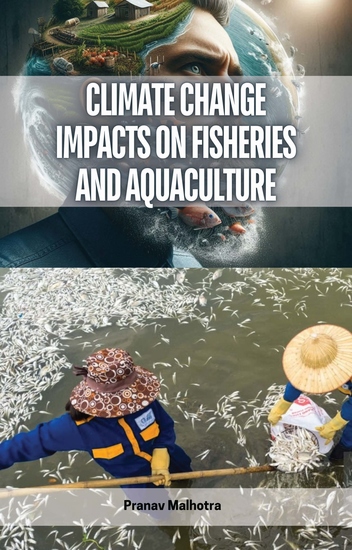
Climate Change Impacts on Fisheries and Aquaculture - cover

Climate Change Impacts on Fisheries and Aquaculture

Pranav Malhotra

Casa editrice: Educohack Press

  • 0
  • 0
  • 0

Sinossi

"Climate Change Impacts on Fisheries and Aquaculture" delves into the intricate relationship between climate change and the vital sectors of fisheries and aquaculture. Through comprehensive analysis, it elucidates the multifaceted impacts of climate change on marine ecosystems and the livelihoods dependent on them.

The book highlights the cascading effects of rising temperatures, ocean acidification, altered precipitation patterns, and sea level rise on fish populations and aquaculture operations worldwide. From shifting fish distribution patterns to harmful algal blooms, it outlines the ecological disruptions threatening fisheries and aquaculture sustainability.

Furthermore, it explores the socio-economic ramifications of these environmental changes, underscoring how vulnerable communities, especially in developing countries, face challenges like income loss, food insecurity, and displacement. Despite these challenges, the book sheds light on potential adaptation strategies and mitigation measures. It emphasizes the importance of science-based management approaches, technological innovations, and international collaboration to safeguard the resilience of fisheries and aquaculture against climate change.

"Climate Change Impacts on Fisheries and Aquaculture" is an indispensable resource for policymakers, researchers, and stakeholders striving to navigate the complex nexus of climate change and marine resource management.
Disponibile da: 20/02/2025.
Lunghezza di stampa: 337 pagine.
Altri libri che potrebbero interessarti

  • Rewriting the History of the Black Death - Unveiling the Truth Behind Medieval Misconceptions - cover

    Rewriting the History of the...

    John Harpoon

    • 0
    • 0
    • 0
    The Black Death, one of the most devastating pandemics in human history, left an indelible mark on the medieval world. From the mid-14th century, this catastrophic event wiped out an estimated one-third of Europe's population, with ramifications extending far beyond the immediate loss of life. Its legacy endures, not only in historical accounts but also in the cultural, social, and economic transformations it triggered. 
      
    The pandemic’s unparalleled scale of mortality created a sense of collective trauma that shaped the mindset of medieval society. Fear, uncertainty, and grief were pervasive, leading to widespread shifts in religious devotion and philosophical thought. For some, the plague strengthened their faith, prompting public acts of penance and increased church attendance. For others, it inspired skepticism about religious authority, paving the way for future reforms and dissent. This dual response reflects the Black Death's role as both a destroyer of tradition and a catalyst for change. 
      
    Economically, the pandemic dramatically altered the medieval labor market. The decimation of the population led to acute labor shortages, forcing landowners to offer better wages and conditions to retain workers. This shift empowered peasants and contributed to the gradual erosion of the feudal system, giving rise to a nascent middle class. The newfound leverage of laborers sowed the seeds of social mobility, challenging the rigid hierarchies that had long defined medieval life.
    Mostra libro
  • Machine Learning Interviews - Kickstart Your Machine Learning and Data Career - cover

    Machine Learning Interviews -...

    Susan Shu Chang

    • 0
    • 0
    • 0
    As tech products become more prevalent today, the demand for machine learning professionals continues to grow. But the responsibilities and skill sets required of ML professionals still vary drastically from company to company, making the interview process difficult to predict. In this guide, data science leader Susan Shu Chang shows you how to tackle the ML hiring process. 


    Having served as principal data scientist in several companies, Chang has considerable experience as both ML interviewer and interviewee. She'll take you through the highly selective recruitment process by sharing hard-won lessons she learned along the way. You'll quickly understand how to successfully navigate your way through typical ML interviews. 


    This guide shows you how to: explore various machine learning roles, including ML engineer, applied scientist, and data scientist; assess your interests and skills before deciding which ML role(s) to pursue; evaluate your current skills and close any gaps that may prevent you from succeeding in the interview process; acquire the skill set necessary for each machine learning role; ace ML interview topics, including coding assessments, statistics and machine learning theory, and behavioral questions; and prepare for interviews in statistics and machine learning theory by studying common interview questions.
    Mostra libro
  • Pompeii - History of the Roman Pleasure Resort That Got Buried in Ashes - cover

    Pompeii - History of the Roman...

    Kelly Mass

    • 0
    • 0
    • 0
    Pompeii was an ancient Roman city situated near modern-day Naples in the Campania region of Italy, within what is now the comune of Pompei. It thrived as a bustling urban center until the catastrophic eruption of Mount Vesuvius in AD 79. This violent explosion buried Pompeii, along with the neighboring cities of Herculaneum and several luxurious villas in the surrounding countryside, including those at Boscoreale and Stabiae, beneath a thick blanket of volcanic ash and pumice. The depth of this sudden entombment ranged from four to six meters (13 to 20 feet), sealing the city and its inhabitants in a chilling moment of suspended animation.  
    When excavations began centuries later, Pompeii revealed itself as an unprecedented time capsule of Roman life. The city was preserved in remarkable detail, offering a rare and invaluable glimpse into the daily routines, architectural styles, and cultural expressions of its people. However, the early excavations, conducted with rudimentary methods, often led to the destruction of crucial evidence. Despite these losses, Pompeii remains one of the most well-documented archaeological sites, providing scholars with insights into the lives of Romans that would have otherwise been lost to history. 
    Mostra libro
  • The Planet You Inherit - Letters to My Grandchildren when Uncertainty's a Sure Thing - cover

    The Planet You Inherit - Letters...

    Larry L. Rasmussen

    • 0
    • 0
    • 0
    For the first time ever, love letters consciously written by elders of one geologic epoch to the young of another. 


    Our children's and grandchildren's generation will face a different world, one affected by climate instability, mass uncertainty, and breathtaking extinction. In fact, the next generation will face the reality that human activity is changing the planet from one geological epoch to another. 


    From this vantage point—two generations across two geological epochs facing a fundamentally changing planet—Larry Rasmussen writes to his grandchildren. As a grandfather invested in a green earth and climate justice as well as a scholar of faith-based earth ethics, Rasmussen bridges this gap between generations to write to the future about climate change, global citizenship, democracy, and legacy. In topics ranging from "A Viable Way of Life" and "Democracy" to "Where We've Come From" and "Who We Are Now," Rasmussen explores the large questions of justice, meaning, and faith, encouraging us to speak to and look to the future generation and their future world.
    Mostra libro
  • The Genetics Revolution – How CRISPR and DNA Editing Will Reshape Humanity - The Science Ethics and Future of Genetic Engineering - cover

    The Genetics Revolution – How...

    David Moses

    • 0
    • 0
    • 0
    Genetic engineering is no longer science fiction—it’s here. But should we edit the code of life? 
    This audiobook takes you inside the revolutionary world of CRISPR and DNA editing, explaining how scientists are rewriting genetics to cure diseases, enhance human traits, and transform industries. Discover: 
    ✅ How CRISPR works and why it’s considered the most powerful genetic tool ever created 
    ✅ The medical breakthroughs in gene therapy, from curing blindness to treating cancer 
    ✅ The ethical debate: Should we allow human enhancement and designer babies? 
    ✅ How genetically modified crops could solve world hunger and climate change challenges 
    ✅ The future of synthetic biology and the risks of playing with evolution 
    The Genetics Revolution – How CRISPR & DNA Editing Will Reshape Humanity is a must-listen for *science enthusiasts, futurists, medical professionals, and anyone curious about the power and limits of genetic engineering.
    Mostra libro
  • Truth is the invention of a liar - Conversations on Epistemology and Ethics - cover

    Truth is the invention of a liar...

    Heinz von Foerster, Bernhard...

    • 0
    • 0
    • 0
    "This book is so rich with insights, sparkling dialogue, and wisdom that one would love to distribute it like a leaflet around town."
    
    Südwestrundfunk (German radio station)
    "The intellectual dance that the two dare to dance is intelligent, light, humorous, and enchanting."
    
    Süddeutsche Zeitung (German daily)
    "I recommend this book not only to the cybernetics and systems community, but to anyone."
    
    Ranulph Glanville, Cybernetics and Human Knowing
    "Easy and enjoyable to read, without loss of scientific and philosophical depth and rigor. … The reader will find the book difficult to put down."
    
    Bernd R. Hornung, Journal of Sociocybernetics
    Conversations for skeptics
    
    How real is reality? Are our images of the world mere inventions or do they correspond to an external reality? Is it possible to know the truth?
    
    These are some of the questions that are discussed in this book by physicist and philosopher Heinz von Foerster and media studies scholar Bernhard Poerksen. Together they explore the limits of our cognitive capacities; they debate the apparent objectivity of our sensual perception and the consequences of "truth terrorism"; and they talk about the relationship between knowledge and ethics, sight and insight.
    The authors:
    Heinz von Foerster (1911–2002) completed his studies of physics in Vienna and worked at different research labs before emigrating to the United States in 1949. In 1957, at the University of Illinois, he established the Biological Computer Lab (BCL) – the cradle of the epistemology that would later cause a stir under the label of "constructivism." The focus was on analyzing the logical and methodological problems that in evitably arise when one seeks to know knowledge. He is the author of numerous books, including Understanding Understanding: Essays on Cybernetics and Cognition.
    Bernhard Poerksen is professor of media studies at the University of Tübingen with a particular research interest in the new media age. His books about systemic thinking have been translated into many languages. In 2008 he was voted "Professor of the Year" in honor of his teaching. His most recent book publications in English include From Being to Doing: The Origins of the Biology of Cognition (with Humberto Maturana), The Unleashed Scandal: The End of Control in the Digital Age (with Hanne Detel), and Digital Fever: Taming the Big Business of Disinformation.
    Mostra libro