Join us on a literary world trip!
Add this book to bookshelf
Grey
Write a new comment Default profile 50px
Grey
Subscribe to read the full book or read the first pages for free!
All characters reduced
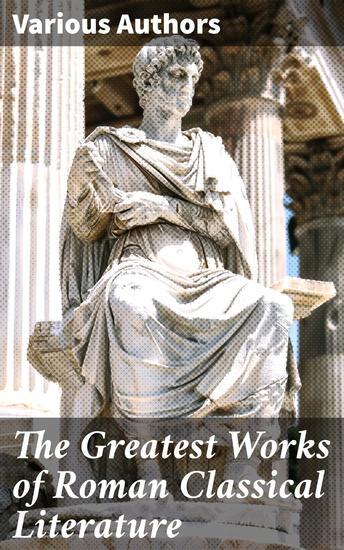
The Greatest Works of Roman Classical Literature - Exploring the Depths of Roman Literary Genius - cover

The Greatest Works of Roman Classical Literature - Exploring the Depths of Roman Literary Genius

Lucius Annaeus Seneca, Julius Caesar, Boethius, Horace, Plutarch Plutarch, Apuleius, Virgil Virgil, Persius, Terence, Ammianus Marcellinus, Sallust, Juvenal, Lucan, Suetonius, Tibullus Tibullus, Tacitus Tacitus, Petronius, Cornelius Nepos, Lucretius Lucretius, Martial, Catullus, Cicero Cicero, Claudian, Pliny the Younger, Saint Augustine of Hippo, Plautus, Ennius, The Metamorphoses, Augustus, Quintilian

Translator Alfred John Church, Paul Nixon, J. S. J.S.Watson, Christopher Smart, William Rose, James Rhodes, Lewis Evans, John William Mackail, William Jackson Brodribb, W. A. McDevitte, W. S. Bohn, Richard Mott Gummere, Henry Thomas Riley, William Ellery Leonard, Frederick Charles Tindal Bosanquet, E. Jones, Robinson Ellis, Harold Edgeworth Butler, Theodore Chickering Williams, John Selby Watson, Frederick W. Shipley, Edward Ridley, William Charles Firebaugh, Maurice Platnauer

Publisher: Good Press

  • 0
  • 0
  • 0

Summary

The anthology, *The Greatest Works of Roman Classical Literature*, encapsulates the grandeur and diversity that define Roman literary achievement. This collection spans a remarkable range of genres and styles, illustrating the complexity and nuance of Roman thought and expression over centuries. From the epic grandeur of Virgil to the philosophical insights of Seneca, and the satirical edge of Juvenal, these texts vividly illuminate the multifaceted nature of Roman cultural and intellectual life. Standout pieces such as those by Cicero and Horace weave together political intrigue with poetic elegance, exemplifying the versatility and enduring significance of Roman literature. The volume assembles the voices of influential figures like Julius Caesar and Pliny the Younger, alongside lesser-known authors who collectively depict the tapestry of Roman society. The anthology is deeply rooted in historical and cultural movements from the late Republic to the early Empire, presenting a dialogue between the political realms of Caesar and Augustus and the philosophical meditations of Boethius and Saint Augustine. By incorporating works from a vast array of backgrounds and disciplines, this collection enhances our understanding of pivotal movements such as Stoicism and Epicureanism, enriching the reader's perspective on antiquity. This comprehensive collection offers readers a unique opportunity to explore the many facets of Roman thought, its educational value extending far beyond mere literary enjoyment. As you delve into the volume, you engage in a rich dialogue between diverse perspectives, providing an enlightening journey through the depths of classical wisdom. *The Greatest Works of Roman Classical Literature* serves as an essential resource for anyone interested in exploring the intersections of history, philosophy, and art, inviting readers to contemplate the timeless relevance of Roman contributions to literature and human knowledge.
Available since: 12/21/2023.
Print length: 7732 pages.

Other books that might interest you

  • Bunyan's The Pilgrim's Progress - Christian Guides to the Classics - cover

    Bunyan's The Pilgrim's Progress...

    Leland Ryken

    • 0
    • 0
    • 0
    Get everything you can out of your time reading the classics with the Christian Guides to the Classics Series!  Leland Ryken provides a clear pathway to understanding the "Great Works" through this engaging series of short guidebooks. Beginning with "why the classics matter" and "the nature and function of literature," readers will find a helpful path to reading and analyzing influential works in the Western canon.  Each book:  Includes an introduction to the author and work  Explains the cultural context  Incorporates published criticism  Defines key literary terms  Contains discussion questions at the end of each unit of the text  Lists resources for further study  Evaluates the classic text from a Christian worldview.    This volume leads readers through John Bunyan’s classic Christian allegory, The Pilgrim’s Progress, offering insights into the nature of faith, the reality of temptation, and the glory of salvation.
    Show book
  • How To Write A Book - Simple Steps To Follow In The Journey Of Writing A Successful Book In A Fun And Intelligent Way - cover

    How To Write A Book - Simple...

    Desmond Callaghan

    • 0
    • 0
    • 0
    Empower your writing skills and turn your literary dreams into reality with this revolutionary audiobook! 
    Say goodbye to generic writing guides that promise the world and deliver nothing. 
    This audiobook delivers a fun and interactive learning experience that will equip you with the tools you need to write not just one, but every book you've ever dreamed of. 
    Unlike the countless boring and serious materials you may find online that promise overnight success and only lead to frustration, this audiobook is presented in a fun and engaging way to make the learning process as easy and efficient as possible. 
    In this audiobook, the steps on how to write your first book are carefully broken down, combining knowledge from research and personal experiences to highlight the principles that can lead you to literary success over time. 
    It's your time to shine - take action and become the writer you've always wanted to be!
    Show book
  • May I Call You Mistress? - cover

    May I Call You Mistress?

    Ruby Scott

    • 0
    • 0
    • 0
    May I Call You Mistress? is the first book in the spicy lesbian romance series entitled An Awakening of Desire, and is a winner of the LESFIC BARD AWARDS EROTICA NOVELLA of the year. 
    If the woman who filled your teenage sexual fantasies walked back into your life seventeen years later, more beautiful and bolder than you thought possible, would you be able to resist? 
    In this steamy sapphic romance, professional photographer Abby Mason's world turns upside down when a last-minute job reunites her with Victoria Fraser - her sister's former piano teacher and her teenage crush. Their age gap means nothing now that they're both adults, but Victoria's involvement in the BDSM lifestyle opens Abby's eyes to possibilities she never imagined. As their second chance at connection unfolds, Victoria introduces Abby to a world of dominance and submission, where trust and consent are as crucial as desire. 
    When Victoria makes it clear that the right to call her your "Mistress" must be earned, Abby finds herself drawn deeper into a journey of sensual discovery. Their explicit FF encounters grow more intense as Abby explores her submissive nature under Victoria's experienced guidance. But in this sophisticated lesbian romance, nothing is simple - Victoria has exacting standards, and Abby must prove herself worthy of surrender. 
    Filled with passion, tension, and the delicate balance of power exchange, "May I Call You Mistress?" is an unforgettable sapphic erotica audiobook that delves deep into what it truly means to trust, submit, and ultimately love, and is the gateway into the full sensual An Awakening of Desire Series. Perfect for listeners who enjoy their romance with a dash of dominance and a helping of heart.
    Show book
  • Moors The: The History of the Muslims Who Lived in North Africa and Europe during the Middle Ages - cover

    Moors The: The History of the...

    Editors Charles River

    • 0
    • 0
    • 0
    The term Moor is a historical rather than an ethnic name. It is an invention of European Christians for the Islamic inhabitants of Maghreb (North Africa), Andalusia (Spain), Sicily and Malta, and was sometimes use to designate all Muslims. It is derived from Mauri, the Latin name for the Berbers who lived in the Roman province of Mauretania, which ranged across modern Algeria and Morocco. Saracen was another European term used to designate Muslims, though it usually referred to the Arabic peoples of the Middle East and derives from an ancient name for the Arabs, Sarakenoi. The Muslims of those regions no more refer to themselves by that term than those of North Africa call themselves Moors. Maghreb, or al-Maghreb, is a historical term used by Arabic Muslims for the territory of coastal North Africa from Alexandria to the Atlantic Coast. It means “The West” and is used in opposition to Mashrek, “The East,” used to refer to the lands of Islam in the Middle East and north-eastern Africa. The Berbers refer to the region in their own language as Tamazgha. In a limited, precise sense it can also refer to the Kingdom of Morocco, the proper name of which is al-Mamlakah al-Maghribiyyah, “Kingdom of the West.” 
    The history of the Spanish Peninsula is closely bound to that of the Moors. The term “Spain” was not in wide use until the region was united by the monarchs of Aragon and Castile, and the Moors called the lands they ruled in the Iberian Peninsula Al-Andalus, traditionally thought to be an Arabic transliteration of Vandal, the Germanic tribe which briefly ruled the region in the early fifth century. The English name Andalusia derives from the Spanish Andalucia, which is still used by Spain to name its southern region. Not surprisingly, three religions attempting to coexist during medieval times resulted in nearly incessant conflicts.
    Show book
  • Bipolar Disorder - A Guide to Understanding and Managing Bipolar Disorder - cover

    Bipolar Disorder - A Guide to...

    Amanda Allan

    • 0
    • 0
    • 0
    BIPOLAR DISORDER 
    Bipolar Disorder is an often severe, greatly misunderstood, and lifelong mental condition that is in simple terms considered to be an emotional rollercoaster of ups and downs. 
    The ups and downs on this roller coaster are called mania and depression. The extreme mood swings and the toll that they take can affect every part of someone’s life. They affect their quality of sleep and their energy levels. They affect their attention and focus while causing the inability to think clearly, and consequently, affect their behavior and judgment. 
    This book aims to educate the reader on the basics of Bipolar Disorder, including what the signs and symptoms are, how it’s diagnosed, what the different treatment methods are, and what the outlook for someone with Bipolar Disorder is like. 
    A Bipolar diagnosis is not at all a death sentence – with proper treatment as well as support and understanding from loved ones, people with Bipolar Disorder are typically able to live successfully, productive, and happy lives.
    Show book
  • The Story of Psychology - From spirits to psychotherapy tracing the mind through the ages - cover

    The Story of Psychology - From...

    Anne Rooney

    • 0
    • 0
    • 0
    What is it that makes you "you"? What produces your likes and dislikes, fear and fantasies? What makes you different from other people, and what makes you the same as them? For thousands of years, people have tried to identify the spirit, soul or mind that makes us human. And they have tried to work out how and why it makes our identity. Answers have ranged from the physiological to the psychological - the influence of early experiences and upbringing. 
     
    The study of psychology, which emerged from philosophy during the 19th century, addresses such questions as what makes us what we are as individuals; how we learn, know and reason; whether we have any innate knowledge or are born with a mind that is a "blank slate"; whether we have freewill; and what is the balance between nature and nurture in forging the individual. Experiments in psychology often probe the darker recesses of the mind - how cruel will we be? how important is it to fit in? how far can the mind be tricked? 
     
    Author Anne Rooney brings together the threads that have made up psychology, from the musings of the Ancient Greeks to the findings of functional MRI scanning. The Story of Psychology is a narrative of how we have tried to approach the very core of our being - of what makes us ourselves.
    Show book