Unisciti a noi in un viaggio nel mondo dei libri!
Aggiungi questo libro allo scaffale
Grey
Scrivi un nuovo commento Default profile 50px
Grey
Iscriviti per leggere l'intero libro o leggi le prime pagine gratuitamente!
All characters reduced
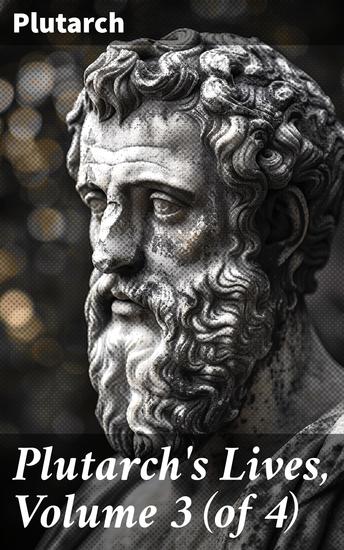
Plutarch's Lives Volume 3 (of 4) - Exploring Virtues and Vices: Insights on Historical Figures in Ancient Greece and Rome - cover

Plutarch's Lives Volume 3 (of 4) - Exploring Virtues and Vices: Insights on Historical Figures in Ancient Greece and Rome

Plutarch Plutarch

Traduttore George Long, Aubrey Stewart

Casa editrice: Good Press

  • 0
  • 0
  • 0

Sinossi

In "Plutarch's Lives, Volume 3 (of 4)", Plutarch curates a compelling comparative biography of notable Greeks and Romans, including figures such as Demosthenes and Cicero. This work diverges from mere historical recounting; instead, it captures the moral character and philosophical essence of these individuals, emphasizing the interplay between their lives and the socio-political contexts they navigated. Plutarch's prose is marked by clarity and eloquence, reflecting his Hellenistic educational background, while his thematic dualities compel readers to ponder the nature of virtue and vice across cultures through anecdotal narrations and insightful reflections. Plutarch, born in the first century A.D. in Chaeronea, Greece, was not only a biographer but also a philosopher, statesman, and priest. His scholarly pursuits and political experiences infused his biographies with rich ethical underpinnings and poignant observations about leadership and morality. Living through a time when Greco-Roman culture was transitioning, he sought to preserve the legacies of great figures while imparting timeless lessons that resonate beyond their eras. This volume is highly recommended for readers interested in the interplay of history, ethics, and literature. By exploring the lives juxtaposed by Plutarch, readers gain wisdom applicable to contemporary leadership and personal conduct. Ideal for scholars, students, and general readers alike, this work remains an essential contribution to the Western literary canon.
Disponibile da: 12/08/2023.
Lunghezza di stampa: 580 pagine.

Altri libri che potrebbero interessarti

  • Dara Shukoh - The Man Who Would Be King - cover

    Dara Shukoh - The Man Who Would...

    Avik Chanda, Kalpan Mitra

    • 0
    • 0
    • 0
    Dara Shukoh -- the emperor Shah Jahan's favourite son, and heir-apparent to the Mughal throne prior to being defeated by Aurangzib -- has sometimes been portrayed as an effete prince, incompetent in military and administrative matters. But his tolerance towards other faiths, and the myths and anecdotes surrounding him, continue to fuel the popular imagination. Even today, over 350 years after his death, the debate rages on: if this 'good' Mughal had ascended the throne instead of his pugnacious younger brother, how would that have changed the course of Indian history? Dara Shukoh: The Man Who Would Be King brings to life the story of this enigmatic Mughal prince. Rich in historical detail and psychological insight, it brilliantly recreates a bygone age, and presents an empathetic and engaging portrait of the crown prince who was, in many ways, clearly ahead of his times.
    Mostra libro
  • Jeevan Ke Arth Ki Talaash Me Manushya (HINDI EDITION) by Viktor Frankl - Hindi Edition of Man's Search for Meaning by Viktor Frankl - cover

    Jeevan Ke Arth Ki Talaash Me...

    Viktor E. Frankl

    • 0
    • 0
    • 0
    About Book 
    A prominent Viennese psychiatrist before the war, Viktor Frankl was uniquely able to observe the way that both he and others in Auschwitz coped (or didn't) with the experience. He noticed that it was the men who comforted others and who gave away their last piece of bread who survived the longest - and who offered proof that everything can be taken away from us except the ability to choose our attitude in any given set of circumstances. 
    The sort of person the concentration camp prisoner became was the result of an inner decision and not of camp influences alone. Frankl came to believe man's deepest desire is to search for meaning and purpose. This outstanding work offers us all a way to transcend suffering and find significance in the art of living. 
    Viktor Emil Frankl M.D., Ph.D.,  
    was an Austrian neurologist and psychiatrist as well as a Holocaust survivor. Frankl was the founder of logotherapy, which is a form of Existential Analysis, the "Third Viennese School" of psychotherapy. 
    His book Man's Search for Meaning (first published under a different title in 1959: From Death-Camp to Existentialism. Originally published in 1946 as Ein Psycholog erlebt das Konzentrationslager) chronicles his experiences as a concentration camp inmate and describes his psychotherapeutic method of finding meaning in all forms of existence, even the most sordid ones, and thus a reason to continue living. He was one of the key figures in existential therapy.
    Mostra libro
  • Arch Rascal An - From their pens to your ears genius in every story - cover

    Arch Rascal An - From their pens...

    Knut Hamsun

    • 0
    • 0
    • 0
    Knud Pedersen was born in Lom in the Gudbrandsdal valley of Norway on the 4th of August, 1859 in what was then the United Kingdoms of Sweden and Norway.  He was the fourth son of seven children born to poor parents who, when he was three, were invited to an uncle’s farm to work his land. 
    When he was nine he moved away from his family to help another uncle who ran a post office.  Whilst with him he was beaten and starved which manifested in a series of chronic nervous difficulties.  The treatment endured for six years until he managed to escape back to Lom. 
    For some time he now took any job that was available to him, including store clerk, peddler, shoemaker's apprentice, sheriff's assistant, elementary-school teacher and ropemaker's apprentice.  At about the same time, with the wealth of these gained experiences, he began to explore his literary talents. 
    In 1877 he published his first book ‘The Enigmatic Man: A Love Story from Northern Norway’, others soon followed but real success only came in 1890 with ‘Hunger’, an influential work for later novelists with its internal monologue and bizarre logic.  His work is often associated with Pantheism; where nature and mankind are unified in a strong and often mystical bond.   
    His work was so influential that in 1920 he was awarded the Novel Prize for Literature. 
    Shortly after this point his works became fewer and his interests darker.  During World War II he became a fervent admirer of the Nazi’s, even meeting Hitler, even though German armies had overrun Norway.  With the war’s end he was detained on charges of treason.  His old age was apparently the primary reason given for Hamsun receiving only a fine.  Other reasons also sought to excuse his abhorrent behaviour but it was clear that whilst he was loved for his literature he was detested for his politics and morals. 
    His literary canon includes more than 20 novels, a poetry collection, short stories, plays, a travelogue, other works of non-fiction and essays. 
    Knut Hamsun died on the 19th February 1952 in Grimstad. He was 92.
    Mostra libro
  • Exclude Not Thyself - How to Thrive as a Covenant-Keeping Gay Latter-Day Saint - cover

    Exclude Not Thyself - How to...

    Skyler Sorensen

    • 0
    • 0
    • 0
    There have been a decent amount of hard truths I've had to embrace as a gay Latter-day Saint in order to feel secure and confident in my role as a husband and father. As I've done so, however, I've been able to be successful in creating a joyous and lasting eternal marriage with an amazing woman. It's not a contrived marriage that I have to white-knuckle my way through; it's an intuitive, natural love and companionship that has stood the test of time and the most bitter of trials. From facing public controversy, to losing our son, to dealing with infertility, we've only become more resilient and connected, and our love has only deepened.
    Mostra libro
  • Hildasay to Home - How I Found a Family by Walking the UK's Coastline - cover

    Hildasay to Home - How I Found a...

    Christian Lewis

    • 0
    • 0
    • 0
    Read by the author, Christian Lewis.Walking saved his life. Now it will help find him a family. In the follow-up to his Sunday Times bestselling Finding Hildasay, Christian Lewis takes his next steps.Since his time on Hildasay, Chris’ adventure has only gotten wilder. No one was more surprised than Chris when, in November 2020, he had an unlikely (seemingly destined) encounter with fellow adventurer Kate. The two turned out to be kindred spirits and – even more astonishingly – Kate made the bold decision to join Chris on the walk of a lifetime. Day in, day out, as they trekked the coastline down from Scotland together, their relationship grew, and soon the couple were thrown in at the deep end when their first child – baby Magnus – arrived.But, away from Scotland, Chris’ struggles with mental health returned. The solitude of Hildasay seemed far away, and he unravelled once again.Through injuries and setbacks, with Jet the dog ageing and baby Magnus growing by the day, the adventurous family of four had to find their feet and come together to complete this epic challenge. They’ve navigated the east coast of Scotland, through Yorkshire and East Anglia, and struggled on to the Jurassic Coast where Chris slowly came back into himself.In Hildasay to Home Chris finally crosses the finish line back in Swansea with almost half a million pounds raised. He reflects beautifully on all that he’s learned and the family he’s found for himself along the way.
    Mostra libro
  • The 56 - Liberty Lessons From Those Who Risked All to Sign The Declaration of Independence - cover

    The 56 - Liberty Lessons From...

    Douglas MacKinnon

    • 0
    • 0
    • 0
    Read why the historical account of the 56 Signers of The Declaration of Independence and the story behind the 4th of July are so critically important … before they and the 4th of July are banned from American society. 
     
    The urgent need to honor the 56 Signers of The Declaration of Independence came to Douglas MacKinnon, fittingly enough, on the 4th of July.While doing research for a column meant to remind the American people of that date’s critical importance, he came across example  
    after example of those from the Left and the Far-Left—be they in the mainstream media, activists, or anarchists—calling for not only the “canceling” of the 4th of July, but the continued smearing, censorship, and canceling of our Founding Fathers. 
     
    One overriding thought then filled his mind: 
    “What if they are successful?” 
     
    Those who believe such totalitarian censorship could never come to be in the United States of America need only review how quickly and brutally many on the Left were able to create the “Woke Cancel Culture” to silence those they oppose today. 
     
    Now they come for Thomas Jefferson, Richard Henry Lee, Benjamin Franklin and others who courageously signed The Declaration of Independence. 
     
    That document and those men created our history. History which should never bebent, twisted, censored, or banned to fit any ideological narrative. If it is good, let us praise it. If it is bad, let us condemn it and learn from it. But let us never twist, censor, or cancel it. 
     
    And yet, more and more followers of the Left want to do just that. As they control the media, academia, entertainment, science, and medicine … who is to stop them? 
     
    Time is of the essence. We must find our voices. The 56 left the blueprint: Liberty.
    Mostra libro