Unisciti a noi in un viaggio nel mondo dei libri!
Aggiungi questo libro allo scaffale
Grey
Scrivi un nuovo commento Default profile 50px
Grey
Iscriviti per leggere l'intero libro o leggi le prime pagine gratuitamente!
All characters reduced
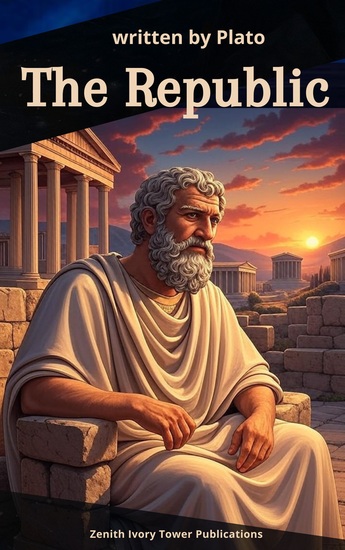
The Republic - Plato's Foundational Work on Justice Government and the Ideal State - cover

The Republic - Plato's Foundational Work on Justice Government and the Ideal State

Plato

Casa editrice: Zenith Ivory Tower Publications

  • 0
  • 0
  • 0

Sinossi

⚖️ What is justice? Who should rule? What makes a perfect society?

In Republic, Plato—the father of Western philosophy—lays out his vision for an ideal state in one of the most important and enduring works of political thought in human history. Through the dialogues of Socrates, this masterpiece examines the meaning of justice, the nature of the soul, the role of education, and the foundations of a just society.

🏛️ A timeless blueprint for thinking about ethics, power, and the human condition.
As Socrates debates with fellow Athenians, readers are drawn into deep questions that remain as vital today as they were in ancient Greece: Who should govern? Can truth and power coexist? Is democracy the best form of government—or the most dangerous?

📚 Part philosophy, part political theory, part psychological study.
Plato's Republic introduces ideas such as the philosopher-king, the Allegory of the Cave, and the Tripartite Soul—concepts that continue to shape political philosophy, psychology, and literature today.

🌟 What Scholars and Readers Say:
"The Republic is not only the cornerstone of Western political thought—it's a mirror we still hold up to our world." — The Guardian

"Required reading for anyone who wants to understand power, justice, or the human mind." — The New York Times

"A book that still challenges and inspires across centuries." — Amazon Reviewer

🎯 Why You'll Love This Book:
A must-read for students of philosophy, politics, ethics, and history

Perfect for fans of deep, thought-provoking literature

Includes key philosophical dialogues on education, leadership, and morality

A cornerstone text for understanding democracy, totalitarianism, and justice

🛒 Click Buy Now to Read One of the Greatest Books Ever Written.
Challenge your mind, question your assumptions, and explore the structure of an ideal society.
👉 Click Buy Now to read Republic by Plato—the book that shaped Western civilization.
Disponibile da: 21/07/2025.
Lunghezza di stampa: 388 pagine.
Altri libri che potrebbero interessarti

  • Rewriting the History of the Black Death - Unveiling the Truth Behind Medieval Misconceptions - cover

    Rewriting the History of the...

    John Harpoon

    • 0
    • 0
    • 0
    The Black Death, one of the most devastating pandemics in human history, left an indelible mark on the medieval world. From the mid-14th century, this catastrophic event wiped out an estimated one-third of Europe's population, with ramifications extending far beyond the immediate loss of life. Its legacy endures, not only in historical accounts but also in the cultural, social, and economic transformations it triggered. 
      
    The pandemic’s unparalleled scale of mortality created a sense of collective trauma that shaped the mindset of medieval society. Fear, uncertainty, and grief were pervasive, leading to widespread shifts in religious devotion and philosophical thought. For some, the plague strengthened their faith, prompting public acts of penance and increased church attendance. For others, it inspired skepticism about religious authority, paving the way for future reforms and dissent. This dual response reflects the Black Death's role as both a destroyer of tradition and a catalyst for change. 
      
    Economically, the pandemic dramatically altered the medieval labor market. The decimation of the population led to acute labor shortages, forcing landowners to offer better wages and conditions to retain workers. This shift empowered peasants and contributed to the gradual erosion of the feudal system, giving rise to a nascent middle class. The newfound leverage of laborers sowed the seeds of social mobility, challenging the rigid hierarchies that had long defined medieval life.
    Mostra libro
  • Nicolaus Copernicus: A short biography - 5 Minutes: Short on time - long on info! - cover

    Nicolaus Copernicus: A short...

    5 Minutes, 5 Minute Biographies,...

    • 0
    • 0
    • 0
    Nicolaus Copernicus, universal scholar and astronomer: Life and work in a short biography! Everything you need to know, brief and concise. Infotainment, education and entertainment at its best!
    Mostra libro
  • The Folklore of Rome - Myth Magic Dying and the Making of The Empire - cover

    The Folklore of Rome - Myth...

    Davis Truman

    • 0
    • 0
    • 0
    Step beyond the ruins and into the pulse of ancient Rome—not the Rome of marble triumphs and imperial decrees, but of whispered spells, ghostly omens, and mythic memory. The Folklore of Rome: Myth, Magic, Dying, and the Making of the Empire is an immersive exploration of how stories, superstitions, and sacred rites shaped the world’s most enduring civilization from its legendary beginnings to its imperial zenith. 
    In these pages, history meets enchantment. Chapter by chapter, the book reveals how Roman identity was bound to its folklore: the way Livy’s histories blurred myth and moral lesson, how domestic charms and street-corner incantations governed daily life, and how rituals of dying transformed death into a civic and spiritual act. From household gods to battlefield omens, from public festivals to private fears, Rome’s imagination was alive with unseen forces—powers that both inspired and restrained its people. 
    With vivid scholarship and a storyteller’s touch, The Folklore of Rome uncovers the Empire’s hidden heartbeat: the dreams, doubts, and supernatural beliefs that gave meaning to conquest and glory. More than a study of myths and rituals, it is a rediscovery of Rome as a living myth itself—a civilization forever poised between the mortal and the divine.
    Mostra libro
  • The Wolves at the Door - The True Story of America's Greatest Female Spy - cover

    The Wolves at the Door - The...

    Judith L. Pearson

    • 0
    • 0
    • 0
    This WWII espionage biography brings "one of America's greatest spies back to life" in a "story of derring-do and white knuckles suspense" (Patrick O'Donnell, author of Operatives, Spies, and Saboteurs) 
    Virginia Hall left her comfortable Baltimore roots in 1931 with dreams of becoming a Foreign Service Officer, but her gender—and her wooden leg—kept her from pursuing politics. As Hitler advanced across Europe, she put her gift for languages to use with the British Special Operations Executive, a secret espionage organization. She was soon deployed to occupied France, where she located drop zones, helped prisoners of war flee to England, and secured safe houses for agents. 
    Soon, wanted posters appeared throughout France, offering a reward for Hall's capture. By 1942, Hall had to flee France via the only route possible: an arduous hike on foot through the frozen Pyrénées Mountains. Upon her return to England, the American espionage organization, the Office of Special Services, recruited her and sent her back to France disguised as an old peasant woman. While there, she was responsible for killing 150 German soldiers and capturing 500 others. Sabotaging communications and directing resistance activities, her brave work helped change the course of the war.
    Mostra libro
  • Captive Gods - Religion and the Rise of Social Science - cover

    Captive Gods - Religion and the...

    Kwame Anthony Appiah

    • 0
    • 0
    • 0
    Philosopher Kwame Anthony Appiah explores how early social scientists developed our modern understandings of society through their theories of religion The foundations of modern social science were built on the study of religion, the acclaimed thinker Kwame Anthony Appiah argues. Delving into the intellectual currents of the nineteenth and early twentieth centuries, he investigates how formative thinkers—notably Edward Burnett Tylor, Émile Durkheim, Georg Simmel, and Max Weber—grappled with the concepts of society and religion as interdependent categories. Appiah shows how their efforts to define religion, or evade the task, mark the power and limitations of social thought in ways that persist among theorists today. Religion was not an object of study but a framework through which early social scientists established sociology as a discipline. Appiah also examines recent work in both interpretive sociology and evolutionary and cognitive psychology about the mechanisms through which communities form beliefs and values—while underscoring the enduring significance of these earlier debates for contemporary social thought. Throughout, he intertwines storytelling, historical analysis, and philosophical reflection to show how our ideas about society and culture have been, and continue to be, forged in dialogue with religious questions.
    Mostra libro
  • Techno-Capitalism - The Rise of the New Robber Barons and the Fight for the Common Good - cover

    Techno-Capitalism - The Rise of...

    Loretta Napoleoni

    • 0
    • 0
    • 0
    The respected Italian economist and journalist offers a bold and provocative argument that the speed of technological transformation is threatening our future 


    At the dawn of the digital revolution, the internet was going to be the great equalizer, a global democratic force. Instead, Wall Street ended up funding a new breed of serial capitalists, the Techtitans, who embraced rapid, transformational change while stripping their workers of rights and enriching themselves beyond anybody's wildest imagination; and the Space Barons, who mine new frontiers for precious resources. 


    Tech pioneers like Google, Facebook, Apple, Uber, and Microsoft never had any intention of spreading democracy. Those who control and own the technology are the absolute masters. As artificial intelligence enters the labor market, companies like Uber are able to cut labor costs to the barest of minimums, by squeezing workers' privileges and rights. 


    Technological transformation is occurring at a speed that is existentially unbearable for most of us. We must fight for our common good to address today's real challenges of global warming and militarism and the soulessness of capitalist endeavor. Napoleoni shows us how.
    Mostra libro