Unisciti a noi in un viaggio nel mondo dei libri!
Aggiungi questo libro allo scaffale
Grey
Scrivi un nuovo commento Default profile 50px
Grey
Iscriviti per leggere l'intero libro o leggi le prime pagine gratuitamente!
All characters reduced
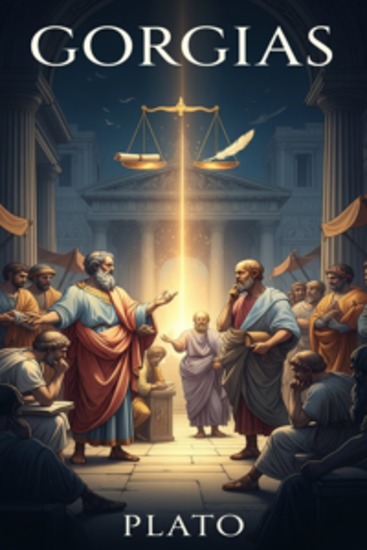
Gorgias - cover

Gorgias

Plato

Casa editrice: Bu Classics Books

  • 0
  • 0
  • 0

Sinossi

Dive into a rigorous debate concerning the true nature of rhetoric and its place in civil society, as Socrates confronts one of the most famous sophists of his time. The dialogue relentlessly questions whether the art of persuasion is a noble pursuit or merely a tool for manipulation and flattery without regard for justice. Plato argues passionately for the health of the soul over the power of speech, suggesting that it is better to suffer wrong than to commit it. This work stands as a powerful critique of political corruption and the moral responsibilities of those who wield influence.
Disponibile da: 29/01/2026.
Lunghezza di stampa: 142 pagine.

Altri libri che potrebbero interessarti

  • It's What You Do Next - The Fall and Rise of Nashville's First Female Mayor - cover

    It's What You Do Next - The Fall...

    Megan Barry

    • 0
    • 0
    • 0
    In 2015, after a historic run-off election, Megan Barry became the first female mayor of Nashville, Tennessee. Quickly becoming one of the most popular progressive politicians in the Bible Belt, Barry was a beloved leader with a sky-high approval rating and an unshakable hope for a new, forward-thinking, modern South. For her first few years in office, she was one of the most important voices at the table—until she became the most notorious. 


    Barry loved three things the most in the world—her son, Max, her husband, Bruce, and her job as the mayor of Nashville . . . until she lost two of them. Her monumental lapse in judgment led to a painful public reckoning and the fall of her rising political career. A battle with substance-use disorder robbed her of her only child. Grief, pride, shame, longing, and resentment nearly destroyed her marriage. Barry has to start again, the right way, with humility, hope, and a wicked sense of humor. 


    It's What You Do Next is a deeply honest book about womanhood at home, in politics, and in the spaces between.  Warm, funny, and uncompromisingly honest, Barry speaks to women as their close friend, not their fearless leader, her true self, not always her best self. She gives listeners permission to come as they are and leave knowing that what matters most, is what happens next.
    Mostra libro
  • Colombia's Economic Transformation - Historical Insights - cover

    Colombia's Economic...

    Anya Solace

    • 0
    • 0
    • 0
    Colombia's economic transformation has been a complex and dynamic process shaped by historical events, political decisions, and global economic trends. From its early indigenous trade systems to its current standing as one of Latin America's largest economies, Colombia's journey has been marked by periods of growth, crisis, and resilience. Understanding this transformation requires a deep dive into the key factors that have influenced its economy over the centuries. 
    The foundation of Colombia's economy was laid long before Spanish colonization. Indigenous communities engaged in agriculture, trade, and resource management, establishing early economic structures. However, the arrival of the Spanish in the early 16th century drastically altered the economic landscape. The Spanish introduced a mercantilist system that prioritized resource extraction, particularly gold, and forced indigenous labor into exploitative economic activities. This period also saw the beginnings of agricultural exports, as crops like sugar and tobacco became integral to the colonial economy. 
    Following independence in 1810, Colombia faced significant economic instability. The transition from colonial rule to a sovereign state disrupted established trade networks and led to political fragmentation. Wars of independence had devastated infrastructure and financial systems, leaving the new republic struggling to establish a stable economy. The 19th century saw slow economic progress, with regional economies developing independently and a reliance on agriculture persisting. Coffee emerged as Colombia's most valuable export by the late 19th century, setting the stage for greater economic integration and growth.
    Mostra libro
  • Too Far on a Whim - The Limits of High-Steam Propulsion in the US Navy - cover

    Too Far on a Whim - The Limits...

    Tyler A. Pitrof

    • 0
    • 0
    • 0
    In Too Far on a Whim, Tyler A. Pitrof presents a high-spirited revision of the US Navy's commitment to high-steam propulsion systems, the mainstay of its World War II fleets. Pitrof's research persuasively demonstrates that in its war against the Imperial Japanese Navy, the US Navy succeeded despite its high-steam propulsion systems rather than because of them. 


    War with an aggressive Japan and a resurgent Germany loomed in the dark days of the late 1930s. Rear Admiral Harold G. Bowen Sr., head of the US Navy's Bureau of Engineering, advanced a radical vision: a new fleet based on high-steam propulsion, a novel technology that promised high speeds with smaller engines and better fuel efficiency. 


    The official record of high-steam technology's subsequent performance has relied heavily on Bowen's own memoir, in which he painted high-steam innovation in heroic colors. Pitrof's empirical review of primary sources such as maintenance records illuminates the opposite. 


    Pitrof provides an account that extends far beyond technology and into matters of naval hierarchies and bureaucracy, strategic theory, and ego. 


    To Far on a Whim is a landmark for those interested in naval history and technology.
    Mostra libro
  • Greek Dark Ages and Greek Renaissance The: The History and Legacy of the Bronze Age Transition to Archaic Greece - cover

    Greek Dark Ages and Greek...

    Editors Charles River

    • 0
    • 0
    • 0
    The Greek Dark Ages, sometimes referred to as the Homeric Age or the Geometric Period, spans the era of Greek history from the end of the Mycenaean civilization around 1100 BCE and the emergence of the Greek poleis in the 9th century BCE. It is an era that has provided little in terms of extant archaeological evidence, which in part explains the name “Dark Ages,” but this lack of evidence has led some archaeologists and historians to make the very great assumption that little of any real significance occurred during these 200 years. Instead, they view it as a sort of hiatus between the collapse of the Mycenaean culture and the emergence of Archaic Greece. As with other so-called “Dark Ages,” this assessment is simplified, and an absence of evidence should never be assumed as evidence of absence. 
    If anything, the collapse of the Mycenaeans was a drawn-out affair, and while the early centuries of the Dark Ages might beseen as a continuation of this trend, even in the worst years, there was a degree of continuity and even some innovations. These changes including the beginnings of the use of iron as an alternative to bronze and some religious practices that continued to be observed. Furthermore, enough remained to form the basis of a recovery in economic, cultural, and artistic aspects of life in the later stage of the era, and in the political sphere, changes necessitated by the collapse in the economic system certainly paved the way for the rise of the polis, which would prove so fundamental in Greece in the centuries that followed.  
    This laid the groundwork for the Greek Renaissance of the 8th century. During that time, the Greek alphabet developed and the earliest surviving Greek literature was composed, while in terms of art and architecture, sculptures and red-figure pottery began. Warfare changed significantly as well when the hoplite became the core infantry.
    Mostra libro
  • Police Law Enforcement Career Planning Audio Book Bundle - 3 in 1 Career Development Plan Box Set - cover

    Police Law Enforcement Career...

    Brian Mahoney

    • 0
    • 0
    • 0
    End Money Worries! 
    Police Law Enforcement Career Planning Audio Book Bundle  
    3 in 1 Career Development Plan Box Set 
    Discover... 
    * What a Police Law Enforcement officer does * How to Become a Police Law Enforcement officer * What is the salary of a Police Law Enforcement officer 
    * What is the Police Law Enforcement Work Environment like * What is the future Job outlook for a Police Law Enforcement officer 
    * How long does it take to become a Police Law Enforcement  * How to Prepare for Your Job Interview 
    * Tips the pros use to Ace their Job Interview  * You'll be confident with the best answers for the toughest job interview questions 
    The knowledge & ability to change your life all for less than the cost of 1 movie ticket! 
     If you are ready to get started & want the knowledge, help & motivation to change your life now!... 
    How to start a YouTube Channel & Make Money 
    Discover... 
    * Why YouTube is Essential for Business Marketing * Creating a YouTube Marketing Strategy 
    *Creating Engaging Video Content *Optimizing Your YouTube Channel  
    *Monetizing your YouTube Channel *Measuring your YouTube Marketing Success 
    *YouTube Shorts Video & Channel Promotion 
    So take advantage of this chance for a lifetime passive income stream from YouTube! 
    Goal Setting Mastery: A Action Plan to Achieving Your Dreams 
    Now you you can take advantage of this goal setting audio book & discover how to achieve success in all aspects of your life: 
    * Understanding the Power of Goal Setting * How to set meaningful goals using the SMART Method 
    * Creating a Action Plan * Reviewing & adjusting your Goals  * Using Goal Setting in all areas of Your life 
    So Don't wait. You'll wait your life away...
    Mostra libro
  • A Short History of Financial Euphoria - cover

    A Short History of Financial...

    John Kenneth Galbraith

    • 0
    • 0
    • 0
    The world-renowned economist offers "dourly irreverent analyses of financial debacle from the tulip craze of the seventeenth century to the recent plague of junk bonds." —The Atlantic. 


    With incomparable wisdom, skill, and wit, world-renowned economist John Kenneth Galbraith traces the history of the major speculative episodes in our economy over the last three centuries. Exposing the ways in which normally sane people display reckless behavior in pursuit of profit, Galbraith asserts that our "notoriously short" financial memory is what creates the conditions for market collapse. By recognizing these signs and understanding what causes them we can guard against future recessions and have a better hold on our country's (and our own) financial destiny.
    Mostra libro