Unisciti a noi in un viaggio nel mondo dei libri!
Aggiungi questo libro allo scaffale
Grey
Scrivi un nuovo commento Default profile 50px
Grey
Iscriviti per leggere l'intero libro o leggi le prime pagine gratuitamente!
All characters reduced
Learn Macedonian - Quick Easy Efficient - 2000 Key Vocabularies - cover

Learn Macedonian - Quick Easy Efficient - 2000 Key Vocabularies

Pinhok Languages

Casa editrice: Pinhok Languages

  • 0
  • 0
  • 0

Sinossi

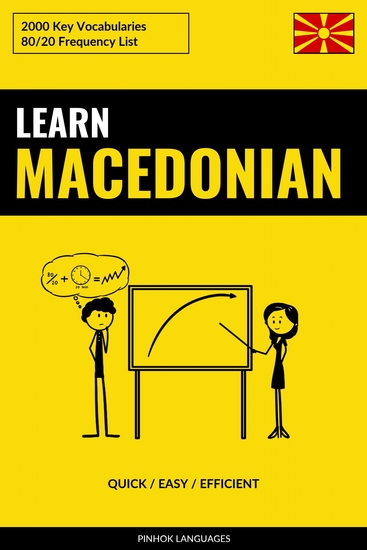
A curated Macedonian word frequency listAre you looking for unconventional ways to speed up the process of learning Macedonian? Then this book is exactly what you are looking for. Following the Pareto principle (80/20 rule), this book is built to streamline the learning process by concentrating on the core words and sentence structures that make up everyday conversations. The result is a unique vocabulary book with 2000 of the most important Macedonian words and phrases ordered by their frequency of use.
 
Who this Macedonian learning book is for:This book is for beginners and intermediate learners of Macedonian who are self-motivated and willing to spend 15 to 20 minutes a day on learning vocabularies. The simple structure of this vocabulary book is the result of taking all unnecessary things out allowing the learning effort to solely be spent on the parts that help you make the biggest progress in the shortest amount of time. If you are willing to put in 20 minutes of learning every day, this book is very likely the single best investment you can make if you are at a beginner or intermediate level. You will be amazed at the speed of progress within a matter of just weeks of daily practice.
 
Who this Macedonian frequency list is not for:This book is not for you if you are an advanced learner of Macedonian. In this case, please go to our website or search for our Macedonian vocabulary book which comes with more vocabularies and is grouped by topic which is ideal for advanced learners who want to improve their language capabilities in certain fields.Furthermore, if you are looking for an all in one Macedonian learning book that guides you through the various steps of learning Macedonian, this book is most likely also not what you are looking for. This book contains vocabularies only and we expect buyers to learn things like grammar and pronunciation either from other sources or through language courses. The strength of this book is its focus on quick acquisition of core vocabularies which comes at the expense of information many people might expect in a conventional language learning book. Please be aware of this when making the purchase.
 
How to use this Macedonian workbook:This book is ideally used on a daily basis, reviewing a set number of pages in each session. The book is split into sections of 50 vocabularies which allows you to step by step progress through the book. Let’s for example say you are currently reviewing vocabularies 101 to 200. Once you know vocabularies 101 to 150 very well, you can start learning vocabularies 201 to 250 and on the next day skip 101-150 and continue reviewing vocabularies 151 to 250. This way, step by step, you will work your way through the book and your language skills will jump with each page you master.
 
Some final thoughts:Like many language hacking methods, this book is quite unconventional in its approach, but for a driven person that uses it correctly it can significantly speed up the learning process. Vocabulary books have been around for centuries and as with so many things that have been around for some time, they are not very fashionable and a bit boring, but they usually work quite well – and that is what counts in the end.
Disponibile da: 17/11/2022.
Lunghezza di stampa: 84 pagine.
Altri libri che potrebbero interessarti

  • Travel words and phrases in Dutch - cover

    Travel words and phrases in Dutch

    J. M. Gardner

    • 0
    • 0
    • 0
    Travel words and phrases in Dutch. 300 essential words and phrases and the 100 most common verbs. The Dutch language is a West Germanic language, spoken by around 23 million people as a first language and by another 5 million as a second language. How to learn a language differently ? Today, language learning is revolutionizing : you do not have to go to traditional language classes anymore. Our learning method : a selection of hundreds of phrases and essential words. You listen to them, you repeat them, and you speak. We rely on pronunciation, oral rehearsal, listening, combined with words, essential phrases, and a vocabulary list. 20% of the words are used 80% of the time. The end goal is to get a sufficient level in one language to be able to hold simple conversations, to be able to understand simple exchanges, deal with with everyday life and start exploring the new culture that opens up to you.
    Mostra libro
  • Fluent in 3 Months - How Anyone at Any Age Can Learn to Speak Any Language from Anywhere in the World - cover

    Fluent in 3 Months - How Anyone...

    Benny Lewis

    • 0
    • 0
    • 0
    Benny Lewis, who speaks over ten languages—all self-taught—runs the largest language-learning blog in the world, Fluent In 3 Months. Lewis is a full-time "language hacker," someone who devotes all of his time to finding better, faster, and more efficient ways to learn languages. Fluent in 3 Months: How Anyone at Any Age Can Learn to Speak Any Language from Anywhere in the World is a new blueprint for fast language learning. Lewis argues that you don't need a great memory or "the language gene" to learn a language quickly, and debunks a number of long-held beliefs, such as adults not being as good of language learners as children.
    Mostra libro
  • Learn French for Beginners - A Complete Audio Method for French Language Learning - cover

    Learn French for Beginners - A...

    Talk In French

    • 0
    • 0
    • 0
    Speak French from Day One with this Beginner-level Audio-only Method for Learning French. 
    Inside Learn French for Beginners, you’ll find:Four weeks of daily lessons: Build a habit of learning French with easy-to-follow lessons you can listen to every day.5+ hours of audio: With their emphasis on spoken communication, the lessons focus on auditory and verbal learning to prioritize your speaking and listening skills.Practical dialogues based on real-life scenarios: In each lesson, listen to sample French conversations that illustrate grammar and vocabulary in a simplified way.900+ French vocabulary terms: Learn the most frequently used words and build on the words and phrases you’ve learned in each lesson.Practical grammar: Focus on the most useful aspects of French grammar with topics that you can readily put to use.Plenty of opportunities to practice speaking: Get a strong grasp of French pronunciation with well-guided and timed instructions using spaced repetition.Easy-to-follow lessons: Sentences are broken down into word groups, and then further into individual words for quicker, more organic learning.Quiz after each lesson and a weekly review: Ensure complete comprehension with a quiz after every lesson and review lessons every 7 days.Free PDF: While the purely audio method is great for auditory learners, a PDF is also provided as support material for the more visual learners. With the PDF, you’ll be able to compare the spoken French word with its written form. 
    Start learning French with this audio method today!
    Mostra libro
  • I am learning Romanian - cover

    I am learning Romanian

    J. M. Gardner

    • 0
    • 0
    • 0
    I am learning Romanian : 300 essential words and phrases, 140 common expressions, the 100 most common verbs, the 1000 essential Romanian words. Romanian is an Eastern Romance language spoken by approximately 26 million people as a native language, primarily in Romania and Moldova, and by another 4 million people as a second language. How to learn a language differently ? Today, language learning is revolutionizing : you do not have to go to traditional language classes anymore. Our learning method : a selection of hundreds of phrases and essential words. You listen to them, you repeat them, and you speak. We rely on pronunciation, oral rehearsal, listening, combined with words, essential phrases, and a vocabulary list. 20% of the words are used 80% of the time. The end goal is to get a sufficient level in one language to be able to hold simple conversations, to be able to understand simple exchanges, deal with with everyday life and start exploring the new culture that opens up to you.
    Mostra libro
  • Farsi Made Easy - Beginner - Volume 2 of 3 - cover

    Farsi Made Easy - Beginner -...

    Lingo Wave

    • 0
    • 0
    • 0
    We broke our new series on learning Farsi down into different learning stages. Start with the “Lower Beginner” books followed by the “Beginner” and “Upper Beginner” books. Next, progress to the “Intermediate” series, then test and reinforce your knowledge with the “Conversations” series.  
    This audiobook is divided into units. While it provides different learning patterns and accommodates various needs, this audiobook focuses on helping you improve your ability to understand, speak, and memorise Farsi. The sample will give you a taste of what you can look forward to.  
    In Unit 1 you will hear Farsi decoded with each syllable spoken very slowly and clearly with repetition. Immediately before each sentence is spoken, you will hear the translation, so you will always understand what is being said. Unit 2 focuses solely on increasing your listening ability, which will improve your abilities to engage in dialogue with a native Farsi speaker. This chapter requires you to listen very carefully to nuances in the language.  
    By Unit 3 you will already notice progress in your abilities to speak and understand Farsi. The spoken translation is followed by two repetitions in Farsi at a completely natural speed. While you are learning to process naturally spoken Farsi, Units 3 and 4 will help you memorise new vocabulary and full sentences. In Unit 5 you can test yourself on how much you have learned. If you are having difficulties, we suggest you revisit the listening, speaking, or memorisation section of Units 1, 2 3 or 4, according to what you need more help with. 
    Topics covered in this book: 
    -Asking about family 
    -Asking about relationship status 
    -Expressing frequency 
    -Talking about spare time activities and hobbies 
    -Using quantifiers/determiners 
    -Talking about preference 
    -Talking about abilities 
    -Talking about location of places 
    -Describing appearance 
    -Talking about personality 
    -Talking about the weather 
    -Talking about being ill
    Mostra libro
  • Decolonizing Language and Other Revolutionary Ideas - cover

    Decolonizing Language and Other...

    Ngũgĩ wa Thiong’o

    • 0
    • 0
    • 0
    Ngũgĩ wa Thiong'o was a towering figure in African literature, and his novels A Grain of Wheat; Weep Not, Child; and Petals of Blood are modern classics. Emerging from a literary scene that flourished in the 1950s and '60s during the last years of colonialism in Africa, he became known not just as a novelist—one who, in the late '70s, famously stopped writing novels in English and turned to the language he grew up speaking, Gĩkũyũ—but as a major postcolonial theorist. 


    In Decolonizing Language and Other Revolutionary Ideas, Ngũgĩ gives us a series of essays that build on the revolutionary ideas about language and its constructive role in national culture, history, and identity that he set out in his earlier work. 


    Intricate and deeply nuanced, this collection examines the enduring power of African languages in resisting both the psychic and material impacts of colonialism, past and present. 


    A brave call for discourse and immensely relevant to our present moment, Decolonizing Language and Other Revolutionary Ideas works both as a wonderful introduction to the enduring themes of Ngũgĩ's work as well as a vital addition to the library of the world's greatest and most provocative writers.
    Mostra libro