Unisciti a noi in un viaggio nel mondo dei libri!
Aggiungi questo libro allo scaffale
Grey
Scrivi un nuovo commento Default profile 50px
Grey
Iscriviti per leggere l'intero libro o leggi le prime pagine gratuitamente!
All characters reduced
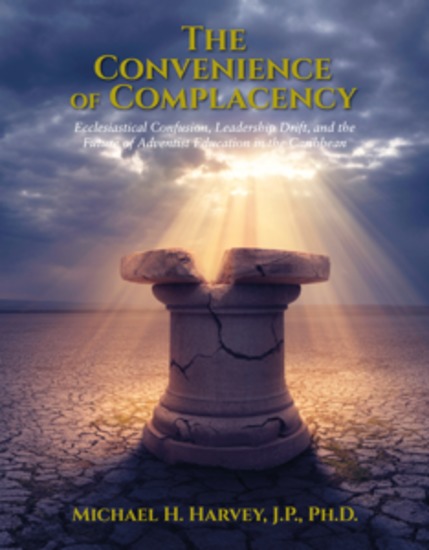
The Convenience of Complacency - Ecclesiastical Confusion Leadership Drift and the Future of Adventist Christian Education in the Caribbean - cover

The Convenience of Complacency - Ecclesiastical Confusion Leadership Drift and the Future of Adventist Christian Education in the Caribbean

PHD Michael H. Harvey JP

Casa editrice: Spines

  • 0
  • 0
  • 0

Sinossi

In the Caribbean, Adventist academic institutions grapple with complacency amidst a legacy of faith-based education. The call for visionary leadership and innovation rings out, to revive the spirit of learning and service that once defined them. This narrative urges a blending of tradition with fresh fervor, challenging educators to cultivate minds for a higher purpose and to renew their commitment to transformative education, balancing scholarship with unwavering faith, and shaping destinies.
Disponibile da: 08/01/2026.
Lunghezza di stampa: 312 pagine.
Altri libri che potrebbero interessarti

  • Trauma Proof - Healing Attachment and the Science of Prevention - cover

    Trauma Proof - Healing...

    Benjamin Perks

    • 0
    • 0
    • 0
    From the moment they're born, babies seek a loving parental attachment. When that connection is absent, it derails childhood development in ways that can last a lifetime. The annual health costs of illness related to child trauma for North America and Europe alone are 1.3 trillion dollars. Child trauma is much more widespread than previously thought and passes from one generation to the next. But that's not the end of the story—there is overwhelming evidence that this intergenerational transmission can be disrupted. So why isn't the eradication of childhood trauma a tier-one public priority, like defense or growth? 


    In Trauma Proof, Benjamin Perks argues that it must be, and that we can tackle it as a public health problem like COVID-19, by 1) making sure everyone is aware of the risk; 2) preventing transmission; and 3) opening pathways to healing. Perks shows we have the tools to make these three things happen, and the evidence to show they work. Psychology, neuroscience, and medicine have made huge leaps in the past twenty-five years. We now know what causes Adverse Childhood Experiences (ACEs), how to reduce them, and how to address them. For the first time in history, we know child mistreatment is not inevitable. Trauma Proof is a rallying call to address child trauma as the public health crisis it is—because we can do better for kids, and we should.
    Mostra libro
  • World War I on the Ground: The History and Legacy of Life in the Trenches - cover

    World War I on the Ground: The...

    Editors Charles River

    • 0
    • 0
    • 0
    World War I, also known in its time as the “Great War” or the “War to End all Wars”, was an unprecedented holocaust in terms of its sheer scale. Fought by men who hailed from all corners of the globe, it saw millions of soldiers do battle in brutal assaults of attrition which dragged on for months with little to no respite. Tens of millions of artillery shells and untold hundreds of millions of rifle and machine gun bullets were fired in a conflict that demonstrated man’s capacity to kill each other on a heretofore unprecedented scale, and as always, such a war brought about technological innovation at a rate that made the boom of the Industrial Revolution seem stagnant. 
    The enduring image of World War I is of men stuck in muddy trenches, and of vast armies deadlocked in a fight neither could win. It was a war of barbed wire, poison gas, and horrific losses as officers led their troops on mass charges across No Man’s Land and into a hail of bullets. While these impressions are all too true, they hide the fact that trench warfare was dynamic and constantly evolving throughout the war as all armies struggled to find a way to break through the opposing lines. 
    There was another war going on beneath the trenches, a war of tunnels and mines fought by men who didn’t see sunlight for days at a time and who lived in constant fear of cave-ins and enemy detection. These men, who had mostly been miners in civilian life, lived a twilight existence, working long hours in silence and near darkness while great battles raged overhead. They suffered from fatigue, stress, and the knowledge that they could be killed at any time by an unseen enemy. Despite this, they persevered, and the mines they laid under enemy trench systems turned the tide of at least one major battle.
    Mostra libro
  • Rome's Imperial Legacy - The Empire's Enduring Impact - cover

    Rome's Imperial Legacy - The...

    Rogan Fish

    • 0
    • 0
    • 0
    The rise of the Roman Empire marks one of the most transformative periods in world history. Emerging from humble beginnings as a small settlement on the banks of the Tiber River, Rome grew to dominate the ancient world through a combination of military prowess, political innovation, and cultural assimilation. This chapter explores the foundations of Roman power, the empire’s expansive reach across continents, and the key figures who shaped its rise. 
    Rome's origins date back to the 8th century BCE, with its legendary founding attributed to Romulus and Remus. Initially a monarchy, Rome evolved into a republic around 509 BCE after the overthrow of the last Etruscan king. This transition marked the beginning of a new political era, where power rested with the Senate and elected magistrates. The republican framework, characterized by a system of checks and balances, laid the foundation for Rome's expansive ambitions. As the republic matured, it developed a complex legal system and a robust military structure that would be instrumental in its growth. 
    One of Rome’s most significant advantages was its strategic location. Positioned at the crossroads of the Mediterranean, Rome became a hub for trade and communication. The city's ability to integrate conquered territories through road networks and infrastructure projects further solidified its control. Additionally, the Roman practice of granting varying levels of citizenship to conquered peoples helped maintain loyalty and stability within the expanding state.
    Mostra libro
  • Why Psychosis Is Not So Crazy - A Road Map to Hope and Recovery for Families and Caregivers - cover

    Why Psychosis Is Not So Crazy -...

    Stijn Vanheule

    • 0
    • 0
    • 0
    An expert's guide to humanizing psychosis through communication offers key insights for family and friends to support loved ones during mental health crises. 


    Are we all a little crazy? Roughly fifteen percent of the population will have a psychotic experience, in which they lose contact with reality. Yet we often struggle to understand and talk about psychosis. Interactions between people build on the stories they tell each other—stories about the past, about who they are or what they want. In psychosis we can no longer rely on these stories, this shared language. So how should we communicate with someone experiencing reality in a radically different way than we are? 


    Drawing on his work in psychoanalysis, Stijn Vanheule seeks to answer this question, which carries significant implications for mental health as a whole. With a combination of theory from Freud to Lacan, present-day research, and compelling examples from his own patients and well-known figures such as director David Lynch and artist Yayoi Kusama, he explores psychosis in an engaging way that can benefit those suffering from it as well as the people who care for and interact with them.
    Mostra libro
  • Make Enterprise Great Again: The Gods Must Be Crazy! - Cradle of Communism to Catacomb of Capitalism: A Proposal to bring back the House of Roosevelt's - cover

    Make Enterprise Great Again: The...

    Saji Madapat, EPM Mavericks

    • 0
    • 0
    • 0
    It’s halftime America! 
    Ay Yi Yai Yi! We are in the middle of The New World Order! 
    Empires rise, decline, and fall. History has witnessed this cycle with the Romans, the Ottomans, and the British. They have all toppled, and if we are not careful, the US will be the next. 
    Many of today’s enterprises are a gaggle of debt-addicted extreme financial engineering frogs floundering in tepid snake oil. Unfortunately, many will find their demise in the clutches of IP vultures. 
    If we don't play our trump cards right, the next voracious Empire - the Middle Kingdom of China - will consume us; sending their errand boys to collect bills from the US and over a hundred other countries that it has economically and digitally colonized since the Economic Tsunami of 2008, through “Belt and Road Initiative” (BRI) to its “Digital Silk Road” (DSR). 
    “Make Enterprise Great Again” digs into the foundations of capitalism and traces the ideals, triumphs and zeitgeist of the Roosevelt years in order to “Build Back Better” – and to save us from the impending Fourth Reich. 
     Yeah! It's halftime, America!
    Mostra libro
  • Inca Mythology - Sacred Legends of the Inca Empire - cover

    Inca Mythology - Sacred Legends...

    Matthew Fillard

    • 0
    • 0
    • 0
    The Inca Empire, at its zenith, spanned much of South America, including present-day Peru, Ecuador, Bolivia, and parts of Chile and Argentina. Known for its advanced architecture, agricultural systems, and administrative organization, the Inca civilization also possessed a deeply spiritual culture. Central to their worldview was a rich tapestry of mythology that explained the creation of the world, the origins of humankind, and the roles of the gods in the natural and spiritual realms. These sacred legends were not just stories; they were the very foundation upon which the Inca society was built, shaping everything from daily rituals to the governance of the empire.  
    Inca mythology was intricately connected to the natural world, with gods and deities representing various elements of the environment, such as the sun, the moon, the earth, and water. The Inca people believed that these deities were not distant, abstract beings but rather active forces that influenced their lives. The most important gods were thought to have a direct relationship with the ruler, often considered to be divine or descended from these gods. As such, the Inca king, or Sapa Inca, was revered as the son of the sun god, Inti, and his authority was considered sacred.  
    The role of mythology extended beyond the divine and into the social and political spheres. It was through myth that the Inca legitimized their rule, connected their empire to the divine order, and reinforced the unity of their vast territories. Legends of the first rulers, such as Manco Capac and Mama Ocllo, were tied to creation myths that depicted them as divine figures sent to bring civilization to the world. These stories were used to justify Inca conquests and to explain the hierarchical structure of society. 
    Mostra libro