Begleiten Sie uns auf eine literarische Weltreise!
Buch zum Bücherregal hinzufügen
Grey
Einen neuen Kommentar schreiben Default profile 50px
Grey
Jetzt das ganze Buch im Abo oder die ersten Seiten gratis lesen!
All characters reduced
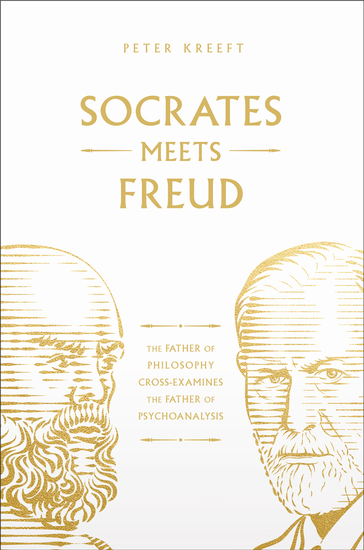
Socrates Meets Freud - The Father of Philosophy Cross-Examines the Father of Psychoanalysis - cover

Socrates Meets Freud - The Father of Philosophy Cross-Examines the Father of Psychoanalysis

Peter Kreeft

Verlag: Word on Fire

  • 0
  • 0
  • 0

Beschreibung

In the Socrates Meets series, Peter Kreeft revives the classic method of bringing philosophy to life through dialogue. In eight innovative volumes, he uncovers the principles, assumptions, and sometimes dangerous conclusions of some of history’s most influential minds.  Each dialogue imagines a purgatory where we can listen in on conversations between Socrates and the great thinkers who, centuries later, picked up the philosopher’s torch. Each conversation investigates one of the philosopher’s key works, a short, readable classic that raises central questions both for philosophy and for life. ​In this volume, Socrates cross-examines Sigmund Freud, the father of psychoanalysis and author of Civilization and Its Discontents, exploring science, religion, happiness, and the pleasure principle.
Verfügbar seit: 05.05.2025.
Drucklänge: 200 Seiten.

Weitere Bücher, die Sie mögen werden

  • Essential Information After High School Graduation - cover

    Essential Information After High...

    Michael Anthony White

    • 0
    • 0
    • 0
    Many subjects critical to personal growth have slowly become regarded as inflammatory: Communication. Culture. Money. Nutrition. Science. Social Media. Politics. Equality. Feminism. 
    Refreshingly operating without bias, these “hot seat” topics are constructively discussed with intelligence and heart — going far beyond the offerings of public school curriculum.
    Zum Buch
  • Little Women Podcast Q&A Your Questions Answered - cover

    Little Women Podcast Q&A Your...

    Niina Niskanen

    • 0
    • 0
    • 0
    How did I get started in Louisa May Alcott's research? Is Beth really just part of the sick girl trope or is there more in her? and why is Friedrich from Germany? Why did the film-makers erase Laurie's backstory? What is Amy's relationship with Catholicism? was Louisa May Alcott religious? Did she want to get married? are Fritz and Laurie really based on men in her life? I've got so many questions from you guys that I will answer them in this excellent Little Women Q&A. One thing that surprised me was that it was really difficult to find studies on Laurie. I was interested in Laurie as an individual, and why he behaves the way he does. I was expecting to find a lot about him because Laurie is a popular character, at least according to the filmmakers, a lot more popular than Friedrich, and I didn't find anything about him. Nothing about him being an orphan. The tricky relationship that he has with his grandfather or why he's hanging in Jo´s apron strings. There are scenes in Little Women where Laurie is annoyed when Jo is lecturing him, but he's still addicted to her care. Maybe Amy's screen portrayals are the reason why there hasn't been that much research made on May Alcott by scholars .I think the same applies to Laurie and Friedrich in films. Laurie is this pretty guy who Jo rejects. Then in a lot of the studies that I read, the writer was asking why did Louisa May Alcott marry Jo to an old German and not to the rich and handsome young Laurie? Okay. Friedrich is not old. He's 39. If you read letters between Louisa and her publisher, Thomas Niles, Louisa was the one who came up with all the marriages.When I was reading these essays, it was so frustrating because the book doesn't show Laurie as this manic pixie dream boy, as the movies do, but more as a seriously troubled young man.
    Zum Buch
  • There Are No Guilty People - The Death Penalty Moral Conscience and the Illusion of Justice - cover

    There Are No Guilty People - The...

    Leo Tolstoy, Tim Zengerink

    • 0
    • 0
    • 0
    What if the people we punish most severely are the ones we understand least? 
    There Are No Guilty People is Leo Tolstoy’s impassioned outcry against the death penalty, delivered through a mix of storytelling and moral argument. Based on real events and driven by a deep sense of compassion, this work asks the reader to look beyond judgment—and into the heart of what it means to be human. 
    This modern audiobook adaptation preserves the intensity and clarity of Tolstoy’s original message while updating the language for today’s listener. 
    What You’ll Hear in This Modern Translation: 
    •	A moving fictional narrative of a condemned man 
    •	A passionate and persuasive critique of the justice system 
    •	A call to compassion that challenges common ideas of guilt and punishment 
    Included in This Edition: 
    This edition brings new urgency to Tolstoy’s moral message, offering a powerful listening experience that speaks directly to the conscience. 
    Listen now—and reconsider what justice really means.
    Zum Buch
  • Jim Crow's Pink Slip - The Untold Story of Black Principal and Teacher Leadership - cover

    Jim Crow's Pink Slip - The...

    Leslie T. Fenwick

    • 0
    • 0
    • 0
    In 1954, the Supreme Court's Brown decision ended segregated schooling in the United States, but regrettably, as documented in congressional testimony and transcripts, it also ended the careers of a generation of highly qualified and credentialed Black teachers and principals. In the Deep South and northern border states over the decades following Brown, Black schools were illegally closed and Black educators were displaced en masse. As educational policy and leadership expert Leslie T. Fenwick deftly demonstrates, the effects of these changes stand contrary to the democratic ideals of an integrated society and equal educational opportunity for all students. 


    Jim Crow's Pink Slip provides a trenchant account of how tremendous the loss to the US educational system was and continues to be. The book draws the line from the past injustices to problems that the educational system grapples with today: not simply the underrepresentation of Black teachers and principals, but also salary reductions, teacher shortages, and systemic inequality. 


    By engaging with the complicated legacy of the Brown decision, Fenwick illuminates a crucial chapter in education history. She also offers policy prescriptions aimed at correcting the course of US education, supporting educators, and improving workforce quality and diversity.
    Zum Buch
  • I Know My Father - cover

    I Know My Father

    Neville Goddard

    • 0
    • 0
    • 0
    I Know My Father by Neville Goddard is a profound exploration of the relationship between the individual and the divine source. In this enlightening work, Goddard delves into the nature of God, the human connection to divinity, and the transformative power of understanding and embracing one's spiritual heritage.Goddard emphasizes that true spiritual enlightenment comes from recognizing and internalizing the belief that the divine resides within each person. This understanding allows individuals to tap into their inherent creative power and live a life aligned with their highest purpose.The book is structured to guide readers through several key themes:Understanding the Divine Nature:Goddard explores the concept of God not as an external entity, but as an indwelling presence within each individual. He highlights the importance of shifting one's perception from an external deity to an intimate, personal connection with the divine.The Power of Belief:Central to Goddard's teachings is the idea that belief shapes reality. He explains how one's beliefs and assumptions create their experiences and how altering these beliefs can lead to profound changes in one's life.Imagination as a Divine Tool:Goddard reiterates his core principle that imagination is the creative force within humans. By harnessing the power of imagination and aligning it with divine intention, individuals can manifest their desires and transform their lives.Faith and Inner Conviction:The book emphasizes the necessity of unwavering faith and inner conviction. Goddard teaches that by maintaining a strong belief in one's divine nature and creative power, individuals can overcome any obstacle and achieve their goals.Practical Application:Goddard provides practical exercises and meditative practices to help readers cultivate a deeper understanding of their divine nature and apply these principles in their daily lives.I Know My Father is an inspiring guide for anyone seeking a deeper connection with the divine and a more fulfilling, purpose-driven life. Neville Goddard's clear and empowering teachings offer timeless wisdom on the nature of God, the power of belief, and the transformative potential within each person.This book remains a valuable resource for those on a spiritual journey, providing insights and practical tools to help readers recognize their divine heritage and live in harmony with their highest self.
    Zum Buch
  • The Race Ahead - Overcoming Racial Bias By Rewiring The American Mind - cover

    The Race Ahead - Overcoming...

    Dr. J. Bruce Stewart

    • 0
    • 0
    • 0
    In Dr. J. Bruce Stewart's transformative work, "The Race Ahead," readers are taken on a compelling journey into the depths of racial bias ingrained in American society and the mind itself. This groundbreaking book not only diagnoses the presence and origins of racial biases but also prescribes a sophisticated blueprint for eradicating them, aimed at rewiring how we perceive and interact across racial lines. 
    Dr. Stewart begins by exploring the psychological foundations of bias, focusing particularly on the amygdala's role in triggering automatic and subconscious responses associated with fear and othering. He explains how these psychological processes, though once essential to human survival, now perpetuate division and misunderstanding in a diverse society. Using relatable anecdotes and rigorous research, Stewart shows how deep-seated fears and stereotypes shape our interactions, often in ways we are not consciously aware of. 
    Central to the book is the "Last Mile" problem, a concept Stewart uses to describe the final and most challenging steps in the journey toward racial equity. These steps involve not only acknowledging and understanding biases but actively implementing strategies to dismantle them within ourselves and our institutions. Stewart argues that this last mile is fraught with complexities and challenges, as it requires changing longstanding societal structures and confronting uncomfortable truths. 
    Part historical review, part psychological exploration, and part sociological study, "The Race Ahead" delves into the origins and perpetuations of racial myths and stereotypes. From the misrepresentations in media and literature that shape public perception to the policies and practices in education and law enforcement that reinforce racial disparities, Stewart leaves no stone unturned. 
    "The Race Ahead" is an urgent call to action, demanding a radical shift in both mindset and behavior from all sectors of society. It challenges readers to confront their biases
    Zum Buch