Join us on a literary world trip!
Add this book to bookshelf
Grey
Write a new comment Default profile 50px
Grey
Subscribe to read the full book or read the first pages for free!
All characters reduced
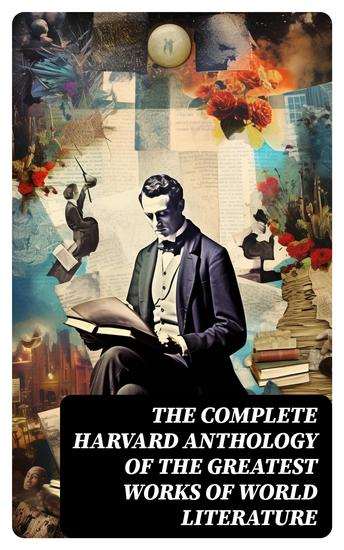
The Complete Harvard Anthology of the Greatest Works of World Literature - Enriched edition All 71 Volumes - The Five Foot Shelf & The Shelf of Fiction - cover

The Complete Harvard Anthology of the Greatest Works of World Literature - Enriched edition All 71 Volumes - The Five Foot Shelf & The Shelf of Fiction

Johann Wolfgang von Goethe, Gotthold Ephraim Lessing, Thomas Carlyle, Plato, Charles Darwin, Alighieri Dante, Euripides, Percy Bysshe Shelley, Charles Lamb, Samuel Johnson, John Stuart Mill, David Hume, Joseph Addison, Leigh Hunt, Epictetus, Thomas De Quincey, Samuel Taylor Coleridge, Jonathan Swift, Christopher Marlowe, Jacob Grimm, Wilhelm Grimm, William Hazlitt, Marcus Tullius Cicero, Daniel Defoe, Aesop Aesop, Richard Henry Dana, John Dryden, Pedro Calderon de la Barca, John Ruskin, Robert Burns, David Garrick, Ralph Waldo Emerson, Izaak Walton, John Bunyan, Homer Homer, Edmund Burke, Plutarch Plutarch, Molière Moliere, Aeschylus Aeschylus, Sophocles, William Makepeace Thackeray, Benjamin Franklin, Pierre Corneille, Jean Racine, Robert Browning, Oliver Goldsmith, John Milton, Aristophanes, Virgil Virgil, Richard Brinsley Sheridan, William Penn, Philip Sidney, Francis Bacon, Adam Smith, Alessandro Manzoni, Abraham Cowley, Ben Jonson, John Woolman, Sydney Smith, Marcus Aurelius, Hans Christian Andersen, George Gordon Byron, Thomas à Kempis, Richard Steele, Thomas Browne, Thomas Babington Macaulay, Miguel de Cervantes, Friedrich von Schiller, Pliny the Younger, Saint Augustine

Publisher: DigiCat

  • 0
  • 0
  • 0

Summary

The Complete Harvard Anthology of the Greatest Works of World Literature stands as a testament to the profound diversity and brilliance of literary expression throughout the ages. This collection compiles an impressive array of literary styles ranging from the classical dialogues of Plato to the romantic verses of Percy Bysshe Shelley, exploring timeless themes of love, reason, morality, and the human condition. Within its pages, readers will encounter the pithy fables of Aesop, the profound tragedies of Euripides, and the incisive wit of Jonathan Swift, providing a sweeping panorama of intellectual and creative endeavors from varied epochs and cultures. The anthology serves not only as a literary treasure trove but also as a crucial cultural artifact, reflecting the evolution of human thought and artistic achievement. Guided by the discerning scholarship of its editors, the anthology gathers luminaries from distinct eras—philosophers like John Stuart Mill and Marcus Aurelius, writers such as Miguel de Cervantes and Charles Lamb, and pioneers like Charles Darwin and Adam Smith. These authors hail from diverse backgrounds, bringing insights from the Enlightenment, Renaissance, Romanticism, and beyond. Their collective voices weave a rich tapestry that enhances the reader's understanding of both the specific themes within their works and broader humanistic discourses. Each piece not only stands alone in its brilliance but also resonates within a larger conversation spanning centuries and borders. This anthology is an indispensable resource for those eager to immerse themselves in the wealth of literary heritage packed within a single volume. It offers a unique opportunity to engage with a plethora of perspectives, experiencing a vibrant dialogue that spans across time and space. Scholars, students, and literature enthusiasts alike will discover a profound educational value in its pages, gaining insights into the myriad ways humanity has sought to understand itself and the world across different epochs. The collection invites readers to not only appreciate the distinct voices contained within but also to reflect upon the enduring dialogue they contribute to the tapestry of world literature.

In this enriched edition, we have carefully created added value for your reading experience:
- An Introduction draws the threads together, discussing why these diverse authors and texts belong in one collection.
- Historical Context explores the cultural and intellectual currents that shaped these works, offering insight into the shared (or contrasting) eras that influenced each writer.
- A combined Synopsis (Selection) briefly outlines the key plots or arguments of the included pieces, helping readers grasp the anthology's overall scope without giving away essential twists.
- A collective Analysis highlights common themes, stylistic variations, and significant crossovers in tone and technique, tying together writers from different backgrounds.
- Reflection questions encourage readers to compare the different voices and perspectives within the collection, fostering a richer understanding of the overarching conversation.
Available since: 11/15/2023.
Print length: 30498 pages.

Other books that might interest you

  • Abortion - A Rational Look at an Emotional Issue - cover

    Abortion - A Rational Look at an...

    R. C. Sproul

    • 0
    • 0
    • 0
    In this book, Dr. R.C. Sproul employs his unique perspective as a highly experienced pastor–theologian and a trained philosopher to provide well–considered and compassionate answers to the difficult questions that attend termination of pregnancy. Dr. Sproul strives for a factual, well–reasoned approach informed by careful biblical scholarship. He considers both sides of this issue in terms of biblical teaching, civil law, and natural law. This edition includes a new foreword by Dr. George Grant and has been updated to reflect developments in the issue. Appendixes provide further background on the issue of when life begins and list sources for pro–life resources.
    Show book
  • Six Principals of a Miracle II - cover

    Six Principals of a Miracle II

    Pastor Philip

    • 0
    • 0
    • 0
    Life confronts everyone with things that allows them to practice the "Six Principals" mentioned in this message. Success in life is not only for the selected few, but for all who can implement the "Six Principals of a Miracle in their lives.
    Show book
  • Poverty by America: Book Summary and Analysis - cover

    Poverty by America: Book Summary...

    Briefly Summaries

    • 0
    • 0
    • 0
    This is a concise summary and analysis of Poverty, by America, by Matthew Desmond.
     
    It is not the original book and is not affiliated with or endorsed by Matthew Desmond.
     
    Ideal those seeking a quick and insightful overview.


    Why does poverty persist in the wealthiest nation in the world? Poverty, by America takes listeners on a powerful journey to uncover the systems, policies, and choices that sustain inequality in the United States. With a critical yet hopeful lens, the author reveals how poverty is not an inevitable condition but a deliberate outcome of exploitation, exclusion, and prioritizing wealth over welfare.
     
    Through compelling stories, hard-hitting data, and bold analysis, this audiobook explores the hidden architecture of poverty—from exploitative housing markets and stagnant wages to systemic exclusion from healthcare, education, and justice. It also tackles the provocative question: Who benefits from poverty? The answer will challenge listeners to rethink their understanding of inequality and their own role in perpetuating it.
     
    But Poverty, by America is more than a diagnosis—it’s a call to action. The author outlines proven solutions to reduce poverty and invites listeners to become “poverty abolitionists,” advocating for systemic change and justice. This audiobook is a clarion call for those who believe in creating a society where everyone has the opportunity to thrive.
     
    Perfect for anyone seeking clarity on one of today’s most pressing issues, Poverty, by America inspires hope and action. It’s not just about understanding poverty—it’s about fighting it.
    Show book
  • We Desire to Be Immoral: It Felt Great to Be Human - cover

    We Desire to Be Immoral: It Felt...

    A.A. Castor

    • 0
    • 0
    • 0
    What does it truly mean to be "immoral"? Is it a flaw to be conquered, or an intrinsic part of our humanity? In this bold and expansive work, A.A. Castor embarks on a sweeping investigation into the roots of our so-called forbidden impulses. Drawing on vivid historical accounts, cutting-edge psychology, and illuminating insights from the animal kingdom, Castor unravels the stories behind behaviors that societies have labeled as taboo or deviant. From ancient rituals to modern counterculture movements, from primal instincts honed by evolution to the ever-shifting moral boundaries shaped by media and technology, this book offers a comprehensive portrait of how "immorality" has both challenged and enriched our collective journey. 
    Through thoughtful analysis and engaging narrative, readers are invited to confront their own assumptions about right and wrong. Rather than condemning our darkest desires, Castor demonstrates how risk-taking, rebellion, and raw self-expression can foster innovation and self-discovery. By weaving together perspectives from philosophy, social science, and personal reflection, We Desire to Be Immoral ultimately urges a more nuanced understanding of human nature—one that embraces our imperfections, values empathy and connection, and dares us to celebrate the liberating power of authenticity. Whether you're intrigued by the hidden forces behind social norms or seeking a deeper appreciation for the complexities of the human spirit, this book is an invitation to step beyond the ordinary and revel in the full spectrum of who we are.
    Show book
  • American Civil War in 1864 The: The History and Legacy of the War’s Penultimate Year - cover

    American Civil War in 1864 The:...

    Editors Charles River

    • 0
    • 0
    • 0
    Americans have long been fascinated by the Civil War, marveling at the size of the battles, the leadership of the generals, and the courage of the soldiers. Since the war's start over 150 years ago, the battles have been subjected to endless debate among historians and the generals themselves. The Civil War was the deadliest conflict in American history, and had the two sides realized it would take 4 years and inflict over a million casualties, it might not have been fought. Since it did, however, historians and history buffs alike have been studying and analyzing the biggest battles ever since.  
    	By the close of 1864, Abraham Lincoln had been reelected, the Union army had taken Nashville from General Hood, and Sherman had concluded his total war, “slash-and-burn” march of destruction to Savannah, Georgia, offering it as a Christmas present to Lincoln. Nevertheless, with everything seemingly falling to pieces, the South still held out hope of some sort of miracle, and Davis even attempted to send a peace delegation to meet with Lincoln in the early months of 1865. On January 28, 1865 as Union General Ulysses S. Grant was continuing to lay siege to Lee’s army at Petersburg, Virginia, Davis sent three commissioners headed by Vice-President Stephens to initiate informal peace talks with Lincoln. By February 3, however, the talks, known as the Hampton Roads Conference, came to a stalemate as Lincoln would accept nothing less than total union, while Davis would only accept Southern independence.  
    	Even at that point, the South was clearly on its last legs. General George H. Thomas destroyed John Bell Hood’s Confederate army at the battles of Nashville and Franklin, leaving only two large Confederate armies still in the field. Lee's army was weakened by desertion, lack of supplies and casualties, and Joseph E. Johnston’s army could barely resist against Sherman’s army as it was advancing north toward Virginia.
    Show book
  • State of the Union 1983 - cover

    State of the Union 1983

    Ronald Reagan

    • 0
    • 0
    • 0
    The 1983 State of the Union address, delivered January 25, 1983, focuses on “what we can do together -- not as Republicans and Democrats, but as Americans -- to make tomorrow's America happy and prosperous at home, strong and respected abroad, and at peace in the world.” 
    Reagan praises a bipartisan proposal to save social security. He blames deficits on domestic spending and not on defense spending or tax cuts. A four-part plan is proposed to reduce the deficit: first, a federal spending freeze; second, reducing fraud and waste in programs such as food stamps; third, reductions in defense spending; and fourth, a future tax increase but only if Congress approves the spending freeze. 
    Reagan proposes the Employment Act of 1983 to provide training for the long-term unemployed. Educational reforms are proposed to promote math and science and tax credits for parents who send their children to private or religiously affiliated schools. Many other reforms relating to port modernization, women’s rights, civil rights, crime, agriculture, job training, health care, and technology are proposed.  
    In the international arena, we export over 20 percent of our industrial production and 40 percent of our farm produce. As the leader of the West, “America must be an unrelenting advocate of free trade.” While pursuing arms reduction with the Soviet Union, Reagan insists that agreements be verifiable, noting “the overwhelming evidence of Soviet violations of international treaties”. 
    Reagan asserts that “America is on the mend” and asks Congress “to make government a help, not a hindrance to our people in the challenging but promising days ahead.” 
    Audio recording courtesy of the Ronald Reagan Presidential Library. 
    AspenLeafMedia.com
    Show book