Unisciti a noi in un viaggio nel mondo dei libri!
Aggiungi questo libro allo scaffale
Grey
Scrivi un nuovo commento Default profile 50px
Grey
Iscriviti per leggere l'intero libro o leggi le prime pagine gratuitamente!
All characters reduced
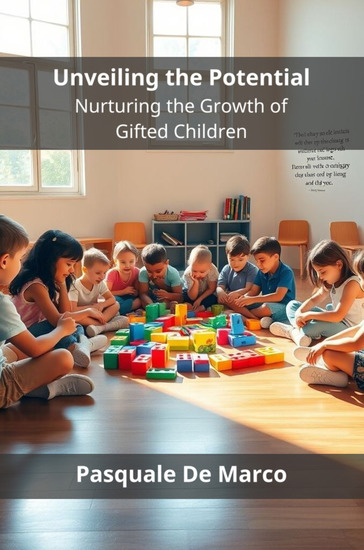
Unveiling the Potential - Nurturing the Growth of Gifted Children - cover

Unveiling the Potential - Nurturing the Growth of Gifted Children

Pasquale De Marco

Casa editrice: Publishdrive

  • 0
  • 0
  • 0

Sinossi

"Unveiling the Potential: Nurturing the Growth of Gifted Children" is a groundbreaking book that offers a comprehensive exploration of the world of giftedness. Delving into the unique challenges and opportunities faced by gifted children, this book provides invaluable guidance to parents, educators, and anyone invested in their success.

Within these pages, readers will find a wealth of insights into the diverse manifestations of giftedness. From prodigious academic abilities to exceptional creativity and leadership skills, gifted children possess a remarkable range of talents and abilities. However, these extraordinary gifts often come with their own set of challenges. Gifted children may struggle to fit in, feeling isolated and misunderstood. They may encounter an educational system that fails to recognize and cater to their unique needs, leading to boredom, frustration, and underachievement.

This book addresses these challenges head-on, offering practical strategies for creating supportive environments that foster the growth and potential of gifted children. Parents will learn how to recognize the signs of giftedness, advocate for their child's needs, and provide a stimulating home environment that encourages curiosity and exploration. Educators will discover how to differentiate instruction, provide appropriate accommodations, and create a classroom climate that values diversity and encourages intellectual growth.

"Unveiling the Potential" also highlights the importance of social and emotional development for gifted children. It explores the unique challenges they face, such as perfectionism, anxiety, and difficulty with peer relationships. The book provides guidance on how to help gifted children develop healthy coping mechanisms, build strong social connections, and cultivate a positive self-image.

With its blend of research-based insights, real-life stories, and practical strategies, "Unveiling the Potential" is an essential resource for anyone committed to nurturing the growth and potential of gifted children. This book is a call to action, inviting educators, parents, and policymakers to work together to create a world where all gifted children can thrive and make a positive impact on society.


If you like this book, write a review!
Disponibile da: 02/06/2025.
Lunghezza di stampa: 165 pagine.


Altri libri che potrebbero interessarti

  • Freedom's Battle - cover

    Freedom's Battle

    Mohandas K. Gandhi

    • 0
    • 0
    • 0
    "Freedom's Battle" is an influential essay written by Mahatma Gandhi in 1922 during the Indian independence movement. In this thought-provoking piece, Gandhi reflects on the principles of nonviolent resistance and civil disobedience as a means to challenge and overcome oppressive systems. 
     
    The essay begins with Gandhi acknowledging the critical juncture at which the fight for freedom stands. He passionately articulates the necessity of the struggle for independence and the moral imperative for individuals to resist unjust laws and policies. 
     
    Gandhi introduces the concept of Satyagraha, emphasizing the power of truth and nonviolence. He argues that nonviolent resistance is not a strategy of the weak but a potent force that requires great courage and strength of character. He believes that nonviolence is not a submission to injustice but a proactive, assertive force that can transform both the oppressor and the oppressed. 
     
    Throughout the essay, Gandhi explores the moral duty of individuals to engage in civil disobedience when faced with unjust laws. He contends that obedience to an unjust law is in itself a form of violence, and breaking such laws nonviolently becomes a powerful instrument for societal change. 
     
    Gandhi also touches on the idea of self-suffering as a means of resistance. He advocates for willingly enduring the consequences of civil disobedience as a way to awaken the conscience of the oppressor and the society at large. 
    "Freedom's Battle" is a call to action, urging individuals to recognize their agency in the struggle for freedom and justice. It remains a significant work that encapsulates Gandhi's philosophy of nonviolence and its application in the pursuit of social and political change. The essay serves as a timeless inspiration for movements advocating civil rights, justice, and freedom around the world.
    Mostra libro
  • Fear Tactics - Using Fear to Control or Manipulate Others - cover

    Fear Tactics - Using Fear to...

    Cito Harder

    • 0
    • 0
    • 0
    Fear is one of the most primal human emotions, deeply embedded in the survival instincts of individuals and societies. Throughout history, it has been harnessed as a tool of control, allowing those in positions of power to manipulate others for personal, political, or financial gain. Fear tactics involve the deliberate use of intimidation, threats, and uncertainty to shape perceptions, influence decisions, and suppress opposition. Whether used in personal relationships, corporate environments, or large-scale governance, these tactics exploit an individual’s natural aversion to danger and discomfort.  
    At its core, a fear tactic works by triggering the instinctive fight-or-flight response. When people perceive a threat—whether real or fabricated—they become more susceptible to external influence. Logical reasoning often takes a backseat to emotional reactions, making individuals more likely to comply with demands, accept misleading information, or make decisions that they otherwise would not consider. Fear-based influence operates on the principle that an individual will do whatever is necessary to avoid the perceived threat, even if it means relinquishing personal freedoms, adopting extreme beliefs, or placing trust in an unworthy authority.
    Mostra libro
  • Zen Morning: Energizing Music to Start Your Day with Peace - cover

    Zen Morning: Energizing Music to...

    ZEN Morning Music

    • 0
    • 0
    • 0
    Start your day with clarity and purpose with Zen Morning, a vibrant selection of energizing music that awakens your mind, body, and spirit.


    Designed to accompany your morning rituals, meditation, or yoga practice, these uplifting tracks blend gentle ethereal melodies with refreshing rhythms to set a positive tone for the day ahead.


    Whether you're sipping your morning tea, journaling, or practicing mindfulness, Zen Morning will fill you with calm energy and focus, helping you embrace the day with peace and confidence.
    Mostra libro
  • Dutch Made Easy - Beginner - Volume 2 of 3 - cover

    Dutch Made Easy - Beginner -...

    Lingo Wave

    • 0
    • 0
    • 0
    We broke our new series on learning Dutch down into different learning stages. Start with the "Lower Beginner" books followed by the "Beginner" and "Upper Beginner" books. Next, progress to the "Intermediate" series, then test and reinforce your knowledge with the "Conversations" series. 
    This audiobook is divided into units.While it provides different learning patterns and accommodates various needs, this audiobook focuses on helping you improve your ability to understand, speak, and memorise Dutch.  
    In Unit 1 you will hear Dutch decoded with each syllable spoken very slowly and clearly with repetition. Immediately before each sentence is spoken, you will hear the translation, so you will always understand what is being said. 
    Unit 2 focuses solely on increasing your listening ability, which will improve your abilities to engage in dialogue with a native Dutch speaker. This chapter requires you to listen very carefully to nuances in the language. 
    By Unit 3 you will already notice progress in your abilities to speak and understand Dutch. The spoken translation is followed by two repetitions in Dutch at a completely natural speed. While you are learning to process naturally spoken Dutch, Units 3 and 4 will help you memorise new vocabulary and full sentences. 
    In Unit 5 you can test yourself on how much you have learned. If you are having difficulties, we suggest you revisit the listening, speaking, or memorisation section of Units 1, 2 3 or 4, according to what you need more help with. 
    Topics covered in this book: 
    1. Asking about family 
    2. Asking about relationship status 
    3. Expressing frequency 
    4. Talking about spare time activities and hobbies 
    5. Using quantifiers/determiners 
    6. Talking about preference 
    7. Talking about abilities 
    8. Talking about location of places 
    9. Describing appearance 
    10. Talking about personality 
    11. Talking about the weather 
    ...
    Mostra libro
  • Evolution Is Wrong - A Radical Approach to the Origin and Transformation of Life - cover

    Evolution Is Wrong - A Radical...

    Erich von Däniken

    • 0
    • 0
    • 0
    A Fascinating Exploration on Why the Darwinists’ Theory No Longer Explains EverythingThere was once a set of ideas called the theory of evolution, conceived by clever people and confirmed by countless scientists. Then people discovered the electron microscope. This made it possible to make the molecules within the cell visible, and suddenly questions about evolution arose that were not possible before. Which force actually bundles the atoms in the right order? What moves the molecular chains into the correct position? How did the first living unit within the cell actually come about? How does inheritance work, how does information pass on to the next generation? Did humans descend only and exclusively from primates—as Charles Darwin and countless other great minds assumed—or did additional “engines” intervene in evolution? Today it is clear: countless questions can no longer be answered with the previous theory of evolution. There is a form of life called “Blob” (Physarum polycephalum). The “thing” has neither eyes nor ears, neither a mouth nor a nose or even a brain. Nevertheless, it takes in food, overcomes obstacles by the shortest route and exchanges information with other “blobs.” The “blob” contradicts any evolutionary thought that one develops from the other. Or the “gastric-brooding frogs” (Rheobatrachus) found in Australia. They hatch their young in the stomach. Impossible in a slow, evolutionary process. Everywhere there are characteristics of animals that do not want to fit into the theory of evolution anywhere. And man? Are we really the most adapted life-form on this planet? Today, more and more scientists who contradict the previous theory of evolution speak out. The theory fits the changes within the species, but it can no longer be reconciled with the inner workings of the cell. Some other influence that has so far escaped us is affecting evolution. It is called “Intelligent Design.” Intelligent planning is suspected behind this. Anyone or anything—a spirit of the universe? Aliens?—could be behind this planning. Erich von Däniken uses countless examples to demonstrate the impossibility of the previous evolutionary idea. He quotes scientists who argue against the previous teaching, but also those who defend it. Unfortunately, established science still refuses to look at discrepancies and holes in the theory of evolution, even though it is quite obvious that there is more going on with regard to the development of all species, as well as human culture, than could be explained by the theory of evolution alone.
    Mostra libro
  • The Searchers - A Quest for Faith in the Valley of Doubt - cover

    The Searchers - A Quest for...

    Joseph Loconte

    • 0
    • 0
    • 0
    Never before had they known such hope. 
    In a world drenched in violence and oppression, here was a man armed with a message of peace and freedom. Into lives nearly overwhelmed by grief and sorrow, he brought compassion and healing and the deepest joy. To people who felt like outcasts and aliens, he showed the way home. And then, in one devastating night, all their hopes collapsed. 
    This is where our story begins—in the valley of despair. It is a tale of two friends, a stranger, and a search for truth in a world gone mad with doubt. 
    Historian Joseph Loconte unlocks the meaning of their exchange, set in the chaotic days following the execution of Jesus of Nazareth. Drawing from literature, film, philosophy, history, and politics, Loconte shows how this biblical drama is an integral part of our own story. Sooner or later, we will find ourselves among the searchers.
    Mostra libro