Rejoignez-nous pour un voyage dans le monde des livres!
Ajouter ce livre à l'électronique
Grey
Ecrivez un nouveau commentaire Default profile 50px
Grey
Abonnez-vous pour lire le livre complet ou lisez les premières pages gratuitement!
All characters reduced
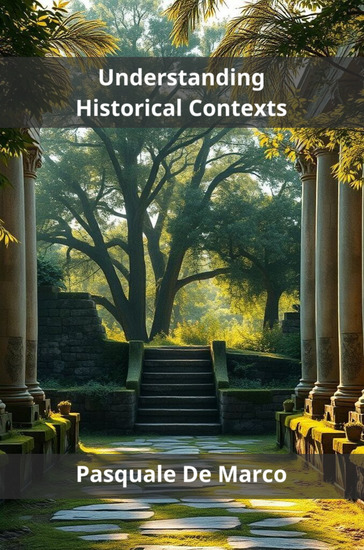
Understanding Historical Contexts - cover

Understanding Historical Contexts

Pasquale De Marco

Maison d'édition: Publishdrive

  • 0
  • 0
  • 0

Synopsis

In this captivating exploration of historical context, we embark on an intellectual journey that unveils the profound influence of the past on diverse aspects of human life. From the realms of literature and art to the corridors of politics and economics, this comprehensive guide delves into the intricate interplay between historical context and human experience.

With erudition and clarity, this book illuminates the significance of historical context in understanding the motivations, challenges, and triumphs that have shaped societies and cultures throughout history. It provides a framework for interpreting literature, appreciating art and music, and analyzing political and social phenomena through the lens of their historical context.

Furthermore, this exploration investigates the impact of historical context on scientific discoveries, technological advancements, and the evolution of religious and philosophical thought. It examines the role of historical context in education and learning, emphasizing its importance in shaping curricula, teaching methods, and the overall learning experience.

Delving into the realm of media and information, this book explores how historical context affects the dissemination of news, the formation of public opinion, and the preservation of cultural heritage. It highlights the dynamic relationship between the past and the present, recognizing the profound influence of historical context on our lives and our world.

Through this comprehensive examination, readers gain a deeper understanding of the forces that have shaped our societies and cultures, enabling them to navigate the complexities of the present and envision a more enlightened future. This book is an indispensable resource for students, scholars, and anyone seeking to expand their knowledge of historical context and its pervasive impact on human existence.


If you like this book, write a review!
Disponible depuis: 02/06/2025.
Longueur d'impression: 166 pages.

D'autres livres qui pourraient vous intéresser

  • Self-Reliance - cover

    Self-Reliance

    Ralph Waldo Emerson

    • 0
    • 0
    • 0
    "Self-Reliance" is an 1841 essay written by American transcendentalist philosopher and essayist Ralph Waldo Emerson. It contains the most thorough statement of one of Emerson's recurrent themes: the need for each individual to avoid conformity and false consistency, and follow his own instincts and ideas. It is the source of one of Emerson's most famous quotations: "A foolish consistency is the hobgoblin of little minds, adored by little statesmen and philosophers and divines. 
    Emerson focuses on seemingly insignificant details explaining how life is "learning and forgetting and learning again".
    Voir livre
  • ChatGPT For Fiction Writing - How to Make Money from Fiction the AI Way - cover

    ChatGPT For Fiction Writing -...

    Omar Johnson

    • 0
    • 0
    • 0
    Unleash Your Creative Genius with ChatGPT For Fiction Writing: How to Make Money from Fiction the AI Way. Journey into a transformative era where artificial intelligence becomes your co-author, enhancing your storytelling prowess to unprecedented levels. This illuminating guide reveals the masterful ways to employ ChatGPT, enabling you to pen riveting stories that not only captivate readers' hearts but also open lucrative avenues for your craft. 
    Are you an aspiring novelist, eager to etch your mark on the literary world? A forward-thinking entrepreneur, on the hunt for the next breakthrough? Or a seasoned storyteller, ready to elevate your narrative? This book is your guiding star, lighting the path to harnessing AI as a potent ally in your creative journey. 
    With "ChatGPT For Fiction Writing", discover the roadmap to: 
    • Conquer Writer’s Block — Say goodbye to the dreaded blank page 
    • Spawn Infinite Plot Ideas — Unearth twists that keep readers on the edge 
    • Engineer Cliffhangers — Craft endings that leave readers craving more 
    • Sculpt Living, Breathing Characters — Characters that leap off the page 
    • Refine Pacing & Flow — Master the rhythm of compelling storytelling 
    • Pen a Bestseller — Secrets to making your book irresistibly magnetic 
    And that’s just the beginning... 
    Beyond the craft, dive into actionable, step-by-step strategies for marketing your book and monetizing your unique skills in fiction writing — transforming your passion into a rewarding, sustainable income. 
    Bonus: 150+ Tailored Prompts Included 
    Embark with a treasure chest of 150+ meticulously crafted prompts spanning a rich tapestry of genres. 
    Copy, paste into ChatGPT, and ignite the spark of your next great novel.
    Voir livre
  • Food - Second Edition - cover

    Food - Second Edition

    John Coveney

    • 0
    • 0
    • 0
    In Food, John Coveney examines "food as . . . " identity, politics, industry, regulation, the environment, justice, and gastronomy. He explores how food helps us understand what it means to be human. 


    The centrality of food in life, and the importance of food as life, is undeniable. As a source of biological substrates, personal pleasure, and political power, food is and has been an enduring requirement of human biological, social, and cultural existence. Interest in food has increased across the academic, public, and popular spheres, fueled by popular media's constant play on the role of food and body size, and food and cooking, as a mass spectacle for TV audiences. Through food, we construct our social identities, our families and communities. However, Coveney also highlights the tensions between the industrialization of food, the environment, and the iniquitous distribution of food. He also considers how the food industries, on which most of us must rely, have also had direct effects on our bodies through diet, and the development of illness and diseases. 


    This accessible primer is for students and general listeners alike, indeed, for anyone with an interest in food. It questions the idea that food is merely something inert on the plate. Instead, it shows how influential, symbolic, powerful, and transformative food has come to be.
    Voir livre
  • The Broken Path - Native Tribes and the Tragedy of the Trail of Tears - cover

    The Broken Path - Native Tribes...

    Davis Truman

    • 0
    • 0
    • 0
    “The Broken Path: Native Tribes and the Tragedy of the Trail of Tears” delves into one of the darkest chapters in American history, documenting the harrowing experiences of Southeastern Native American tribes during the forced relocations known as the Trail of Tears. This book offers a poignant exploration of the devastating consequences of U.S. government policies that sought to remove Indigenous peoples from their ancestral lands. Through the lens of selected tribes, whose fates, though varied, were marked by equal suffering, the narrative reveals the inhumane reality of manifest destiny.  
    This doctrine drove the relentless expansion of white settlers across the continent. Despite efforts by Native Americans to resist through legal battles and armed conflict, their struggle was tragically futile against the overwhelming forces of displacement. This powerful account underscores the enduring impact of this tragic era on the Indigenous populations of America.
    Voir livre
  • Spanish Empire in the Americas The: The History of Spain’s Colonization across Central America and South America - cover

    Spanish Empire in the Americas...

    Editors Charles River

    • 0
    • 0
    • 0
    By the time Christopher Columbus started setting east from the New World, he had explored San Salvador in the Bahamas (which he thought was Japan), Cuba (which he thought was China), and Hispaniola, the source of gold. As the common story goes, Columbus, en route back to Spain from his first journey, called in at Lisbon as a courtesy to brief the Portuguese King John II of his discovery of the New World. King John subsequently protested that according to the 1479 Treaty of Alcáçovas, which divided the Atlantic Ocean between Spanish and Portuguese spheres of influence, the newly discovered lands rightly belonged to Portugal. To make clear the point, a Portuguese fleet was authorized and dispatched west from the Tagus to lay claim to the “Indies,” which prompted a flurry of diplomatic activity in the court of Ferdinand and Isabella. At the time, Spain lacked the naval power to prevent Portugal from acting on this threat, and the result was the hugely influential 1494 Treaty of Tordesillas. 
    	The Treaty of Tordesillas was one of the most important documents of its kind of the age, for it established the essential parameters of the two competing empires, the first of the major European imperial entities. The Treaty of Tordesillas drew an imaginary line from pole to pole, running 100 leagues west of the westernmost islands of the Azores. According to the terms of a supporting papal bull, all the lands to the west of that belonged to Spain, and all of those to the east belonged to Portugal. What this meant in practical terms was that Portugal was given Africa and the Indian Ocean while Spain was granted all the lands to the west, including the Americas and the Caribbean, all collectively known as the “Indies,” or the New World. Perhaps inevitably, a regional rivalry had developed as the Portuguese began to establish a colony in Brazil and push its boundaries southwards. 
    Voir livre
  • Quirky History - Maritime Moments Most History Books Don't Mention - cover

    Quirky History - Maritime...

    John Quirk

    • 0
    • 0
    • 0
    John Quirk loves history, drawing and boats and these three elements come together in this attractive and entertaining book. He has sought out obscure episodes or familiar events from the past and written engagingly about them, illustrated with his excellent colour cartoons. Where possible he relates the historical happenings and maritime moments to the present day, be it when tracing the history of the screw, misinformation (fake news) during the Second World War, plague ships in the fourteenth century, or Russia's ill-fated war with Japan in 1904. The events covered range from Henry V's invasion of France in 1415, consisting mainly of chartered French ships and paid for partially by Dick Whittington, to episodes in the Second World War, like the Somali Camel Corps capturing a German U-boat. Other historic figures involved include Horatio Nelson, Napoleon, Rudolf Diesel and Lawrence of Arabia. The 25 stories and over 100 cartoons are a treasure-trove of compelling, salt-infused, tales told with imagination and humour, with an eye on the present day, which will be enjoyed by anyone with an interest in maritime history (or even just history).
    Voir livre