Unisciti a noi in un viaggio nel mondo dei libri!
Aggiungi questo libro allo scaffale
Grey
Scrivi un nuovo commento Default profile 50px
Grey
Iscriviti per leggere l'intero libro o leggi le prime pagine gratuitamente!
All characters reduced
The Golden Chronicles - cover

The Golden Chronicles

Pasquale De Marco

Casa editrice: Publishdrive

  • 0
  • 0
  • 0

Sinossi

In this captivating journey through California's rich history, culture, and natural wonders, you'll discover the stories of those who shaped the Golden State's destiny. From Native American tribes and Spanish explorers to Gold Rush pioneers and Hollywood legends, California's past is as diverse and fascinating as its present.

With its breathtaking landscapes, from towering mountains to fertile valleys and sun-kissed beaches, California is a natural paradise. But beyond its beauty lies a story of human endeavor, innovation, and resilience.

California has long been a land of opportunity, attracting people from all over the world who dream of a better life. The Gold Rush of the 1840s brought a wave of fortune seekers, and in the 20th century, the state became a hub of technological innovation with the rise of Silicon Valley.

But California's story is not without its challenges. The state has faced environmental degradation, economic inequality, and social injustice. Yet, through it all, Californians have shown a remarkable ability to overcome adversity and create a better future for themselves and their children.

Today, California stands as a beacon of hope and progress, a state that continues to attract people from all over the world who dream of a better life. Its diverse population, innovative spirit, and commitment to sustainability make California a model for the 21st century.

This book is an invitation to explore the Golden State in all its glory, to learn about its history, culture, and people, and to be inspired by its unwavering spirit of optimism and resilience.


If you like this book, write a review!
Disponibile da: 02/06/2025.
Lunghezza di stampa: 162 pagine.

Altri libri che potrebbero interessarti

  • Episode 8 - Rural Development - cover

    Episode 8 - Rural Development

    Anjum Sharma

    • 0
    • 0
    • 0
    Why is it said that the empowerment of Panchayati Raj institutions is necessary for rural development. In a rapidly changing world, it is necessary to take care that the units of local self-government do not lag behind. In such a scenario, what is the government doing to improve the economic condition of the rural people? Find out in this episode.
    Mostra libro
  • How Would You Like Your Mammoth? - 12000 Years of Culinary History in 50 Bite-Size Essays - cover

    How Would You Like Your Mammoth?...

    Uta Seeburg, Max Miller

    • 0
    • 0
    • 0
    Did you know that Egyptians mummified beef ribs for their dearly departed to enjoy in the afterlife? That Roman gladiators were relegated to a vegan diet of grains and beans? That the fast-food hamburger was a result of a postwar, high-efficiency work ethic? This is not a cookbook; instead, How Would You Like Your Mammoth? is a chronological journey through the culinary history of humankind, with fifty short, snackable essays packed to the brim with juicy tidbits and cultural insights. With author Uta Seeburg as your guide, you'll learn not only which dishes are linked to key cultural moments, but also how each represents the social hierarchy and values of the civilization that invented it. 
     
    Discover how and why: the Columbian exchange gave Indian curry its spicy kick; roasted swan became the centerpiece of choice in spectacle-loving 1650s high society; a Portuguese princess helped popularize tea in England; the first dish ever to be prepared live on television was an omelet; and much more. 
     
    Foodies and history buffs alike will savor every amusing yet educational historical snapshot, from one of the oldest recorded recipes (lamb stew with barley and onions) to out-of-this-world food fit for astronauts (dehydrated chicken soup just like mom used to make).
    Mostra libro
  • The Political Development of American Debt Relief - cover

    The Political Development of...

    Emily Zackin, Chloe N. Thurston

    • 0
    • 0
    • 0
    A political history of the rise and fall of American debt relief. 
    Americans have a long history with debt. They also have a long history of mobilizing for debt relief. Throughout the nineteenth century, indebted citizens demanded government protection from their financial burdens, challenging readings of the Constitution that exalted property rights at the expense of the vulnerable. Their appeals shaped the country’s periodic experiments with state debt relief and federal bankruptcy law, constituting a pre-industrial safety net. Yet, the twentieth century saw the erosion of debtor politics and the eventual retrenchment of bankruptcy protections. 
    The Political Development of American Debt Relief traces how geographic, sectoral, and racial politics shaped debtor activism over time, enhancing our understanding of state-building, constitutionalism, and social policy.
    Mostra libro
  • Normandy to Nazi Surrender - Firsthand Account of a P-47 Thunderbolt Pilot - cover

    Normandy to Nazi Surrender -...

    Patrecia Slayden Hollis, Colonel...

    • 0
    • 0
    • 0
    The late Van Slayden trained on the PT-3 kite-like biplane in 1937, but he learned fighter pilot operations flying "by the seat of his pants," walking away from five crashes. Shortly after the invasion of Normandy, he landed on Utah Beach to help establish a US Army Air Forces' (AAF's) presence in Europe. He flew the P-47 Thunderbolt, a fighter-bomber, in combat over Northern France and commanded the 36th Fighter Group-the "Fightin' 36th-at Batogne, St. Vith, the Bridgehead at Remagen, Operations Grenade, Clarion, Varsity and other missions. His 22nd Fighter Squadron was the first in the AAF to land voluntarily on German soil. 


    He was deep into Germany when the Nazis surrendered on May 8, 1945, which was remarkably anticlimactic. Van Slayden, a country boy from rural Tennessee, like so many of his contemporaries, stepped up to the challenge as part of the Greatest Generation.
    Mostra libro
  • Outsourcing Duty - The Moral Exploitation of the American Soldier - cover

    Outsourcing Duty - The Moral...

    Bradley J. Strawser, Michael J....

    • 0
    • 0
    • 0
    Are contemporary soldiers exploited by the state and society that they defend? More specifically, have America's professional service members disproportionately carried the moral weight of America's war-fighting decisions since the inception of an all-volunteer force? In this volume, Michael J. Robillard and Bradley J. Strawser examine the question of whether and how American soldiers have been exploited in this way. 


    Robillard and Strawser offer an original theory of "moral exploitation"—the notion that persons or groups can be wrongfully exploited by being made to shoulder an excessive amount of moral weight. They make the case that this exploitation accurately describes the relationship between the United States and the members of its military, and offer an in-depth analysis of some of the exploitative and misleading elements of present-day military recruitment, the moral burdens soldiers often bear, and the stifling effect that a "Thank You for Your Service" and "I support the troops" culture has had on serious public engagement about America's ongoing wars. Robillard and Strawser offer a critique of the pernicious divide between military members and the civilians who direct them. They conclude by arguing for several normative and prudential prescriptions to help close this ever-widening fissure between the US and its military, and within the US itself.
    Mostra libro
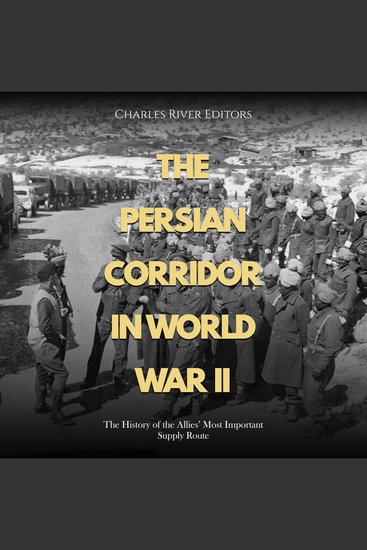
  • Persian Corridor in World War II The: The History of the Allies’ Most Important Supply Route - cover

    Persian Corridor in World War II...

    Editors Charles River

    • 0
    • 0
    • 0
    Operation Barbarossa was the most fateful decision of World War II, and when it gave the Soviets common cause with the British (and subsequently the Americans), the purpose of the Lend-Lease Act changed in nature as well. The bulk of Germany’s formidable armed forces were committed to the offensive in the east, which relieved the pressure on the British and meant that a German attack on Britain or elsewhere in Western Europe was not going to happen, so keeping the Soviets in the war became the most essential goal of the supply program. 
    Getting supplies to the Soviets to help them resist the German armies became a strategic imperative, and Iran’s geography of bordering the Persian Gulf to the south and Soviet territory to the north brought Iran to the front and center in the strategic supply effort. The German invasion devastated much of European Russia, but also devastated Ukraine and Belarus, other member “republics” in the Soviet Union, and the portions of the Soviet Union that bordered on Iran were Armenia, Azerbaijan and east of the Caspian, Turkmenistan. 
    The Persian Corridor involved British and Dominion forces, as well as Soviet armed forces and personnel, but the operation and management of the Persian Corridor became largely an American show. Most of the immense amount of aid sent was for transshipment across Iran to the Soviets, but it also involved supplying British and Commonwealth forces in Iran, Iraq and elsewhere in the Middle East. Some was used to feed and supply Iran’s people, and some was used to modernize and maintain Iran’s infrastructure. There was also the need to supply the American troops working in the Persian Corridor. While 80% or so of the aid came from the U.S., there was also a significant amount of aid sent from Canada, Australia, South Africa and especially India. 
    Mostra libro