Begleiten Sie uns auf eine literarische Weltreise!
Buch zum Bücherregal hinzufügen
Grey
Einen neuen Kommentar schreiben Default profile 50px
Grey
Jetzt das ganze Buch im Abo oder die ersten Seiten gratis lesen!
All characters reduced
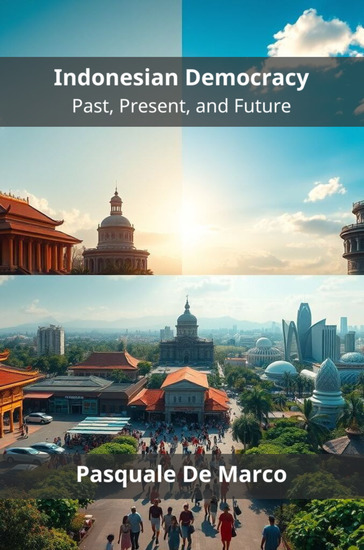
Indonesian Democracy - Past Present and Future - cover

Indonesian Democracy - Past Present and Future

Pasquale De Marco

Verlag: Publishdrive

  • 0
  • 0
  • 0

Beschreibung

Indonesian Democracy: Past, Present, and Future tells the story of Indonesia's remarkable journey from authoritarian rule to democracy. From the ashes of Dutch colonial rule, Indonesia emerged as a beacon of hope for democracy and self-determination. However, the early years of independence were marked by political instability and economic turmoil.

The New Order era under President Suharto brought a period of stability and economic growth, but at the expense of political and civil liberties. The 1998 student-led protests marked a turning point in Indonesian history, leading to the fall of Suharto and the beginning of a new era of reform and democratization.

The Reformasi movement transformed Indonesia's political landscape, opening up space for civil society organizations, political parties, and independent media. The new democratic government faced a daunting task in addressing the challenges of poverty, inequality, and corruption. Yet, despite these challenges, Indonesia made significant progress in consolidating its democracy and promoting human rights.

This book provides a comprehensive overview of Indonesian democracy, from its historical roots to its current challenges and prospects. It examines the role of civil society, the political system, economic development, foreign policy, and cultural identity in shaping Indonesia's democratic trajectory.

Indonesian Democracy: Past, Present, and Future is an essential resource for scholars, students, policymakers, and anyone interested in understanding the complexities of Indonesian politics and society. It offers a nuanced and insightful analysis of Indonesia's democratic transition and the challenges it faces in the 21st century.


If you like this book, write a review!
Verfügbar seit: 02.06.2025.
Drucklänge: 156 Seiten.

Weitere Bücher, die Sie mögen werden

  • The Fabulanarchist Luxury Uprising - cover

    The Fabulanarchist Luxury Uprising

    Jack Houston

    • 0
    • 0
    • 0
    Playful, formal, satirical and tender, the poems in The Fabulanarchist Luxury Uprising are wildly wide-ranging. Jack Houston whisks the reader through meditations on family life, the teachings of Lucretius, the sexual potential of Captain Barnacles, and dreams of a socialist utopia, managing to be both deeply weird and touching.
    In his debut pamphlet, Houston draws out and scrutinises the mundanities of life, showing how they can form part of something much bigger. His poems aim to awaken the capacity for revolution within us all, even if it only gets us as far as the roundabout in the local playpark.
    "In the year 2121, we're all now too aware that a sofa is simply a bench
    
    constructed from the hewn corpse
    
    of a tree, covered in a mesh made from the amniotic fibres
    
    of oppressedly mono-cropped cotton plants
    
    & filled with the plumage
    
    from many a murdered full-grown duck [...]"
    
    - from 'Utopia'
    Zum Buch
  • Parliamentary America - The Least Radical Means of Radically Repairing Our Broken Democracy - cover

    Parliamentary America - The...

    Maxwell L. Stearns

    • 0
    • 0
    • 0
    Americans face increasingly stark choices each presidential election and a growing sense that our government can't solve the nation's most urgent challenges.  Our eighteenth-century system is ill-suited to our twenty-first-century world. Information-age technology has undermined our capacity to face common problems together and turned our democracy upside down, with gerrymanders letting representatives choose voters rather than voters choosing them. In Parliamentary America, Maxwell L. Stearns argues that the solution to these complex problems is a parliamentary democracy. 


    Stearns considers such leading alternatives as ranked choice voting, the national popular vote, and congressional term limits, showing why these can't solve our constitutional crisis. Instead, three amendments—expanding the House of Representatives, having House party coalitions choose the president, and letting the House end a failing presidency based on no confidence—will produce a robust multiparty democracy. 


    Stearns takes listeners on a world tour—England, France, Germany, Israel, Taiwan, Brazil, and Venezuela—showing what works in government, what doesn't, and how to make the best features our own. Genuine party competition and governing coalitions, commonplace across the globe, may seem like a fantasy in the United States. But we can make them a reality.
    Zum Buch
  • Wage Labor And Capital - cover

    Wage Labor And Capital

    Karl Marx

    • 0
    • 0
    • 0
    Originally written as a series of newspaper articles in 1847, Wage-Labor and Capital were intended to give an overview of Marx’s central theories regarding the economic relationships between workers and capitalists. These theories outlined include the Marxian form of the Labour Theory of Value, which distinguishes “labor” from “labor-power”, and the Theory of Concentration of Capital, which states that capitalism tends towards the creation of monopolies and the disenfranchisement of the middle and working classes. These theories were later elaborated in Volume 1 of Capital, published in 1867. Karl Heinrich Marx FRSA was a German philosopher, a critic of political economy, economist, historian, sociologist, political theorist, journalist, and socialist revolutionary. His best-known titles are the 1848 pamphlet The Communist Manifesto and the four-volume Das Kapital.
    Zum Buch
  • Henry David Thoreau: On The Duty of Civil Disobedience - original title: Resistance to Civil Government - cover

    Henry David Thoreau: On The Duty...

    Henry David Thoreau

    • 0
    • 0
    • 0
    "That government is best which governs least" is the famous opening line of this essay. The slavery crisis inflamed New England in the 1840s and 1850s. The environment became especially tense after the Fugitive Slave Act of 1850. A lifelong abolitionist, Thoreau delivered an impassioned speech which would later become Civil Disobedience in 1848, just months after leaving Walden Pond. The speech dealt with slavery, but at the same time excoriated American imperialism, particularly the Mexican–American War. Thoreau asserts that because governments are typically more harmful than helpful, they therefore cannot be justified. Democracy is no cure for this, as majorities simply by virtue of being majorities do not also gain the virtues of wisdom and justice. The judgment of an individual's conscience is not necessarily inferior to the decisions of a political body or majority, and so "[i]t is not desirable to cultivate a respect for the law, so much as for the right. The only obligation which I have a right to assume is to do at any time what I think right.... Law never made men a whit more just; and, by means of their respect for it, even the well-disposed are daily made the agents of injustice." He adds, "I cannot for an instant recognize as my government [that] which is the slave's government also.
    Zum Buch
  • The Myth of Left and Right - How the Political Spectrum Misleads and Harms America - cover

    The Myth of Left and Right - How...

    Verlan Lewis, Hyrum Lewis

    • 0
    • 0
    • 0
    A groundbreaking argument that the political spectrum today is inadequate to twenty-first-century America and a major source of the confusion and hostility that characterize contemporary political discourse. 


    As American politics descends into a battle of anger and hostility between two groups called "left" and "right," people increasingly ask: What is the essential difference between these two ideological groups? In The Myth of Left and Right, Hyrum Lewis and Verlan Lewis provide the surprising answer: nothing. As the authors argue, there is no enduring philosophy, disposition, or essence uniting the various positions associated with the liberal and conservative ideologies of today. Far from being an eternal dividing line of American politics, the political spectrum came to the United States in the 1920s and, since then, left and right have evolved in so many unpredictable and even contradictory ways that there is currently nothing other than tribal loyalty holding together the many disparate positions that fly under the banners of "liberal" and "conservative." Cutting against the grain of most scholarship on polarization in America, this book shows why the idea that the political spectrum measures deeply held worldviews is the central political myth of our time and a major cause of the confusion and vitriol that characterize public discourse.
    Zum Buch
  • Heart of Atlanta - Five Black Pastors and the Supreme Court Victory for Integration - cover

    Heart of Atlanta - Five Black...

    Ronnie Greene

    • 0
    • 0
    • 0
    The Heart of Atlanta Supreme Court decision stands among the court’s most significant civil rights rulings. 
     
    In Atlanta, Georgia, two arch segregationists vowed to flout the Civil Rights Act of 1964, the sweeping slate of civil rights reforms just signed into law by President Lyndon B. Johnson. The Pickrick restaurant was run by Lester Maddox, soon to be  
    governor of Georgia, and the Heart of Atlanta motel was operated by lawyer Moreton Rolleston Jr. After the law was signed, a group of ministry students—George Willis, Albert Dunn, and Woodrow Lewis—showed up for a plate of skilletfried chicken at the Pickrick; Maddox greeted them with a pistol, axe handles, and  
    a mob of White supporters. At the Heart of Atlanta, ministers Albert Sampson and Charles Wells sought rooms, but Moreton Rolleston refused to accept the Black patrons. 
     
    These confrontations became the centerpiece of the nation’s first two legal challenges to the Civil Rights Act. In gripping detail built from exclusive interviews and original documents, Heart of Atlanta reveals the saga of the case’s rise to the  
    US Supreme Court, which unanimously rejected the segregationists. Heart of Atlanta restores the legal cases and their heroes to their proper place in history.
    Zum Buch