Unisciti a noi in un viaggio nel mondo dei libri!
Aggiungi questo libro allo scaffale
Grey
Scrivi un nuovo commento Default profile 50px
Grey
Iscriviti per leggere l'intero libro o leggi le prime pagine gratuitamente!
All characters reduced
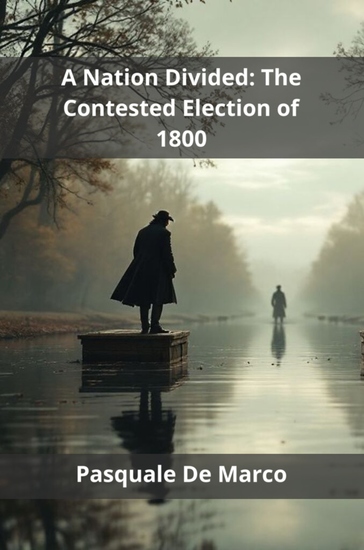
A Nation Divided - The Contested Election of 1800 - cover

A Nation Divided - The Contested Election of 1800

Pasquale De Marco

Casa editrice: Publishdrive

  • 0
  • 0
  • 0

Sinossi

In the annals of American history, few elections have captured the imagination and left an enduring legacy quite like the election of 1800. A tumultuous contest marked by bitter rivalries, political intrigue, and a nation teetering on the brink of disunion, this pivotal event forever altered the course of American democracy.

At the heart of this extraordinary election were two towering figures: Thomas Jefferson and John Adams, men of profound intellect, unwavering principles, and starkly different visions for the future of their young nation. Jefferson, a brilliant statesman and ardent advocate of states' rights, embodied the spirit of republicanism and the pursuit of individual liberty. Adams, a steadfast Federalist and champion of a strong central government, believed in the necessity of order and stability to safeguard the fledgling republic.

As the election of 1800 approached, the nation found itself deeply divided along political, ideological, and geographical lines. Jefferson and Adams, former allies in the fight for independence, now stood as fierce rivals, their personal animosity fueling a campaign that descended into mudslinging and character assassination. The muddied waters of the election were further roiled by the machinations of political parties, each seeking to seize power and advance their own interests.

The election itself was a nail-biting affair, with the outcome hanging in the balance for weeks. The Electoral College, a complex and controversial system, became the battleground for a bitter struggle between Jefferson and Adams, their supporters pulling every lever at their disposal to secure victory. As the electoral votes were tallied, the nation held its breath, fearing the potential for a constitutional crisis.

Ultimately, it was Jefferson who emerged victorious, narrowly defeating Adams in a contest that left both sides bruised and battered. His election marked a watershed moment in American history, heralding the triumph of republican ideals and the ascendancy of the Democratic-Republican Party. Yet, the wounds inflicted during the campaign lingered, leaving a scar on the nation's political landscape that would take years to heal.

This book delves into the fascinating story of the election of 1800, shedding new light on this pivotal event and its profound impact on American history. Through meticulous research and engaging storytelling, the book brings to life the key players, the dramatic events, and the complex issues that shaped the outcome of this momentous election.


If you like this book, write a review!
Disponibile da: 02/06/2025.
Lunghezza di stampa: 162 pagine.

Altri libri che potrebbero interessarti

  • A Fool's Wisdom - Science Conspiracies & The Secret Art of Alchemy - cover

    A Fool's Wisdom - Science...

    Steven A. Young

    • 0
    • 0
    • 0
    Attend to these words gentle soul, herein ye shall find a two-part alchemical discourse concerning the purity and veracity of scientific thought, separating the 'ugly truth' (science conspiracies) from the 'beautiful truth' (the secret art of Alchemy). 
    Part One takes aim at the post-modern secular worldview of Scientific Materialism or Scientism, rebuking and revealing the fatal flaws inherent in its core beliefs and cosmology, as well as the various conspiracies and occult shenanigans underlying physics, chemistry and medicine. It is said that 'adventure is an attitude towards discomfort', and to the theorists, statists and sophists take heed, there may be some discomfort ahead, as the pillars upon which you stand will be systematically dismantled and debunked through a combination of wit, fierce logic and timeless wisdom. 
    Part Two unveils the ancient Hermetic practice of Alchemy, also known as The Science of Transformation or The Art, a universal system of spiritual knowledge common to all mankind but hidden behind a mantle of domestic counter-intelligence and worthless academic theories. Alchemy is so empowering and enlightening that it is deemed unfit for public programming, and so it must be sought out by curious individuals who initiate themselves on the path. 
    Scientism is the troll that guards the gates to the fountain of alchemical truth, and so it must be overcome before one can proceed to higher levels of knowledge. For the humble awakening souls and lovers of truth and wisdom, what awaits you in these pages is a treasure trove of philosophical gold so potent as to transform even the most asinine fool into a sage.
    Mostra libro
  • Skid Dogs - cover

    Skid Dogs

    Emelia Symington-Fedy

    • 0
    • 0
    • 0
    A raw and riveting coming-of-age story about the wild love of teenage friendships and the casual oppression of nineties rape culture. 


    Emelia Symington-Fedy grew up with her girl gang on the railroad tracks of a small town in British Columbia. Unsupervised and wild, the girls explored the power and shortcomings of "best" friendships and their growing sexuality. 


    Two decades later an eighteen-year-old girl is murdered on Halloween on the same tracks, and Symington-Fedy returns to her hometown to stay with her mother, who is fearful of a murderer at large. 


    While the media narrows its focus on how the girl dared be alone on the tracks, Symington-Fedy slowly comes to terms with the mistreatment of her own teenage body. Giving a bold and often darkly humorous first-hand account of nineties rape culture and the sexual coercion that still permeates girlhood, Symington-Fedy holds her hometown close and accountable and exposes the subtle ways that misogyny shows up daily.
    Mostra libro
  • The Quest of Rose - The Cosmic Keys of Our Future Becoming - cover

    The Quest of Rose - The Cosmic...

    Anneloes Smitsman, Jean Houston

    • 0
    • 0
    • 0
    The Quest of Rose is a Winner of the 2022 Silver Nautilus Book Award in the category of Personal Growth, and the first book of the Future Humans Trilogy by Anneloes Smitsman, Ph.D. and Jean Houston, Ph.D. Written as an allegory, The Quest of Rose weaves together cutting-edge insights from the new paradigm sciences with indigenous wisdom and consciousness teachings for our evolutionary next steps. Offering 9 Cosmic Keys and 12 transformation practices for becoming the future humans of the emerging new era. Praised as, "epic, unlike any other", "one of the most important books of our catalytic time", and "a true gift to humanity." 
    In the words of Lynne McTaggart's foreword: "The Quest of Rose is a work of profound hope, offering a powerful new definition of ourselves and a vision of unlimited future possibility. But this trilogy also means to be an incitement to radical transformation. Once you are caught up in Rose's revelations and begin to understand the deep truths within them, a new way of your own being must be born. Allow this brilliant new story to unleash the imaginal cells of your own extraordinary potential and become the future human you were always meant to be." 
    "Pure inspiration - soul gold, genius. A guidebook that instructs people how to connect to the hidden power map governing this epic of transformation." ~ Caroline Myss, Ph.D. 
    "Full of wisdom and insight, with a vision of the future everyone can benefit from in our age of change amid uncertainty. An act of true compassion, which exhibits empathy and understanding that leads to answers." ~ Deepak Chopra, M.D. 
    "It is the start of a journey that can literally repattern your nervous system to better meet the trials of these challenging times." ~ Donna Eden and David Feinstein, Ph.D.
    Mostra libro
  • Accordion Eulogies - A Memoir of Music Migration and Mexico - cover

    Accordion Eulogies - A Memoir of...

    Noé Álvarez

    • 0
    • 0
    • 0
    Searching, propulsive, and deeply spiritual, Accordion Eulogies is an odyssey to repair a severed family lineage, told through the surprising history of a musical instrument 


    Growing up in Yakima, Washington, Noé Álvarez never knew his grandfather. Stories swirled around this mythologized, larger-than-life figure: That he had abandoned his family, and had possibly done something awful that put a curse on his descendants. About his grandfather, young Noé was sure of only one thing: That he had played the accordion. Now an adult, reckoning with the legacy of silence surrounding his family's migration from Mexico, Álvarez resolves both to take up the instrument and to journey into Mexico to discover the grandfather he never knew. 


    Álvarez travels across the US with his accordion, meeting makers and players in cities that range from San Antonio to Boston. He uncovers the story of an instrument that's been central to classic American genres, but also played a critical role in indigenous Mexican history. Like the accordion itself, Álvarez feels trapped between his roots in Mexico and the US. As he tries to make sense of his place in the world—as a father, a son, a musician—he gets closer to uncovering the mystery of his origins.
    Mostra libro
  • Rethinking the Police - An Officer's Confession and the Pathway to Reform - cover

    Rethinking the Police - An...

    Daniel Reinhardt

    • 0
    • 0
    • 0
    A former officer grapples with the reality of our broken police culture 


    Our society has long been stuck in cultural and ideological battles about police brutality and the police force's broken relationship with our communities. Rethinking the Police promises to start a more hopeful conversation. 


    Daniel Reinhardt spent twenty-four years as a police officer near Cleveland, Ohio. He was long unaware of the ways the culture of the police department was shaping him, but gradually, through his own experiences as a police officer and through the mentorship of Black Christians in his life, his eyes were opened to a difficult truth: police brutality against racial minorities was endemic to the culture of the system itself. 


    In Rethinking the Police, Reinhardt lays out a history of policing in the United States, showing how it developed a culture of dehumanization, systemic racism, and brutality. But Reinhardt doesn't stop there: he offers a new model of policing based not in dominance and control but in a culture of servant leadership, with concrete suggestions for procedural justice and community policing.
    Mostra libro
  • Division of the Roman Empire The: The History of the Conflicts that Split the Western Roman Empire and Eastern Roman Empire in the 4th Century - cover

    Division of the Roman Empire...

    Editors Charles River

    • 0
    • 0
    • 0
    Rome’s Imperial Crisis has been difficult for historians to summarize, which is why, despite being one of the most intriguing periods in Roman history, it is often overlooked by people who have chosen to focus on the more cohesive periods before and after it. Even though he is best remembered for his religious reforms and what his (mostly Christian) admirers described as his spiritual enlightenment, Constantine was also an able and effective ruler in his own right. Rising to power in a period of decline and confusion for the Roman Empire, he gave it a new and unexpected lease on life by repelling the repeated invasions of the Germanic tribes on the Northern and Eastern borders of the Roman domains, even going so far as to re-expand the frontier into parts of Trajan’s old conquest of Dacia (modern Romania), which had been abandoned as strategically untenable.  
    	However, it can be argued that despite his military successes – the most notable of which occurred fighting for supremacy against other Romans – Constantine may well have set the stage for the ultimate collapse of the Roman Empire as it had existed up until that point. It was Constantine who first decided that Rome, exposed and vulnerable near the gathering masses of barbarians moving into Germania and Gaul, was a strategically unsafe base for the empire, and thus he expanded the city of New Rome on the Dardanelles Straits, creating what eventually became Constantinople. By moving the political, administrative, and military capital of the empire from Rome to the East, as well as the imperial court with all its attendant followers, Constantine laid the groundwork for the eventual schism which saw the two parts of the Roman Empire become two entirely separate entities, go their own way, and eventually collapse piecemeal under repeated waves of invasion.
    Mostra libro