Unisciti a noi in un viaggio nel mondo dei libri!
Aggiungi questo libro allo scaffale
Grey
Scrivi un nuovo commento Default profile 50px
Grey
Iscriviti per leggere l'intero libro o leggi le prime pagine gratuitamente!
All characters reduced
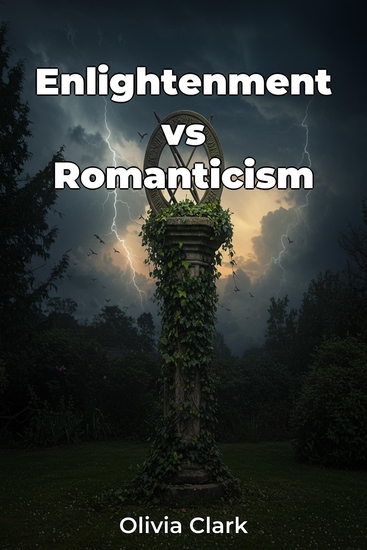
Enlightenment vs Romanticism - cover

Enlightenment vs Romanticism

Olivia Clarke

Traduttore A Ai

Casa editrice: Publifye

  • 0
  • 0
  • 0

Sinossi

Enlightenment vs Romanticism explores the profound intellectual transition from the Age of Reason to the rise of Romanticism during the French Revolution. The book meticulously examines how the Enlightenment's emphasis on reason and universal principles gave way to Romanticism's focus on emotion, individualism, and the power of subjective experience. This shift wasn't a simple replacement, but a complex interplay, challenging the notion that Romanticism was a complete rejection of reason. In fact, the emerging Romantic movement critically responded to the perceived limitations of Enlightenment rationalism amidst revolutionary upheaval. 

 
The book progresses by first establishing the core tenets of Enlightenment thought, then examining the emergence of Romanticism. Through case studies of key thinkers, it illustrates the tensions between these perspectives. Finally, it explores their influence on art, literature, and political movements.

 
What makes this book unique is its nuanced approach, avoiding oversimplified characterizations and instead focusing on the complex interactions between these intellectual currents. It offers a fresh perspective on the intellectual history of this transformative era.
Disponibile da: 25/02/2025.
Lunghezza di stampa: 54 pagine.

Altri libri che potrebbero interessarti

  • 5 Types of People Who Can Ruin Your Life - Identifying and Dealing with Narcissists Sociopaths and Other High-Conflict Personalities - cover

    5 Types of People Who Can Ruin...

    LCSW Esq. Bill Eddy

    • 0
    • 0
    • 0
    Some difficult people aren’t just hard to deal with—they’re dangerous. 
      
    Do you know someone whose moods swing wildly? Do they act unreasonably suspicious or antagonistic? Do they blame others for their own problems? 
      
    When a high-conflict person has one of five common personality disorders—borderline, narcissistic, paranoid, antisocial, or histrionic—they can lash out in risky extremes of emotion and aggression. And once an HCP decides to target you, they’re hard to shake. 
      
    But there are ways to protect yourself. Using empathy-driven conflict management techniques, Bill Eddy, a lawyer and therapist with extensive mediation experience, will teach you to: 
      
    • Spot warning signs of the five high-conflict personalities in others and in yourself.  
    • Manage relationships with HCPs at work and in your private life.  
    • Safely avoid or end dangerous and stressful interactions with HCPs. 
      
    Filled with expert advice and real-life anecdotes, 5 Types of People Who Can Ruin Your Life is an essential guide to helping you escape negative relationships, build healthy connections, and safeguard your reputation and personal life in the process. And if you have a high-conflict personality, this book will help you help yourself. 
      
    “[This] brilliant book on high-conflict personalities saves us from trusting the wrong people and making the worst relationship mistakes at work, at home, and in our lives. You need this information today!”—Randi Kreger, bestselling author of Stop Walking on Eggshells and The Essential Family Guide to Borderline Personality Disorder
    Mostra libro
  • Byzantium: The History of the Ancient Greek City Before It Became Constantinople - cover

    Byzantium: The History of the...

    Editors Charles River

    • 0
    • 0
    • 0
    Byzantium may have reached its zenith during the Middle Ages as Constantinople, but it had previously stood out among Greek and other ancient cities for its wealth, size, and strategic location. It is probable that given the location, if the Megarans had not founded their city where they did, another Greek polis would have. It is equally probable that any city in that area would have enjoyed success from the wealth generated from its involvement in the key two-way trade between the Greek states and their numerous colonies around the Black Sea and the increasing general east-west trade between the Roman Empire and the exotic lands to the east.  
    Byzantium’s position as guardian of the Bosphorus gave it advantages that stood the city in good stead for thousands of years and consolidated the city as an intercontinental and international trading hub. Inevitably, such a vibrant international center produced many creative thinkers, and Byzantium was the birthplace or home to such figures as Homerus, a tragedian who lived in the early 3rd century BCE. Another overlooked figure was Philo, an engineer who lived from 280-220 BCE and is known as Philo Mechanicus. Although he was primarily an engineer, he was also a physicist and writer on mechanics. His most important work was the huge Syntaxis, which contained sections on general mathematics, mechanics, harbor construction, siege engine construction, pneumatics, mechanical toys, and coding for military use. The military sections Belopoeica and Poliorcetica survived, and they detailed how to build missiles, construct fortresses, and how to properly provision an army.
    Mostra libro
  • The New World Order - cover

    The New World Order

    H. G. Wells

    • 0
    • 0
    • 0
    The New World Order is a non-fiction book written by H.G. Wells and was published by Secker & Warburg in January 1940. In The New World Order, Wells proposed a framework of international functionalism that could guide the world towards achieving world peace. To achieve these ends, Wells asserted that a socialist and scientifically planned world government would need to be formed to defend human rights.Wells's motivation for writing The New World Order was based upon the outbreak of World War II. Wells was concerned that the Allies had no clear statement of aims for fighting in the war and that this would lead to the continuation of the pre-existing balance of power. In The New World Order, Wells writes that without a revolution in international affairs and the establishment of human rights, then further destructive wars were inevitable.
    Mostra libro
  • Perceiving Without the Perceiver - Brockwood Park and Gstaad 1975 - Dialogue 6 - cover

    Perceiving Without the Perceiver...

    Jiddu Krishnamurti

    • 0
    • 0
    • 0
    Perceiving without the perceiver - 28 June 1975 
    • Can thought naturally cease? 
    • Perceiving without the perceiver 
    • Facing the truth of death 
    • Krishnamurti’s ‘process’ and early years. 
    • Kundalini 
    • If you can understand suffering, face it and not escape from it, that has quite a 
    different energy. 
    • Truth is a pathless land. 
    • There is something really tremendously mysterious. 
    • Knowledge is becoming the curse. 
    • When the mind, with all the confusion, is nothing, not a thing, then perhaps 
    there is the other.
    Mostra libro
  • Over the Years - Selected Collected Poems 1972-2015 - cover

    Over the Years - Selected...

    Gillian Bickley, Verner Bickley

    • 0
    • 0
    • 0
    The fifty poems collected in Gillian Bickley’s Over The Years have been chosen by Verner Bickley from her five previously published collections. 
    “Sensitive, serious, sincere and sometimes a little sad...." (Dumitru M. Ion ( Romania), Member of the Arts and Sciences Academy in R. Macedonia, etc.,2014) 
    "Driven by curiosity as a poet but also by responsibility as the president of "The International Festival Curtea de Argeş Poetry Nights" in Romania (There have been twenty editions, attended in total by over fifteen hundred guests from about a hundred countries), I read and translate the lyrics of hundreds of poets. That's how I discovered the exceptional poet Gillian Bickley from Hong Kong. What firstly drew my attention was the savant level of her poetry; the science of balancing the rational with the sentiment. Each of her poems is sometimes a small novel, an essay or at other times a lyrical sublimate. Her poems are remembrances: from the past (an ancient past, a medieval past, and so on), from her own past or a possible reader's past. The way of shaping her poetry especially fascinates the professional reader. Because, of course, a professional poet (as Gillian Bickley is) will always need a professional reader.” – Dumitru M. Ion, 2016.
    Mostra libro
  • Strong Floor No Ceiling - Building a New Foundation for the American Dream - cover

    Strong Floor No Ceiling -...

    Oliver B. Libby

    • 0
    • 0
    • 0
    We’re not just divided—we’re adrift. Strong Floor, No Ceiling presents a bold, radically moderate blueprint to reconnect our fractured country and restore belief in opportunity, fairness, and shared progress.
    Mostra libro