Junte-se a nós em uma viagem ao mundo dos livros!
Adicionar este livro à prateleira
Grey
Deixe um novo comentário Default profile 50px
Grey
Assine para ler o livro completo ou leia as primeiras páginas de graça!
All characters reduced
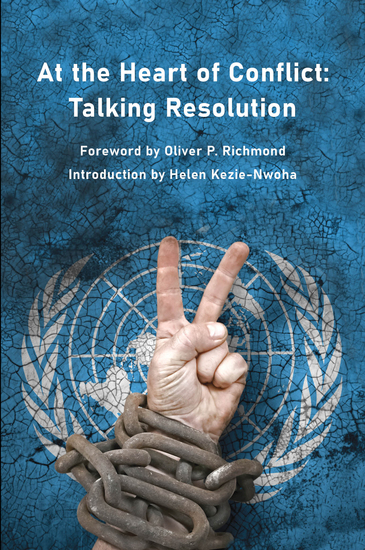
At the Heart of Conflict - Talking Resolution - cover
LER

At the Heart of Conflict - Talking Resolution

Oliver P. Richmond

Editora: Supernova Books

  • 0
  • 0
  • 0

Sinopse

A ground-breaking new book that dares to bridge the divide between peacemakers and military strategists.
 
As the world reels from an unprecedented surge in destructive wars and international crises, a new and critically important book challenges conventional wisdom and asks: Can peace be built by dialogue alone? When is the use of force necessary? Is there cause for hope? With 20 unflinching first-person accounts, the book uniquely gives voice to both sides of the conflict resolution debate from seasoned UN negotiators and grassroots peacebuilders to intelligence experts and military veterans.
 
This book is an essential read for those studying conflict resolution, international relations, or working in the field, looking to know more about the lived experiences of UN officials, translators, ambassadors, NGOs and military personnel.
 
“At the Heart of Conflict: Talking Resolution is a profoundly hopeful book. In these pages, we hear directly from practitioners who have not only witnessed conflict but have actively worked to transform it. Their voices bring a rare depth and texture to our understanding of mediation and peacebuilding — grappling with the political conditions on the ground and reflecting on how those moments fit into larger historical arcs. These accounts offer more than technical and political insight — they remind us that in the midst of violence and fragility, there are always individuals building bridges, nurturing resilience, and creating space for hope.”
 
– Dr Christine Cheng, War Studies, King’s College London
 
“A fascinating insight into the challenging world of conflict resolution that is likely to be as relevant tomorrow as it is today.”
 
-York Membery, writer and journalist, Sunday Times.
Disponível desde: 30/05/2025.
Comprimento de impressão: 296 páginas.

Outros livros que poderiam interessá-lo

  • Battle of Saipan The: The History and Legacy of the Pacific D-Day - cover

    Battle of Saipan The: The...

    Editors Charles River

    • 0
    • 0
    • 0
    Just over one week after the landings in Normandy, American troops took part in a massive amphibious invasion of Saipan, but intense public interest in operations in Europe meant that this invasion received less media coverage at the time, and it has been the subject of far less interest from historians and writers since. Part of the reason seems to be the different perception of the war in the Pacific. During the war in Europe, Allied troops were, for the most part, welcomed as liberators by the inhabitants of the countries they occupied. Combat was generally conducted according to the accepted rules of war, with troops who surrendered becoming prisoners of war.  
    	In the Pacific Theater, combat was very different. The clash between American and Japanese troops was not just a battle between two modern nations; it was a conflict between two very different cultures and ideologies. Many Japanese soldiers fought according to the tenets of Bushido, the ancient warrior code first employed by the Samurai. This held that death was infinitely preferable to surrender, and that suicide was regarded as a legitimate and even praiseworthy act. The Japanese soldiers who did surrender were regarded with contempt, and enemy soldiers who fell into Japanese hands were treated with extreme cruelty. To American soldiers, the Japanese troops they encountered seemed to fight with fanatical zeal.  
    	As a result, the fighting on Saipan was bloody and intense. Although the battle lasted less than one month, almost 50,000 soldiers died or became casualties on the island, and many Japanese soldiers chose death, either through suicide or assaults on the enemy that had no real prospect of success. Civilians also suffered horrendous casualties on Saipan - more than 20,000 died, with many committing suicide rather than becoming prisoners of the Americans. 
    Ver livro
  • Nonfiction Alchemy - Your Guide to Finishing Your Book and Finally Becoming an Author - cover

    Nonfiction Alchemy - Your Guide...

    Jordan Ring

    • 0
    • 0
    • 0
    Writing a book is like poking around in the fog with a flashlight. You don't know if you're going in the right direction, you can't see the next clearing, and your next step might be into a swamp. In short: It's hard. Instead of doing it alone, grab a copy of "Nonfiction Alchemy". Read it, take notes, and apply what Jordan teaches you. The fog will clear—and when it does, you'll be holding your completed book! —Adam Knorr, LinkedIn Ghostwriter and Writing CoachStop poking around in the fog: Transform your idea into a book! 
    Your completed book will be a magnet that attracts your ideal customer, a boon to your personal brand, and a part of your undying legacy. 
    The problem? 
    Your book isn't a book… Not yet. 
    You think that writing a book will consume your time, your energy, and your will to live. You think writing a book is impossible, right? 
    Actually, there’s a proven method for writing a great book that won't leave you feeling like a zombie lost in a swamp. 
    Nonfiction Alchemy will show you how to write, publish, and market your book—without resorting to AI writing tools, wasting time and resources pursuing traditional publishing (only to be ignored or rejected), or attending nausea-inducing signing tables at your local bookstore. 
    If you follow the recipe in this book, you’ll write, publish, and launch a great book in under twelve months. 
    And the best part? You’ll enjoy every second of the process. 
    With his decade of experience in the publishing arena, the author, Jordan Ring, is a book-writing wizard. 
    If you're a coach, entrepreneur, or business owner, he'll show you how to write like an author, form a self-publishing squad that takes care of the details for you, and cultivate recurring business with your new lead-generating machine. 
    If you're ready, 
    Let’s brew your book!
    Ver livro
  • The Cuban Missile Crisis - Brink of Nuclear War - cover

    The Cuban Missile Crisis - Brink...

    Nova Ashford

    • 0
    • 0
    • 0
    The Cuban Missile Crisis, one of the most critical moments in the Cold War, did not emerge in isolation but was the culmination of a decades-long geopolitical struggle between the United States and the Soviet Union. The context of this crisis lies deeply within the broader Cold War, which began shortly after the end of World War II. This period was marked by intense ideological rivalry, military standoffs, and a nuclear arms race that would define much of the second half of the 20th century. 
    The origins of the Cold War can be traced back to the conflicting political and economic ideologies of the two superpowers. The United States, championing capitalism and democracy, viewed the spread of communism, led by the Soviet Union, as a direct threat to global stability and democratic values. On the other hand, the Soviet Union, under the leadership of Joseph Stalin, sought to expand the reach of communism and solidify its control over Eastern Europe, which had been acquired as a result of the war. This division between the capitalist West and the communist East created a tense geopolitical environment that shaped every diplomatic interaction between the two powers. 
    In the early stages of the Cold War, several key events served to heighten the distrust between the U.S. and the Soviet Union. The Berlin Blockade in 1948, the Korean War in the early 1950s, and the formation of opposing military alliances like NATO (North Atlantic Treaty Organization) and the Warsaw Pact solidified the division of the world into two hostile camps. As both nations escalated their military capabilities, the nuclear arms race emerged as a central aspect of Cold War tensions. The development and stockpiling of nuclear weapons made the Cold War not just an ideological battle but also a dangerous game of survival, with the constant threat of global annihilation hanging over every political and military maneuver.
    Ver livro
  • No Greater Love - The Story of Michael Crescenz Philadelphia's Only Medal of Honor Recipient of the Vietnam War - cover

    No Greater Love - The Story of...

    Kevin Ferris, John A. Siegfried

    • 0
    • 0
    • 0
    The story of Philadelphia's only Medal of Honor recipient from the Vietnam War told here for the first timeMichael Crescenz grew up in one of Philadelphia’s booming post-war Catholic neighborhoods, distinguishing himself early on as a leader, brother and friend who fearlessly rose to the defense of others in need. The second of six sons born to a World War II veteran, Michael was known for his big smile, athletic abilities, toughness and fierce competitive spirit. Growing up, Michael’s world revolved around his family, parish, local playgrounds, and the bustling Catholic schools he attended from first grade through high school graduation. All these influences shaped the man he would become – the one who felt a sense of duty to serve his country and enlisted in the U.S. Army to do his part during the Vietnam War.   He was in Vietnam barely two months when his unit, the 4th Battalion, 31st Infantry, was sent into battle against deeply entrenched enemy forces on Nui Chom Mountain, the fortress in the clouds tucked away in the far northwest corner of South Vietnam near the borders with North Vietnam and Laos. Commanders knew they were in for a fight, but didn’t know the enemy had more than 250 machine gun bunkers deployed along the mountain’s slopes. On November 20, 1968, Alpha Company was ambushed on the wet jungle mountainside, the NVA taking down the two men up front and pinning down the rest with relentless fire.  Thinking first of the danger to those around him, Private First Class Michael J. Crescenz picked up an M60 machine gun and charged the enemy bunkers. He did not survive but his actions saved the lives of his fellow soldiers and allowed them to advance and ultimately prevail. For his valor and sacrifice, Michael was posthumously awarded the Medal of Honor.  No Greater Love tells this story from the perspective of those who loved Michael Crescenz most, close friends, family, Michael’s commanding officer in Vietnam, retired Lieutenant General Sam Wetzel, and medic William “Doc” Stafford, the soldier closest to Michael when he was cut down by enemy fire and who believes to this day that he survived Nui Chom only because of the selfless actions of Private First Class Crescenz.
    Ver livro
  • Picturing America - The Golden Age of Pictorial Maps - cover

    Picturing America - The Golden...

    Stephen J. Hornsby

    • 0
    • 0
    • 0
    Instructive, amusing, colorful—pictorial maps have been used and admired since the first medieval cartographer put pen to paper depicting mountains and trees across countries, people and objects around margins, and sea monsters in oceans. More recent generations of pictorial map artists have continued that traditional mixture of whimsy and fact, combining cartographic elements with text and images and featuring bold and arresting designs, bright and cheerful colors, and lively detail. In the United States, the art form flourished from the 1920s through the 1970s, when thousands of innovative maps were mass-produced for use as advertisements and decorative objects—the golden age of American pictorial maps.  Picturing America is the first book to showcase this vivid and popular genre of maps. Geographer Stephen J. Hornsby gathers together 158 delightful pictorial jewels, most drawn from the extensive collections of the Library of Congress. In his informative introduction, Hornsby outlines the development of the cartographic form, identifies several representative artists, describes the process of creating a pictorial map, and considers the significance of the form in the history of Western cartography. Organized into six thematic sections, Picturing America covers a vast swath of the pictorial map tradition during its golden age, ranging from “Maps to Amuse” to “Maps for War.” Hornsby has unearthed the most fascinating and visually striking maps the United States has to offer: Disney cartoon maps, college campus maps, kooky state tourism ads, World War II promotional posters, and many more. This remarkable, charming volume’s glorious full­-color pictorial maps will be irresistible to any map lover or armchair traveler.
    Ver livro
  • The 21 Divisions - Mysteries and Magic of Dominican Voodoo - cover

    The 21 Divisions - Mysteries and...

    Hector Salva, Hoodoo Sen Moise

    • 0
    • 0
    • 0
    One of the first books to explore the unique tradition of Dominican shamanism, the magical practices called the 21 Divisions. 


    Like all forms of Caribbean Voodoo, practitioners of the 21 Divisions believe in one God, a distant God that doesn't get involved in human affairs. Followers of this Dominican spiritual tradition believe that God created intermediaries to help humans, beings known as Los Misterios. 


    The Misterios are powerful beings with rulership and dominion over universal forces and human conditions. Practitioners of the 21 Divisions have ways of connecting with the Misterios to achieve success in life, improve their careers, resolve love and relationship issues, heal illness, and much more. 


    Filled with detailed insider information and real stories of healing, magic, and mystery, this book will serve as an illuminating guide to the 21 Divisions. Hector Salva—one of the foremost authorities on the practice of the 21 Divisions—offers his insights into: the history and foundations of Dominican Voodoo; the major Misterios, or spirits, of the 21 Divisions; ceremonies, rituals, and magical spells; and how to get started on the path of the 21 Divisions.
    Ver livro