



Te Adamavi - Legal fiction
Oburoh Roli Hazel
Casa editrice: Floreat Systems
Sinossi
The book is a legal fiction that captures the love story of Hadassah and Desmond
Disponibile da: 27/05/2024.
Lunghezza di stampa: 54 pagine.

Casa editrice: Floreat Systems
The book is a legal fiction that captures the love story of Hadassah and Desmond
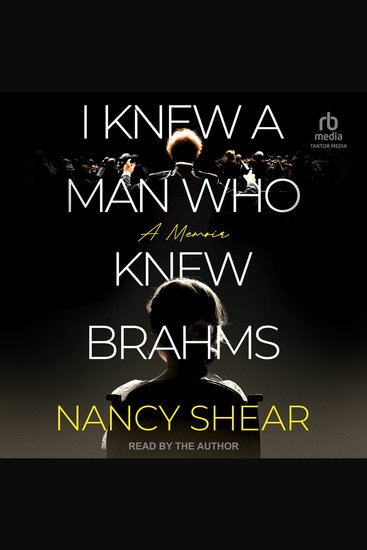
Nancy Shear was only fifteen when she began sneaking into Philadelphia Orchestra concerts through the stage door, and seventeen when she was hired as a member of the orchestra's library staff to help prepare the music; one year later, she became Leopold Stokowski's musical assistant. Being young and female, she was a pioneer in both positions.


I Knew a Man Who Knew Brahms takes listeners into the homes, studios, and minds of legendary artists with whom Shear shared close personal relationships, including Stokowski, Mstislav Rostropovich, Eugene Ormandy, and others with the Philadelphia Orchestra. Many of these brilliant and talented artists were also outrageous, egocentric, and tyrannical. Throughout this book, Shear topples more than a few revered musicians from their podiums and their pedestals.


A literary welcome mat to the beautiful world of classical music, this memoir is accessible and engaging for all. It brings listeners into rehearsals and concert halls, revealing the choices musicians must consider, and what conductors, players, and composers really do. A heartwarming story about passion, determination, and survival, I Knew a Man Who Knew Brahms explores music at its core. You will never listen to music the same way again, after hearing Nancy Shear's story.
Mostra libro

On the Lukmanier route to Italy in the Swiss Alps, in the village of Flims, stands the 17th century Schlössli, the former residence of the wealthy and influential Johann Gaudenz von Capol (1641–1723). With its stucco work by artists from Valle Mesolcina and Southern Germany, stoves from Winterthur and the Lake Constance region, a panelled parlour – possibly by a southern German master, and a panel from Eger, the building unites prevailing influences from allover Europe. The architectural monument is an excellent example of how open and internationally oriented the inhabitants were even1883, first to Berlin and later to the Metropolitan Museum of Art in New York, where it is still located and called ‹Swiss Room›, as wellas the conversion of the residential house into the town hall of Flims – also exemplifies a chapter of Swiss art and cultural history.Mostra libro

Building Inclusion: A Practical Guide to Equity, Diversity and Inclusion in Architecture and the Built Environment is just that—a manual to support and provide essential guidance to the profession on these key issues. Acknowledging that the existence of EDI procedures does not necessarily ensure their use, it focuses on demonstrating behaviors that help create, implement, and enforce policies, procedures, and practices to deliver inclusion.


Written by Marsha Ramroop, former inaugural EDI director at the RIBA and award-winning EDI strategist, the book targets the pain points of talent attraction and retention, public sector procurement, community engagement, and inclusive design. It utilizes case studies from organizations across the sector and the world with successful EDI practices, as well as testimonials of lived experiences of discrimination which provide important insight to the listener. The book takes an intersectional approach, considering not just the separate identities of race, ethnicity, nationality, age, gender and sexual identity, disability, neurodiversity, and class but the overlap of these.


Clearly written and accessible, with key points at the end of each chapter, this book is essential for those in the profession seeking to implement EDI practices in their work and workplace.
Mostra libro
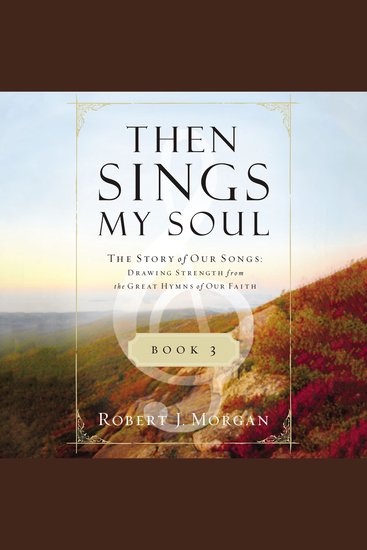
In the third volume of his bestselling series, Pastor Robert Morgan expands his material to include the great history of worship, the first biblical hymns, biographical sketches of the most interesting composers, and almost 60 generations of hymn singing.
In 2003, Robert Morgan released what would become a future classic for over a million readers: a unique book entitled Then Sings My Soul. This collection of the world’s greatest hymns and the stories behind them stirred an entire generation to better understand the heritage of our faith through song.
Now, in the third volume of this series, Morgan expands his material to include:The fascinating history of worship from ancient times to contemporary praiseAlmost 60 generations of hymn singingBiographical sketches of the most interesting composersHymn index for easy reference
Then Sings My Soul: Book 3 also includes a collection of the greatest hymns you’ve never heard, with lead-sheets included. All of this is in addition to even more standard hymns and the stories of the composers behind them.
Morgan’s conclusion guides you into enjoying all of God’s music, blending the old and the new into a symphony of praise that keeps the worship alive for a new generation.
Lead sheets for the hymns is included in the audiobook companion PDF download.
Mostra libro

'There is no acting, only reacting to the space.'
In his bestselling book The Actor and the Target, Declan Donnellan laid out a fresh and radical approach to acting that has inspired actors around the world.
Now, in The Actor and the Space, he develops and extends those ideas, exploring that most profound source of vitality in life as well as performance: the space around us.
Tackling fundamental questions that face any actor – What makes performance better? How do I create a space for my character to live in? How do I tap into that space, and draw energy from it? – Donnellan offers a universal set of keys to unlock the mysteries of performance.
Full of insightful precepts, acute psychology and practical, hands-on advice, the book presents a bold new way of thinking about acting, illustrated throughout with line-by-line analysis of scenes from Macbeth to show how it works in rehearsal and performance.
Essential reading for any actor or theatre director, The Actor and the Space is also a fascinating distillation of the work of a world-leading director that will reward and enrich anyone with an interest in theatre.
'A hand grenade of a book. It contains all the humility and chutzpah you need to work in the theatre.' Cate Blanchett
'A wonderful book. Few directors think as deeply or perceptively about the art of acting as Declan Donnellan. This is an essential text for the actor, supremely useful, practical, elegant and profound.' Matthew Macfadyen
'Beautifully clear. This generous vision takes a very complex art form and makes it all seem so simple. The whole book is a key. Unlocking the problems actors face as they try to accept another reality long enough to let the audience get a glimpse of the best our art can offer – a glimpse into themselves.' Adrian Lester
'Declan Donnellan's profound insight and point of departure is that great theatre, like a child's sandcastle, inhabits a vulnerable and ever-changing space between the safe and the dangerous. There is a whole lot of wisdom in this book – about tragedy, human psychology, words, dread and about how great acting really works – conveyed with remarkable clarity and simplicity. It's worth sharing with non-actor friends for its insights into Macbeth alone. Most of all, it's a distillation of hard-won lessons learned from decades of immersion in the mysteries of theatre by one of the great directors of our day.' James Shapiro, Shakespeare scholar and author of 1599: A Year in the Life of William Shakespeare
Mostra libro
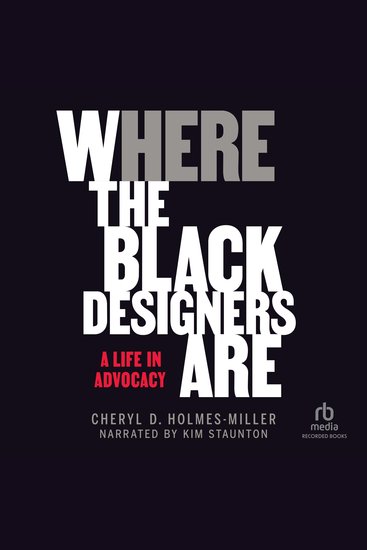
Designer, activist, and educator Cheryl D. Holmes-Miller is legendary for her
decades of scholarship and advocacy, and as a touchstone and conscience for the
design profession. In HERE: Where the Black Designers Are, Holmes-Miller
documents the history of—and answers to—the question she has been asking for
decades: “Where are the Black designers?”
Holmes-Miller explores this essential question through the lens of her own
development as a designer and leader, beginning with her own family and its rich
multiethnic history. She narrates her experiences as a design student at Rhode
Island School of Design (RISD), Maryland Institute College of Art (MICA), and Pratt
Institute, leading up to her oft-cited Pratt thesis examining barriers to success for
Black designers. Holmes-Miller describes the work of her eponymous studio for
noted clients that included NASA, Time Inc., and the nascent Black Entertainment
Television (BET), as well as the story of her later critiques of the industry in Print
magazine and other design publications. Holmes-Miller also recounts the parallel
history of collective efforts by fellow scholars and advocates over the past fifty
years to identify and celebrate Black designers.
HERE is part memoir, part historical investigation, and an urgent call for justice
and recognition for Black designers.
“This book is representative of the shoulders on which we, as Black graphic
designers, stand. These are the legacies we are fighting to uphold and the torches
we must continue to carry. The journey of the Black designer has not been easy. It
isn’t easy. And while we may be left out of history books, this is a reminder that we
are here. Always have been. Always will be.”—Tré Seals, Vocal Type
Mostra libro





